Centre for Targeted Protein Degradation, School of Life Sciences, University of Dundee, 1 James Lindsay Place, Dundee DD1 5JJ, UK.
Division of Biological Chemistry and Drug Discovery, School of Life Sciences, University of Dundee, James Black Centre, Dow Street, Dundee DD1 5EH, UK.
Sci Adv. 2024 Oct 11;10(41):eado6492. doi: 10.1126/sciadv.ado6492.
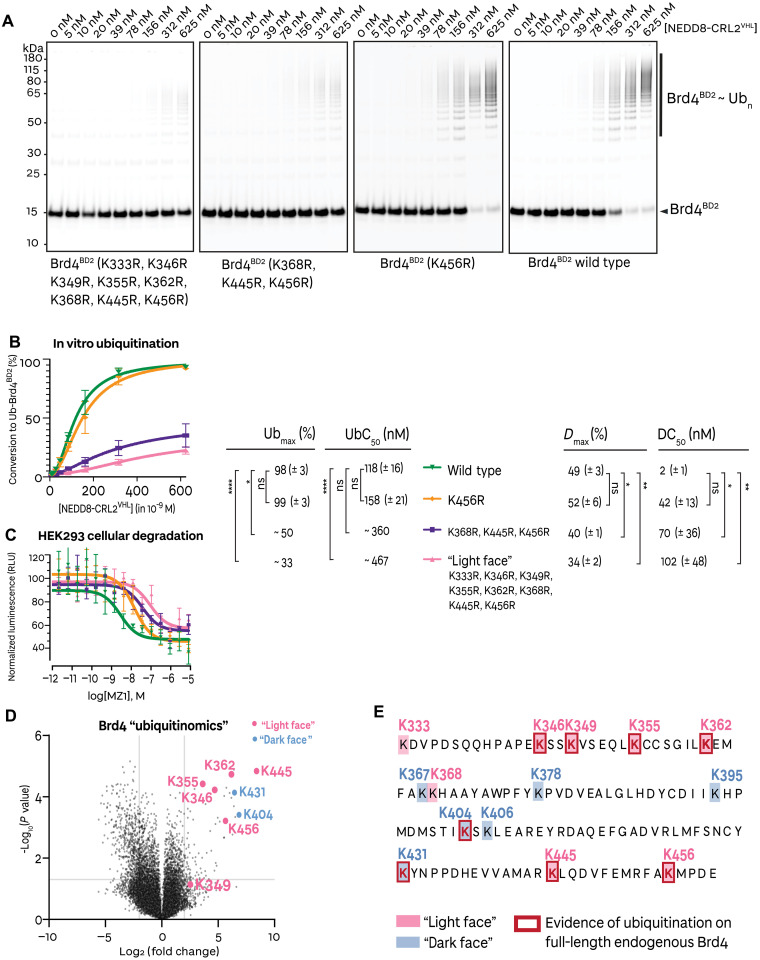
Small-molecule degraders of disease-driving proteins offer a clinically proven modality with enhanced therapeutic efficacy and potential to tackle previously undrugged targets. Stable and long-lived degrader-mediated ternary complexes drive fast and profound target degradation; however, the mechanisms by which they affect target ubiquitination remain elusive. Here, we show cryo-EM structures of the VHL Cullin 2 RING E3 ligase with the degrader MZ1 directing target protein Brd4 toward UBE2R1-ubiquitin, and Lys at optimal positioning for nucleophilic attack. In vitro ubiquitination and mass spectrometry illuminate a patch of favorably ubiquitinable lysines on one face of Brd4, with cellular degradation and ubiquitinomics confirming the importance of Lys and nearby Lys/Lys, identifying the "ubiquitination zone." Our results demonstrate the proficiency of MZ1 in positioning the substrate for catalysis, the favorability of Brd4 for ubiquitination by UBE2R1, and the flexibility of CRL2 for capturing suboptimal lysines. We propose a model for ubiquitinability of degrader-recruited targets, providing a mechanistic blueprint for further rational drug design.
小分子疾病驱动蛋白降解剂提供了一种经过临床验证的治疗模式,具有增强的治疗效果和潜在的潜力,可以解决以前未经治疗的靶点问题。稳定且持久的降解剂介导的三元复合物可快速、深度地降解靶标;然而,它们影响靶标泛素化的机制仍不清楚。在这里,我们展示了 VHL Cullin 2 RING E3 连接酶与降解剂 MZ1 的冷冻电镜结构,该降解剂将靶蛋白 Brd4 引导至 UBE2R1-泛素和 Lys,使其处于最佳的亲核攻击位置。体外泛素化和质谱分析揭示了 Brd4 一个面上有利于泛素化的赖氨酸斑块,细胞降解和泛素组学证实了 Lys 和附近 Lys/Lys 的重要性,确定了“泛素化区域”。我们的结果表明,MZ1 能够有效地将底物定位进行催化,UBE2R1 对 Brd4 进行泛素化的亲和力,以及 CRL2 捕获非最佳赖氨酸的灵活性。我们提出了一种用于降解剂招募的靶标可泛素化性的模型,为进一步的合理药物设计提供了一种机制蓝图。