Couret Jennifer, Tasker Carley, Kim Jaeha, Sihvonen Tiina, Fruitwala Saahil, Quayle Alison J, Lespinasse Pierre, Heller Debra S, Chang Theresa L
Department of Microbiology and Molecular Genetics, New Jersey Medical School, Rutgers, The State University of New Jersey, 225 Warren Street, Newark, NJ 07103 USA.
Public Health Research Institute, New Jersey Medical School, Rutgers, The State University of New Jersey, 225 Warren Street, Newark, NJ 07103 USA.
Cell Biosci. 2017 Nov 2;7:57. doi: 10.1186/s13578-017-0185-z. eCollection 2017.
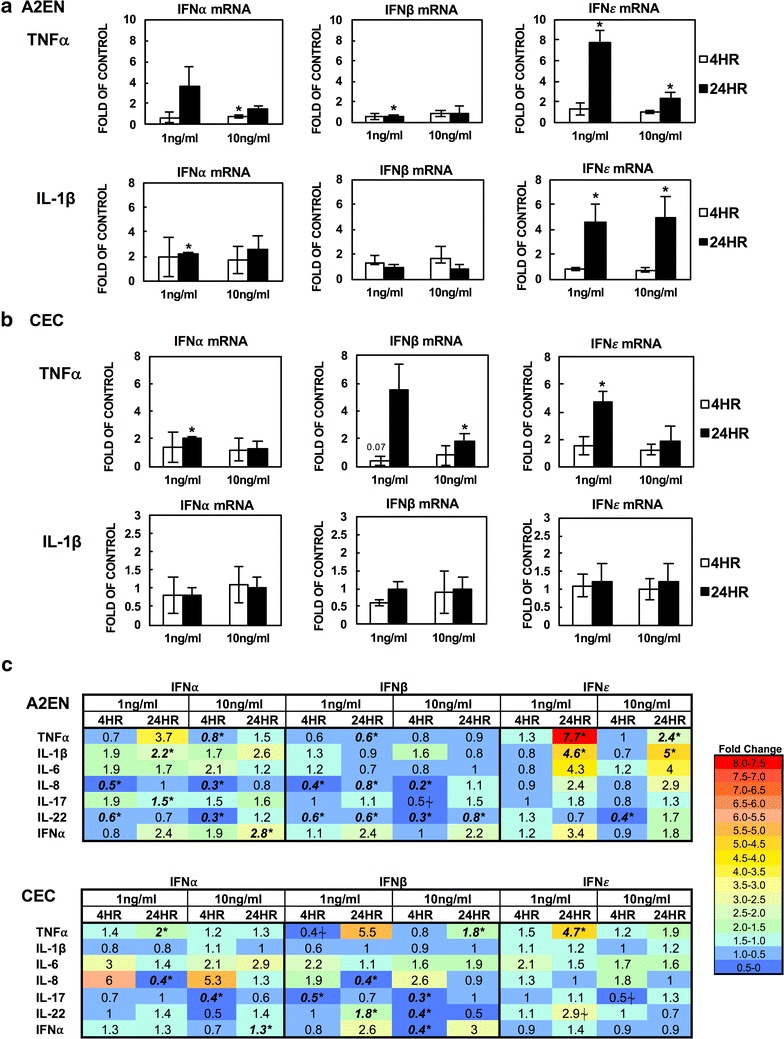
Interferonε (IFNε) is a unique type I IFN that has distinct functions from IFNα/β. IFNε is constitutively expressed at mucosal tissues, including the female genital mucosa, and is reported to be modulated by estrogen and seminal plasma. However, its regulation by cytokines, including TNFα, IL-1β, IL-6, IL-8, IL-17, IL-22 and IFNα, which are commonly present in the female genital mucosa, is not well documented in freshly isolated primary cervical cells from tissues. We determined the effect of these cytokines on gene expression of type I IFNs in an immortalized endocervical epithelial cell line (A2EN) and in primary cervical epithelial cells. Several pro-inflammatory cytokines were found to induce IFNε, and TNFα induced the strongest response in both cell types. Pretreatment of cells with the IκB inhibitor, which blocks the NF-κB pathway, suppressed TNFα-mediated IFNε gene induction and promoter activation. Expression of IFNα, IFNβ, and IFNε was differentially regulated in response to various cytokines. Taken together, our results show that regulation of these IFNs depends on cell type, cytokine concentration, and incubation time, highlighting the complexity of the cytokine network in the cervical epithelium.
干扰素ε(IFNε)是一种独特的I型干扰素,其功能与IFNα/β不同。IFNε在包括女性生殖黏膜在内的黏膜组织中组成性表达,据报道它受雌激素和精浆调节。然而,在从组织中新鲜分离的原代宫颈细胞中,其受细胞因子(包括女性生殖黏膜中常见的肿瘤坏死因子α、白细胞介素-1β、白细胞介素-6、白细胞介素-8、白细胞介素-17、白细胞介素-22和IFNα)的调节情况尚未得到充分记录。我们确定了这些细胞因子对永生化宫颈内膜上皮细胞系(A2EN)和原代宫颈上皮细胞中I型干扰素基因表达的影响。发现几种促炎细胞因子可诱导IFNε,其中肿瘤坏死因子α在两种细胞类型中诱导的反应最强。用IκB抑制剂预处理细胞可阻断核因子κB通路,抑制肿瘤坏死因子α介导的IFNε基因诱导和启动子激活。IFNα、IFNβ和IFNε的表达在对各种细胞因子的反应中受到不同调节。综上所述,我们的结果表明,这些干扰素的调节取决于细胞类型、细胞因子浓度和孵育时间,突出了宫颈上皮中细胞因子网络的复杂性。