Uchino Kenji, Shiraishi Makoto, Tanaka Keita, Akamatsu Masashi, Hasegawa Yasuhiro
Department of Neurology, St. Marianna University School of Medicine, Kawasaki, Kanagawa, Japan.
PLoS One. 2017 Nov 9;12(11):e0187616. doi: 10.1371/journal.pone.0187616. eCollection 2017.
Difficulty turning over in bed is a common night-time symptom in Parkinson's disease (PD). We aimed to quantitatively evaluate overnight turnover movements using a three-axis accelerometer and to investigate whether inability to turn in bed is related to daytime sleepiness, sleep quality, and depressive mood in PD patients.
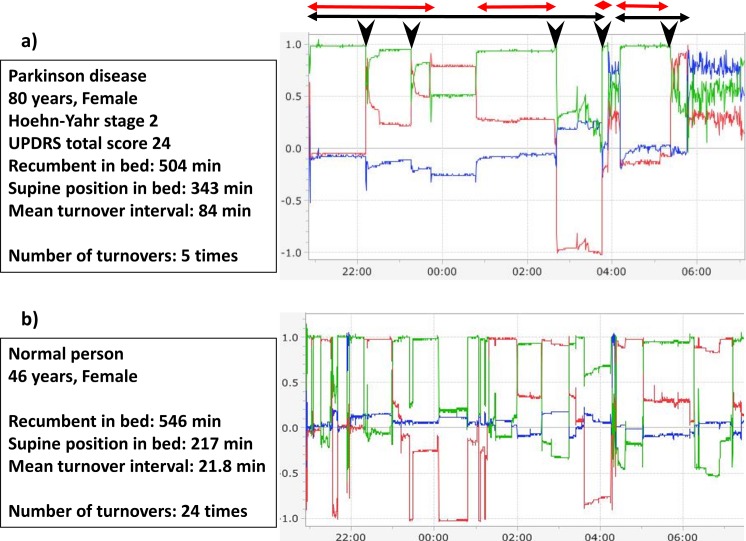
We examined 64 patients with PD (mean age, 73.3±8.21 years; modified Hoehn-Yahr [mH-Y] stage, 3.0±1.0; disease duration, 7.2±6.3 years; unified Parkinson's disease rating scale [UPDRS], 36.9±18.3). Overnight monitoring of turnover movements using a wearable three-axis accelerometer was performed in all patients. Nocturnal kinetic parameters including total time recumbent, total time supine, number of turnover movements, and mean interval between turnover movements were obtained. Daytime immobility was assessed using the Barthel index (B-I), UPDRS, and mH-Y stage. Patients were also assessed with the Epworth Sleepiness Scale (ESS), Parkinson's Disease Sleep Scale-2 (PDSS-2), and Beck Depression Inventory (BDI).
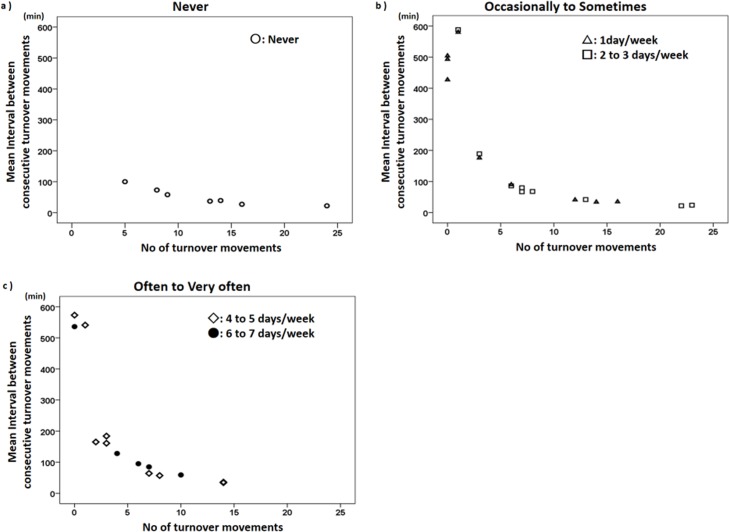
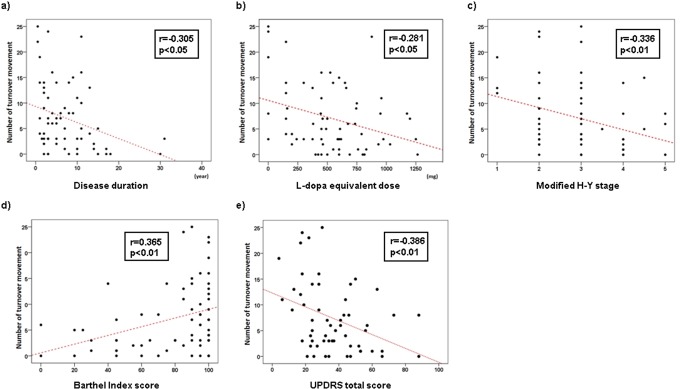
Number of turnover movements in bed correlated negatively with disease duration (r = -0.305; p<0.05), L-dopa-equivalent dose (r = -0.281; p<0.05), mH-Y staging (r = -0.336; p<0.01), total score of UPDRS (r = -0.386; p<0.01) and positively with B-I score (r = 0.365; p<0.01). Number of turnover movements in bed was generally inconsistent with awareness of turnover movement impairment as evaluated by PDSS-2 Item 9 scores, but patients who were never aware of impaired turnover movements showed ≥5 turnover movements overnight. Multivariate logistic regression analyses revealed no correlations between number of nocturnal turnover movements in bed and BDI, ESS, or PDSS-2. Use of anti-psychotic drugs was associated with ESS (p = 0.045). UPDRS was associated with PDSS-2 (p = 0.016).
Decreased number of turnover movements may not be a direct determinant of daytime sleepiness, sleep disorders, or depressive mood in PD patients. Use of anti-psychotic drugs and higher UPDRS score are factors significantly associated with daytime sleepiness and uncomfortable sleep, respectively.
帕金森病(PD)患者夜间常见的症状是翻身困难。我们旨在使用三轴加速度计对夜间翻身动作进行定量评估,并调查卧床翻身困难是否与PD患者的日间嗜睡、睡眠质量和抑郁情绪有关。
我们检查了64例PD患者(平均年龄73.3±8.21岁;改良Hoehn-Yahr[mH-Y]分期3.0±1.0;病程7.2±6.3年;统一帕金森病评定量表[UPDRS]36.9±18.3)。所有患者均使用可穿戴三轴加速度计对翻身动作进行夜间监测。获得夜间动力学参数,包括总卧床时间、总仰卧时间、翻身动作次数以及翻身动作之间的平均间隔时间。使用Barthel指数(B-I)、UPDRS和mH-Y分期评估日间活动能力。还使用Epworth嗜睡量表(ESS)、帕金森病睡眠量表-2(PDSS-2)和贝克抑郁量表(BDI)对患者进行评估。
床上翻身动作次数与病程(r=-0.305;p<0.05)、左旋多巴等效剂量(r=-0.281;p<0.05)、mH-Y分期(r=-0.336;p<0.01)、UPDRS总分(r=-0.386;p<0.01)呈负相关,与B-I评分呈正相关(r=0.365;p<0.01)。床上翻身动作次数通常与PDSS-2第9项评分评估的翻身动作障碍意识不一致,但从未意识到翻身动作受损的患者夜间翻身动作≥5次。多因素逻辑回归分析显示,夜间床上翻身动作次数与BDI、ESS或PDSS-2之间无相关性。使用抗精神病药物与ESS相关(p=0.045)。UPDRS与PDSS-2相关(p=0.016)。
翻身动作次数减少可能不是PD患者日间嗜睡、睡眠障碍或抑郁情绪的直接决定因素。使用抗精神病药物和较高的UPDRS评分分别是与日间嗜睡和睡眠不适显著相关的因素。