Málaga-Machaca Edith S, Romero-Ramirez Alessandra, Gilman Robert H, Astupiña-Figueroa Sofía, Angulo Noelia, Florentini Alejandro, Lovon-Luque Cinthya J, Gonza Remo A, Del Carpio-Sanz Ada, Cabello Inés, Camargo Rosina, Recuenco Fernando, Barrueta-Soria Liliam A, Verastegui Manuela R, Calderon Maritza, Mayta Holger
Infectious Diseases Research Laboratory, Departamento de Ciencias Celulares y Moleculares, Facultad de Ciencias y Filosofía, Universidad Peruana Cayetano Heredia, Lima, Perú.
Department of International Health, Johns Hopkins Bloomberg School of Public Health, Baltimore, Maryland, United States of America.
PLoS Negl Trop Dis. 2017 Nov 9;11(11):e0006069. doi: 10.1371/journal.pntd.0006069. eCollection 2017 Nov.
Detection of Trypanosoma cruzi antigens in clinical samples is considered an important diagnostic tool for Chagas disease. The production and use of polyclonal antibodies may contribute to an increase in the sensitivity of immunodiagnosis of Chagas disease.
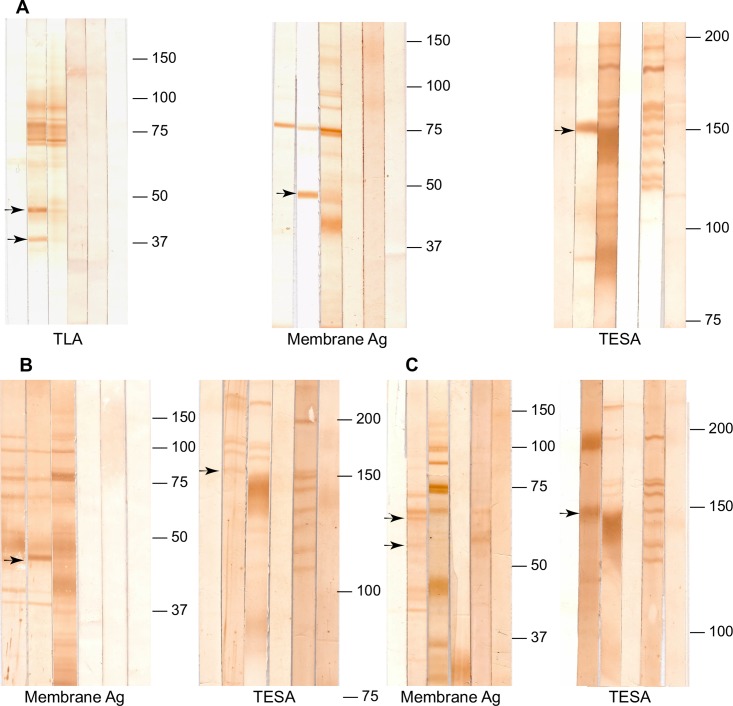
METHODOLOGY/PRINCIPAL FINDINGS: Polyclonal antibodies were raised in alpacas, rabbits, and hens immunized with trypomastigote excreted-secreted antigen, membrane proteins, trypomastigote lysate antigen and recombinant 1F8 to produce polyclonal antibodies. Western blot analysis was performed to determine specificity of the developed antibodies. An antigen capture ELISA of circulating antigens in serum, plasma and urine samples was developed using IgY polyclonal antibodies against T. cruzi membrane antigens (capture antibody) and IgG from alpaca raised against TESA. A total of 33 serum, 23 plasma and 9 urine samples were analyzed using the developed test. Among serum samples, compared to serology, the antigen capture ELISA tested positive in 55% of samples. All plasma samples from serology positive subjects were positive in the antigen capture ELISA. All urine positive samples had corresponding plasma samples that were also positive when tested by the antigen capture ELISA.
Polyclonal antibodies are useful for detection of circulating antigens in both the plasma and urine of infected individuals. Detection of antigens is direct evidence of the presence of the parasite, and could be a better surrogate of current infection status.
在临床样本中检测克氏锥虫抗原被认为是恰加斯病的一项重要诊断工具。多克隆抗体的制备和使用可能有助于提高恰加斯病免疫诊断的敏感性。
方法/主要发现:用锥鞭毛体排泄-分泌抗原、膜蛋白、锥鞭毛体裂解物抗原和重组1F8免疫羊驼、兔子和母鸡以产生多克隆抗体。进行蛋白质印迹分析以确定所制备抗体的特异性。使用针对克氏锥虫膜抗原的IgY多克隆抗体(捕获抗体)和针对排泄-分泌抗原的羊驼IgG,开发了一种用于检测血清、血浆和尿液样本中循环抗原的抗原捕获酶联免疫吸附测定法。使用所开发的检测方法对总共33份血清、23份血浆和9份尿液样本进行了分析。在血清样本中,与血清学检测相比,抗原捕获酶联免疫吸附测定法在55%的样本中检测为阳性。血清学检测阳性受试者的所有血浆样本在抗原捕获酶联免疫吸附测定法中均为阳性。所有尿液阳性样本对应的血浆样本在通过抗原捕获酶联免疫吸附测定法检测时也为阳性。
多克隆抗体可用于检测感染个体血浆和尿液中的循环抗原。抗原检测是寄生虫存在的直接证据,并且可能是当前感染状态的更好替代指标。