Franse Carmen B, van Grieken Amy, Qin Li, Melis René J F, Rietjens Judith A C, Raat Hein
Department of Public Health, Erasmus University Medical Center, Rotterdam, The Netherlands.
Department of Geriatric Medicine, Radboud University Medical Center, Nijmegen, The Netherlands.
PLoS One. 2017 Nov 9;12(11):e0187946. doi: 10.1371/journal.pone.0187946. eCollection 2017.
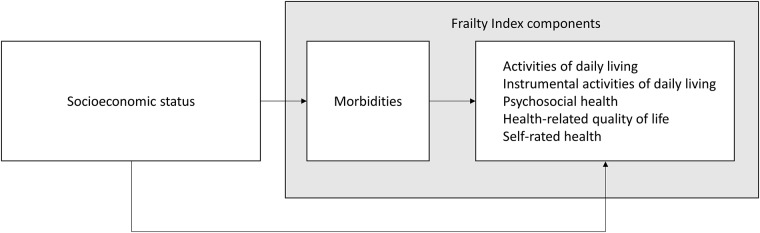
So far, it has not yet been studied whether socioeconomic status is associated with distinct frailty components and for which frailty component this association is the strongest. We aimed to examine the association between socioeconomic status and frailty and frailty components. In addition we assessed the mediating effect of the number of morbidities on the association between socioeconomic status and other frailty components.
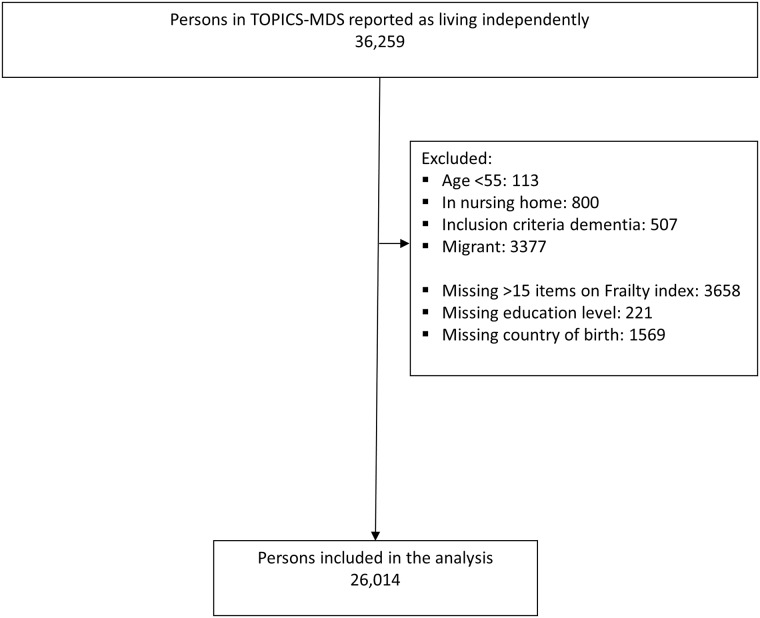
This is a cross-sectional study of pooled data of The Older Persons and Informal Caregivers Survey Minimum DataSet in the Netherlands among community-dwelling persons aged 55 years and older (n = 26,014). Frailty was measured with a validated Frailty Index that consisted of 45 items. The Frailty Index contained six components: morbidities, limitations in activities of daily living (ADL), limitations in instrumental ADL (IADL), health-related quality of life, psychosocial health and self-rated health. Socioeconomic indicators used were education level and neighbourhood socioeconomic status.
Persons with primary or secondary education had higher overall frailty and frailty component scores compared to persons with tertiary education (P < .001). Lower education levels were most consistently associated with higher overall frailty, more morbidities and worse self-rated health (P < .05 in all age groups). The strongest association was found between primary education and low psychosocial health for persons aged 55-69 years and more IADL limitations for persons aged 80+ years. Associations between neighborhood socioeconomic status and frailty (components) also showed inequalities, although less strong. The number of morbidities moderately to strongly mediated the association between socioeconomic indicators and other frailty components.
There are socioeconomic inequalities in frailty and frailty components. Inequalities in frailty, number of morbidities and self-rated health are most consistent across age groups. The number of morbidities a person has play an important role in explaining socioeconomic inequalities in frailty and should be taken into account in the management of frailty.
迄今为止,尚未研究社会经济地位是否与不同的衰弱成分相关,以及这种关联在哪个衰弱成分上最为强烈。我们旨在研究社会经济地位与衰弱及衰弱成分之间的关联。此外,我们评估了发病数在社会经济地位与其他衰弱成分之间关联中的中介作用。
这是一项对荷兰老年人及非正式照料者调查最小数据集的汇总数据进行的横断面研究,研究对象为55岁及以上的社区居住者(n = 26,014)。使用经过验证的衰弱指数来测量衰弱,该指数由45个项目组成。衰弱指数包含六个成分:发病情况、日常生活活动(ADL)受限、工具性ADL(IADL)受限、健康相关生活质量、心理社会健康和自评健康。所使用的社会经济指标为教育水平和邻里社会经济地位。
与受过高等教育的人相比,接受小学或中学教育的人总体衰弱及衰弱成分得分更高(P < .001)。较低的教育水平与更高的总体衰弱、更多的发病情况以及更差的自评健康最为一致相关(所有年龄组中P < .05)。在55 - 69岁的人群中,发现小学教育与低心理社会健康之间的关联最强,而在80岁及以上的人群中,发现更多的IADL受限与之关联最强。邻里社会经济地位与衰弱(成分)之间的关联也显示出不平等,尽管程度较弱。发病数对社会经济指标与其他衰弱成分之间的关联起到了中度至强烈的中介作用。
在衰弱及衰弱成分方面存在社会经济不平等。衰弱、发病数和自评健康方面的不平等在各年龄组中最为一致。一个人的发病数在解释衰弱方面的社会经济不平等中起着重要作用,在衰弱管理中应予以考虑。