Rassouli Frank, Baty Florent, Stolz Daiana, Albrich Werner Christian, Tamm Michael, Widmer Sandra, Brutsche Martin Hugo
Department of Pulmonary and Sleep Medicine, Cantonal Hospital St Gallen, St Gallen, Switzerland.
Department of Pulmonary and Sleep Medicine, University Hospital Basel, Basel, Switzerland.
Int J Chron Obstruct Pulmon Dis. 2017 Oct 24;12:3103-3109. doi: 10.2147/COPD.S141646. eCollection 2017.
There are only scarce data regarding the evolution of the chronic obstructive pulmonary disease (COPD) assessment test (CAT) over time. Our aim was to investigate the evolution of the CAT in a telehealthcare (THC) cohort and to evaluate its potential to predict exacerbations.
The CAT was measured weekly over up to 1 year in 40 COPD patients undergoing a THC intervention. The evolution of the CAT was analyzed using linear regression. The association between this evolution and the occurrence of exacerbations was evaluated using the Andersen-Gill formulation of the Cox proportional hazards model for the analysis of recurrent time-to-event data with time-varying predictors.
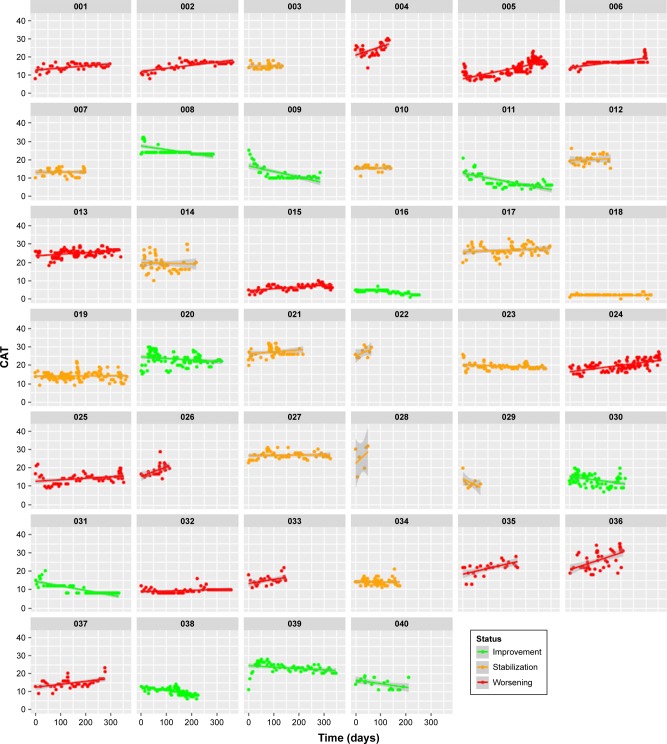
The median CAT at inclusion was 17 (interquartile range 13-22) points. During the study, 25% of patients had a significant negative slope (median -7 points per year [ppy]), 38% were stable (median +0 ppy) and 38% had a significant positive slope (median +6 ppy). The median slope of the CAT in the overall cohort was +1 (interquartile range -3 to +6) ppy. A significant positive association was found between the change in CAT scores and the risk of exacerbations (hazard ratio =1.08, 95% CI: 1.03-1.13; <0.001). There was an 8% increase of the risk of exacerbation per unit increase in CAT. We detected a significant learning effect in filling out the CAT in 18.4% of patients with a median learning phase of five filled questionnaires.
Sixty-three percent of the COPD patients monitored by THC experienced a stable or improved CAT during 1-year follow-up. We found a significant positive association between the evolution of the CAT over time and the risk of exacerbations. In about one-fifth of patients, there was a significant learning effect in filling out the CAT, before reliable results could be obtained. The evolution of the CAT could help to assess the risk for future exacerbations.
关于慢性阻塞性肺疾病(COPD)评估测试(CAT)随时间的变化情况,现有数据稀少。我们的目的是研究远程医疗保健(THC)队列中CAT的变化情况,并评估其预测病情加重的潜力。
对40例接受THC干预的COPD患者进行了长达1年的每周一次CAT测量。使用线性回归分析CAT的变化情况。采用Cox比例风险模型的Andersen-Gill公式,对具有时间变化预测因子的复发事件时间数据进行分析,评估这种变化与病情加重发生之间的关联。
纳入时CAT的中位数为17分(四分位间距为13 - 22分)。在研究期间,25%的患者CAT斜率显著为负(中位数为每年-7分[ppy]),38%的患者CAT稳定(中位数为每年+0分),38%的患者CAT斜率显著为正(中位数为每年+6分)。整个队列中CAT的中位数斜率为每年+1分(四分位间距为-3至+6分)。发现CAT评分变化与病情加重风险之间存在显著正相关(风险比=1.08, 95%置信区间:1.03 - 1.13;P<0.001)。CAT每增加一个单位,病情加重风险增加8%。在18.4%的患者中,我们检测到填写CAT时存在显著的学习效应,学习阶段的中位数为填写5份问卷。
在1年的随访中,接受THC监测的COPD患者中有63%的CAT保持稳定或改善。我们发现CAT随时间的变化与病情加重风险之间存在显著正相关。在约五分之一的患者中,在获得可靠结果之前,填写CAT时存在显著的学习效应。CAT的变化有助于评估未来病情加重的风险。