Flanagan Colleen A, Manilall Ashmeetha
Faculty of Health Sciences, School of Physiology, University of the Witwatersrand, Johannesburg, South Africa.
Front Endocrinol (Lausanne). 2017 Oct 24;8:274. doi: 10.3389/fendo.2017.00274. eCollection 2017.
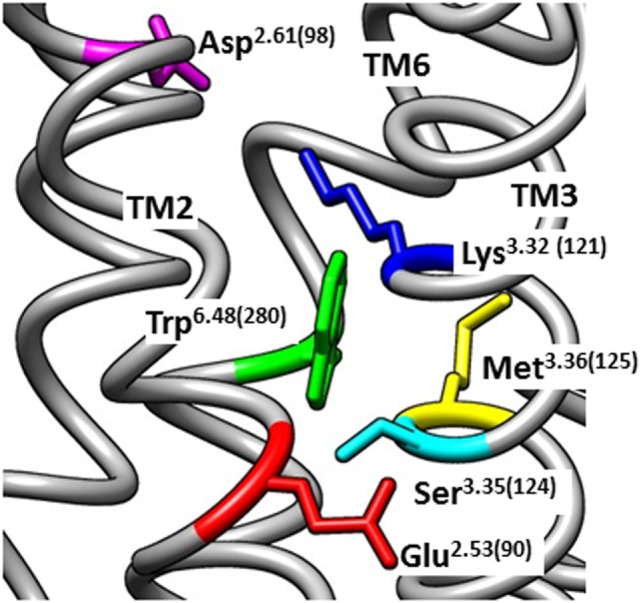
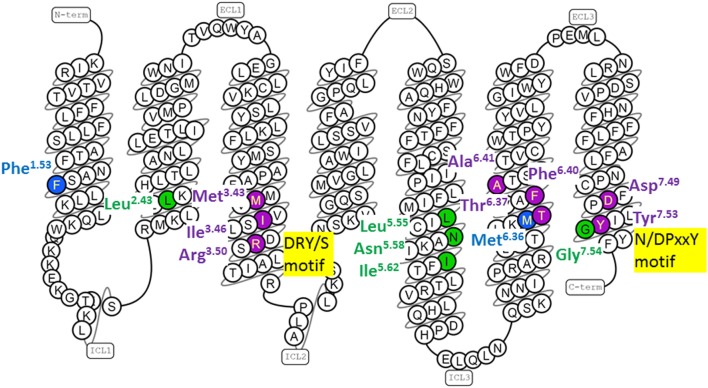
Gonadotropin-releasing hormone (GnRH) regulates reproduction. The human GnRH receptor lacks a cytoplasmic carboxy-terminal tail but has amino acid sequence motifs characteristic of rhodopsin-like, class A, G protein-coupled receptors (GPCRs). This review will consider how recent descriptions of X-ray crystallographic structures of GPCRs in inactive and active conformations may contribute to understanding GnRH receptor structure, mechanism of activation and ligand binding. The structures confirmed that ligands bind to variable extracellular surfaces, whereas the seven membrane-spanning α-helices convey the activation signal to the cytoplasmic receptor surface, which binds and activates heterotrimeric G proteins. Forty non-covalent interactions that bridge topologically equivalent residues in different transmembrane (TM) helices are conserved in class A GPCR structures, regardless of activation state. Conformation-independent interhelical contacts account for a conserved receptor protein structure and their importance in the GnRH receptor structure is supported by decreased expression of receptors with mutations of residues in the network. Many of the GnRH receptor mutations associated with congenital hypogonadotropic hypogonadism, including the Glu Lys mutation, involve amino acids that constitute the conserved network. Half of the ~250 intramolecular interactions in GPCRs differ between inactive and active structures. Conformation-specific interhelical contacts depend on amino acids changing partners during activation. Conserved inactive conformation-specific contacts prevent receptor activation by stabilizing proximity of TM helices 3 and 6 and a closed G protein-binding site. Mutations of GnRH receptor residues involved in these interactions, such as Arg of the DRY/S motif or Tyr of the N/DPxxY motif, increase or decrease receptor expression and efficiency of receptor coupling to G protein signaling, consistent with the native residues stabilizing the inactive GnRH receptor structure. Active conformation-specific interhelical contacts stabilize an open G protein-binding site. Progress in defining the GnRH-binding site has recently slowed, with evidence that Tyr contacts Tyr of GnRH, whereas other residues affect recognition of Trp and GlyNH. The surprisingly consistent observations that GnRH receptor mutations that disrupt GnRH binding have less effect on "conformationally constrained" GnRH peptides may now be explained by crystal structures of agonist-bound peptide receptors. Analysis of GPCR structures provides insight into GnRH receptor function.
促性腺激素释放激素(GnRH)调节生殖。人类GnRH受体缺乏细胞质羧基末端尾巴,但具有视紫红质样A类G蛋白偶联受体(GPCR)的氨基酸序列基序。本综述将探讨GPCR非活性和活性构象的X射线晶体学结构的最新描述如何有助于理解GnRH受体的结构、激活机制和配体结合。这些结构证实配体结合到可变的细胞外表面,而七个跨膜α螺旋将激活信号传递到细胞质受体表面,该表面结合并激活异源三聚体G蛋白。在A类GPCR结构中,无论激活状态如何,连接不同跨膜(TM)螺旋中拓扑等效残基的40种非共价相互作用都是保守的。构象无关的螺旋间接触构成了保守的受体蛋白结构,并且网络中残基发生突变的受体表达降低,这支持了它们在GnRH受体结构中的重要性。许多与先天性低促性腺激素性性腺功能减退相关的GnRH受体突变,包括Glu Lys突变,都涉及构成保守网络的氨基酸。GPCR中约250种分子内相互作用的一半在非活性和活性结构之间有所不同。构象特异性螺旋间接触取决于激活过程中改变伙伴的氨基酸。保守的非活性构象特异性接触通过稳定TM螺旋3和6的接近度以及封闭的G蛋白结合位点来阻止受体激活。参与这些相互作用的GnRH受体残基的突变,如DRY/S基序的Arg或N/DPxxY基序的Tyr,会增加或降低受体表达以及受体与G蛋白信号传导偶联的效率,这与天然残基稳定非活性GnRH受体结构一致。活性构象特异性螺旋间接触稳定开放的G蛋白结合位点。最近,确定GnRH结合位点的进展有所放缓,有证据表明Tyr与GnRH的Tyr接触,而其他残基影响对Trp和GlyNH的识别。破坏GnRH结合的GnRH受体突变对“构象受限”的GnRH肽影响较小,这一惊人一致的观察结果现在可能由激动剂结合肽受体的晶体结构来解释。对GPCR结构的分析有助于深入了解GnRH受体的功能。