Sita Kumari, Sehgal Akanksha, HanumanthaRao Bindumadhava, Nair Ramakrishnan M, Vara Prasad P V, Kumar Shiv, Gaur Pooran M, Farooq Muhammad, Siddique Kadambot H M, Varshney Rajeev K, Nayyar Harsh
Department of Botany, Panjab University, Chandigarh, India.
World Vegetable Center, South Asia, Hyderabad, India.
Front Plant Sci. 2017 Oct 4;8:1658. doi: 10.3389/fpls.2017.01658. eCollection 2017.
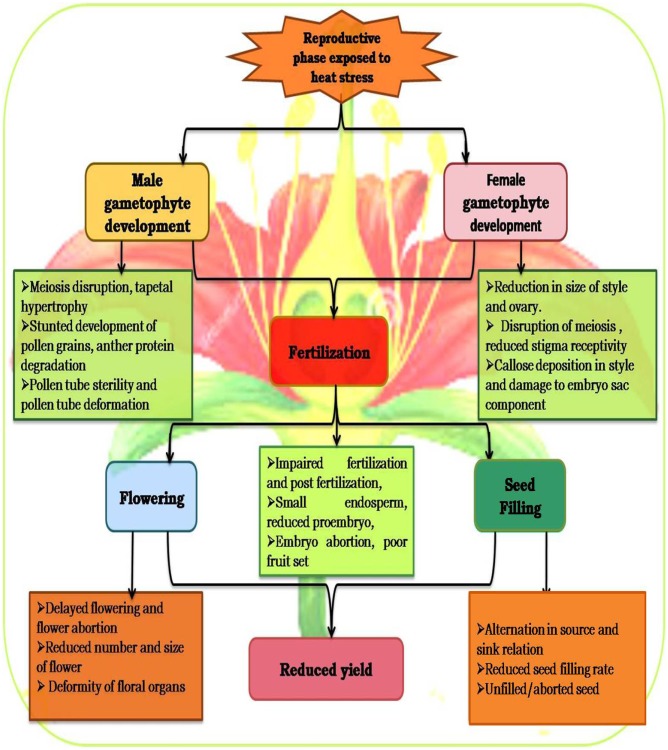
Ambient temperatures are predicted to rise in the future owing to several reasons associated with global climate changes. These temperature increases can result in heat stress- a severe threat to crop production in most countries. Legumes are well-known for their impact on agricultural sustainability as well as their nutritional and health benefits. Heat stress imposes challenges for legume crops and has deleterious effects on the morphology, physiology, and reproductive growth of plants. High-temperature stress at the time of the reproductive stage is becoming a severe limitation for production of grain legumes as their cultivation expands to warmer environments and temperature variability increases due to climate change. The reproductive period is vital in the life cycle of all plants and is susceptible to high-temperature stress as various metabolic processes are adversely impacted during this phase, which reduces crop yield. Food legumes exposed to high-temperature stress during reproduction show flower abortion, pollen and ovule infertility, impaired fertilization, and reduced seed filling, leading to smaller seeds and poor yields. Through various breeding techniques, heat tolerance in major legumes can be enhanced to improve performance in the field. Omics approaches unravel different mechanisms underlying thermotolerance, which is imperative to understand the processes of molecular responses toward high-temperature stress.
由于与全球气候变化相关的多种原因,预计未来环境温度将会上升。这些温度升高会导致热应激,这对大多数国家的作物生产构成严重威胁。豆类因其对农业可持续性的影响以及营养和健康益处而闻名。热应激给豆类作物带来挑战,并对植物的形态、生理和生殖生长产生有害影响。随着豆类作物的种植扩展到温暖环境且由于气候变化温度变异性增加,生殖阶段的高温胁迫正成为谷物豆类生产的严重限制因素。生殖期在所有植物的生命周期中至关重要,并且易受高温胁迫影响,因为在此阶段各种代谢过程会受到不利影响,从而降低作物产量。在生殖期遭受高温胁迫的食用豆类会出现花朵败育、花粉和胚珠不育、受精受损以及种子充实减少,导致种子变小且产量低下。通过各种育种技术,可以提高主要豆类的耐热性,以改善田间表现。组学方法揭示了耐热性背后的不同机制,这对于理解对高温胁迫的分子反应过程至关重要。