Fukushima Hidetada, Kawai Yasuyuki, Asai Hideki, Seki Tadahiko, Norimoto Kazunobu, Urisono Yasuyuki, Okuchi Kazuo
Department of Emergency and Critical Care Medicine Nara Medical University Kashihara City Nara Japan.
Department of Emergency Nara Prefectural General Hospital Nara City Nara Japan.
Acute Med Surg. 2017 Apr 2;4(3):293-299. doi: 10.1002/ams2.273. eCollection 2017 Jul.
To investigate variations in emergency medical service (EMS) pre-arrival cardiopulmonary resuscitation (CPR), including both bystander CPR without dispatch assistance and dispatch-assisted CPR (DACPR).
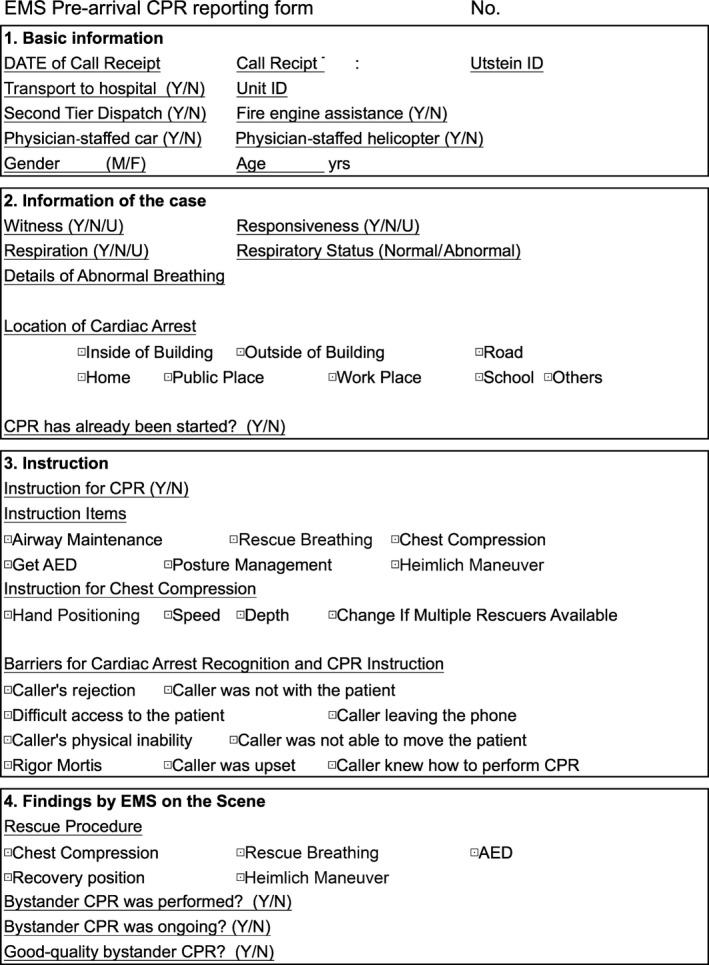
We carried out an observational study by implementing EMS pre-arrival CPR reports in three fire agencies. We included adult, non-traumatic, and non-EMS witnessed out-of-hospital cardiac arrests. This reporting system comprised the dispatch instruction process and bystander CPR quality based on evaluations by EMS crews who arrived on the scene. Bystander CPR was categorized as "ongoing CPR" if the bystander was performing CPR when the EMS reached the patient's side and "good-quality CPR" if the CPR was performed proficiently. We compared the frequencies of ongoing and good-quality CPR in the bystander CPR already started without dispatch assistance (CPR in progress) group and DACPR group.
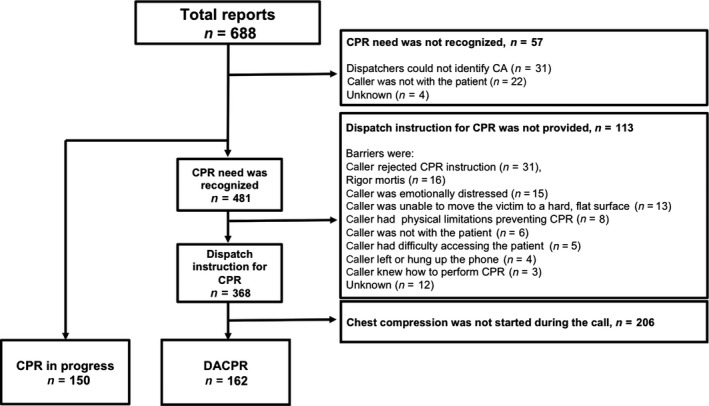
Of 688 out-of-hospital cardiac arrests, CPR was already started in 150 cases (CPR in progress group). Dispatcher CPR instruction was provided in 368 cases. Among these, callers started chest compressions in 162 cases (DACPR group). Ongoing CPR was performed in 220 cases and was more frequent in the DACPR group (128/162 [79.0%] versus 92/150 [61.3%], < 0.001). Good-quality CPR was more frequent in the CPR in progress group, but the difference was not statistically significant (36/92 [39.1%] versus 42/128 [29.0%], = 0.888).
Ongoing CPR and good-quality CPR were not frequent in EMS pre-arrival CPR. Detailed analysis of dispatch instructions and bystander CPR can contribute to improvement in EMS pre-arrival CPR.
调查紧急医疗服务(EMS)到达前心肺复苏(CPR)的差异,包括无调度协助的旁观者心肺复苏和调度辅助心肺复苏(DACPR)。
我们通过在三个消防机构实施EMS到达前心肺复苏报告进行了一项观察性研究。我们纳入了成人、非创伤性且非EMS目击的院外心脏骤停病例。该报告系统包括调度指导过程以及基于到达现场的EMS急救人员评估的旁观者心肺复苏质量。如果EMS到达患者身边时旁观者正在进行心肺复苏,则旁观者心肺复苏被分类为“正在进行的心肺复苏”;如果心肺复苏操作熟练,则分类为“高质量心肺复苏”。我们比较了在无调度协助(正在进行的心肺复苏)组和DACPR组中已开始的旁观者心肺复苏中正在进行的心肺复苏和高质量心肺复苏的频率。
在688例院外心脏骤停病例中,150例(正在进行的心肺复苏组)已经开始了心肺复苏。368例提供了调度员心肺复苏指导。其中,呼叫者开始胸外按压的有162例(DACPR组)。220例进行了正在进行的心肺复苏,且在DACPR组中更频繁(128/162 [79.0%] 对92/150 [61.3%],<0.001)。高质量心肺复苏在正在进行的心肺复苏组中更频繁,但差异无统计学意义(36/92 [39.1%] 对42/128 [29.0%],=0.888)。
EMS到达前心肺复苏中正在进行的心肺复苏和高质量心肺复苏并不常见。对调度指导和旁观者心肺复苏的详细分析有助于改善EMS到达前心肺复苏。