Institute for Food Safety and Hygiene, Vetsuisse Faculty, University of Zurich, Zurich, Switzerland.
Neuropathology-Division of Neurological Sciences, Vetsuisse Faculty, University of Bern, Bern, Switzerland.
Front Cell Infect Microbiol. 2017 Oct 26;7:453. doi: 10.3389/fcimb.2017.00453. eCollection 2017.
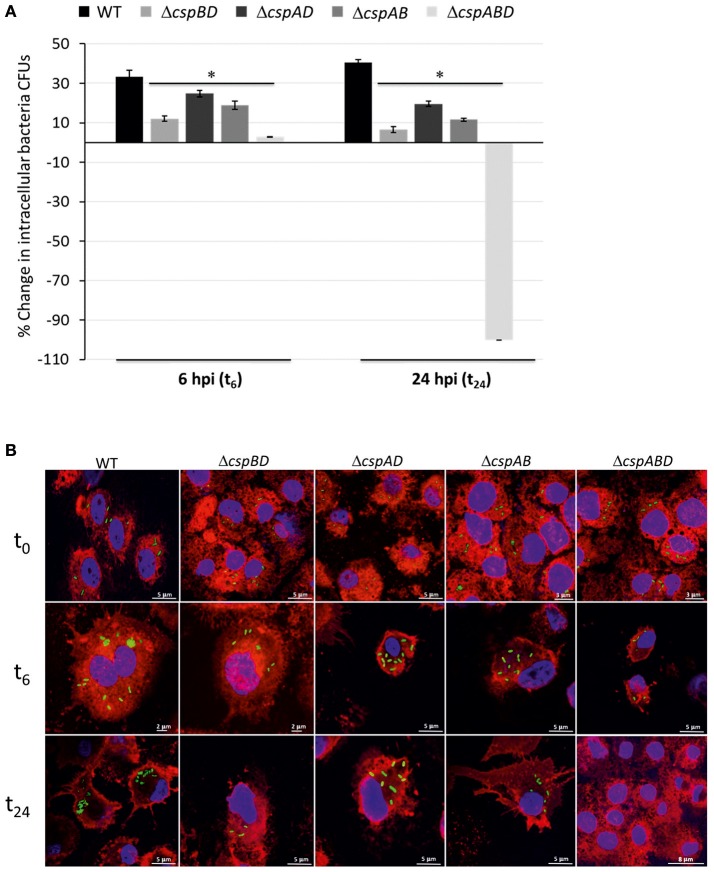
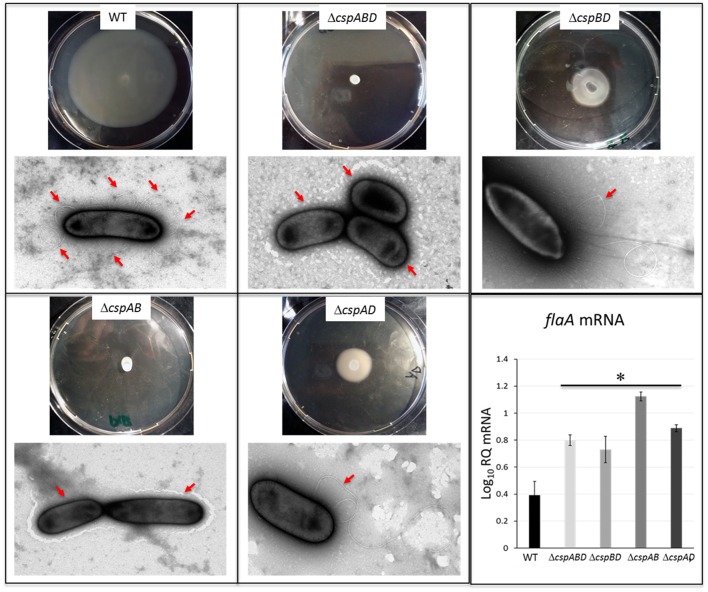
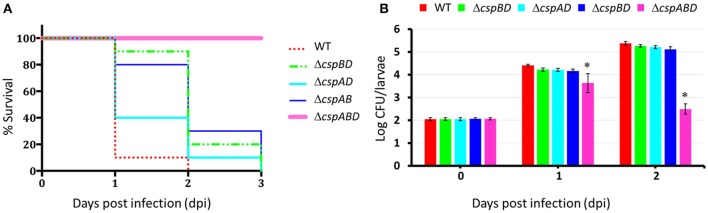
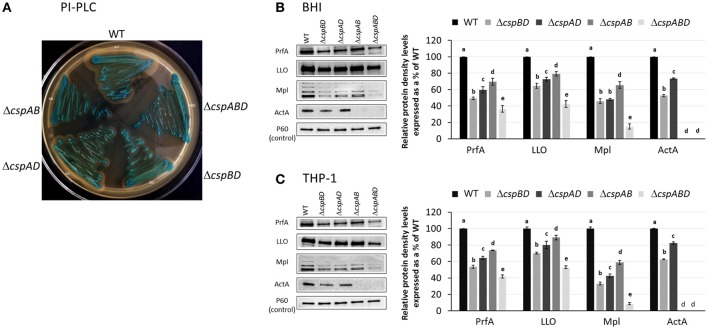
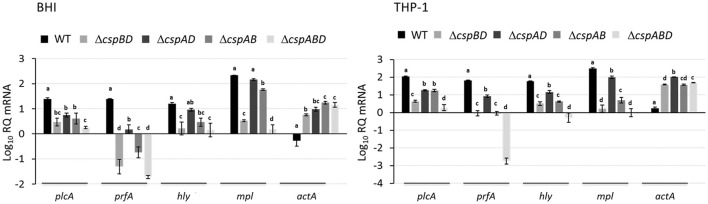
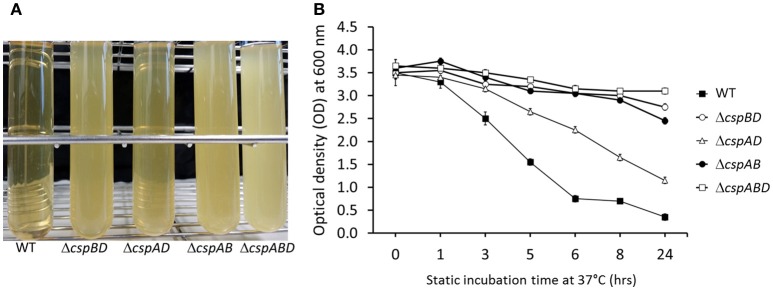
Cold shock-domain family proteins (Csps) are highly conserved nucleic acid binding proteins regulating the expression of various genes including those involved in stress resistance and virulence in bacteria. We show here that Csps are involved in virulence, cell aggregation and flagella-based extracellular motility of . A mutant deleted in all three genes (Δ) is attenuated with respect to human macrophage infection as well as virulence in a zebrafish infection model. Moreover, this mutant is incapable of aggregation and fails to express surface flagella or exhibit swarming motility. An evaluation of double gene deletion mutant (Δ, Δ and Δ) strains that produce single genes showed that there is redundancy as well as functional differences among the three Csps in their contributions to virulence, cellular aggregation, flagella production, and swarming motility. Protein and mRNA expression analysis further showed impaired expression of key virulence and motility genes in the mutants. Our observations at protein and mRNA level suggest Csp-dependent expression regulation of these genes at transcriptional and post-transcriptional levels. In a mutant lacking all genes (Δ) as well as those possessing single genes (Δ, Δ, and Δ) we detected reduced levels of proteins or activity as well as transcripts from the , and genes suggesting a Csp-dependent transcriptional regulation of these genes. These mutants also had reduced or completely lacked ActA proteins and cell surface flagella but contained elevated and mRNA levels compared to the parental wild type strain suggesting Csp involvement in post-transcriptional regulation of these genes. Overall, our results suggest that Csps contribute to the expression regulation of virulence and flagella-associated genes thereby promoting host pathogenicity, cell aggregation and flagella-based motility processes in .
冷休克结构域家族蛋白(Csps)是高度保守的核酸结合蛋白,可调节包括应激抗性和毒力相关基因的表达。我们在此表明,Csps 参与了细菌的毒力、细胞聚集和鞭毛驱动的细胞外运动。敲除了所有三个 csp 基因的突变体(Δ)在人类巨噬细胞感染以及斑马鱼感染模型中的毒力方面均表现出衰减。此外,该突变体不能聚集,无法表达表面鞭毛或表现出群集运动。对产生单个 Csp 基因的双 csp 基因缺失突变体(Δ、Δ 和 Δ)菌株的评估表明,这三个 Csp 在对毒力、细胞聚集、鞭毛产生和群集运动的贡献方面存在冗余和功能差异。蛋白和 mRNA 表达分析进一步表明,这些突变体中的关键毒力和运动基因的表达受到了损害。我们在蛋白和 mRNA 水平上的观察结果表明,这些基因的表达受到 Csp 依赖的转录和转录后调控。在缺乏所有 Csp 基因的突变体(Δ)以及那些只含有单个 Csp 基因的突变体(Δ、Δ 和 Δ)中,我们检测到这些基因的蛋白或活性水平以及转录物水平降低,这表明这些基因受到 Csp 依赖的转录调控。这些突变体也缺乏 ActA 蛋白和细胞表面鞭毛,但与亲本野生型菌株相比, 、 和 基因的 mRNA 水平升高,这表明 Csp 参与了这些基因的转录后调控。总体而言,我们的结果表明,Csps 有助于毒力和鞭毛相关基因的表达调控,从而促进了 在宿主致病性、细胞聚集和鞭毛驱动的运动过程中的作用。