Lo Suet Y, Säbel Crystal E, Mapletoft Jonathan P J, Siemann Stefan
Department of Chemistry and Biochemistry, Laurentian University, Sudbury, Ontario, Canada.
Bharti School of Engineering, Laurentian University, Sudbury, Ontario, Canada.
Biochem Biophys Rep. 2015 Mar 24;1:68-77. doi: 10.1016/j.bbrep.2015.03.004. eCollection 2015 May.
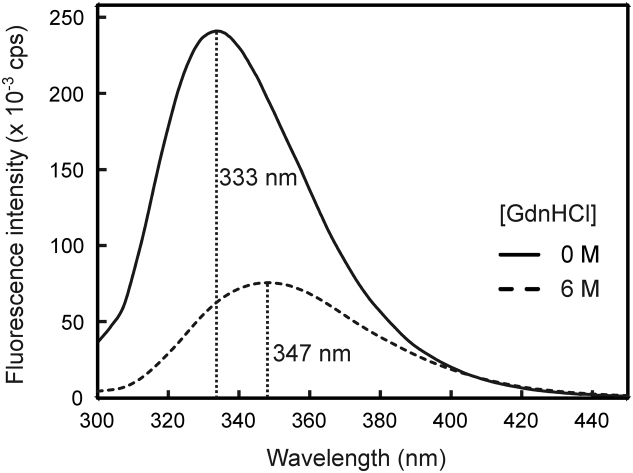
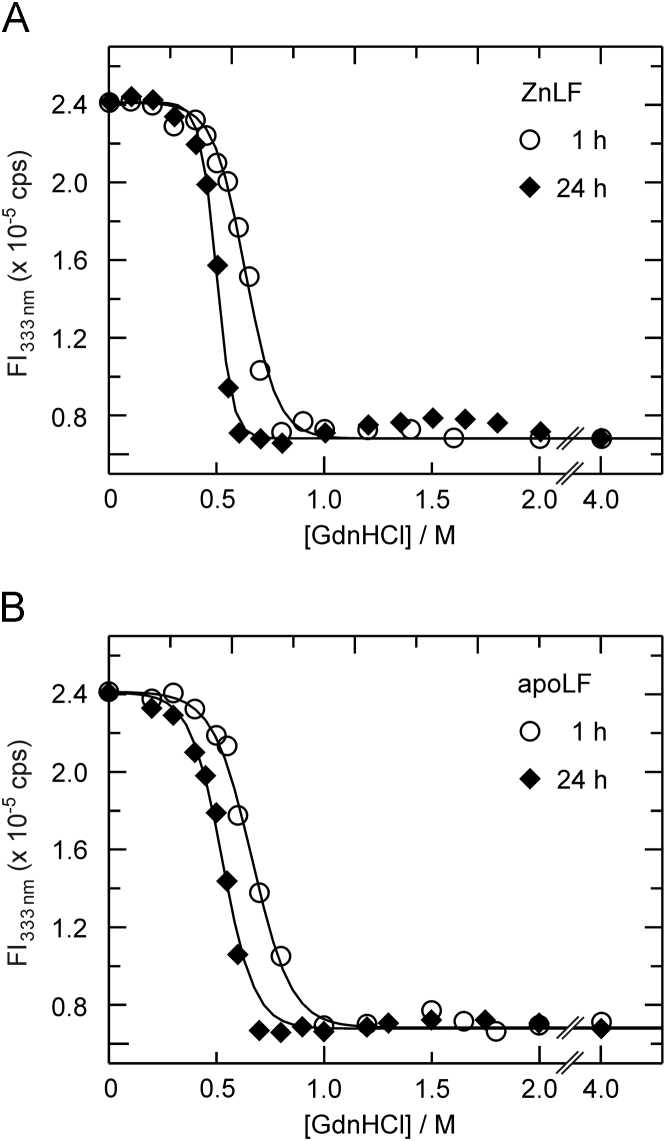
Anthrax lethal factor (LF) is a zinc-dependent endopeptidase which, through a process facilitated by protective antigen, translocates to the host cell cytosol in a partially unfolded state. In the current report, the influence of urea and guanidine hydrochloride (GdnHCl) on LF׳s catalytic function, fold and metal binding was assessed at neutral pH. Both urea and GdnHCl were found to inhibit LF prior to the onset of unfolding, with the inhibition by the latter denaturant being a consequence of its ionic strength. With the exception of demetallated LF (apoLF) in urea, unfolding, as monitored by tryptophan fluorescence spectroscopy, was found to follow a two-state (native to unfolded) mechanism. Analysis of the metal status of LF with 4-(2-pyridylazoresorcinol) (PAR) following urea or GdnHCl exposure suggests the enzyme to be capable of maintaining its metal ion passed the observed unfolding transition in a chelator-inaccessible form. Although an increase in the concentration of the denaturants eventually allowed the chelator access to the protein׳s zinc ion, such process is not correlated with the release of the metal ion. Indeed, significant dissociation of the zinc ion from LF was not observed even at 6 M urea, and only high concentrations of GdnHCl (>3 M) were capable of inducing the release of the metal ion from the protein. Hence, the current study demonstrates not only the propensity of LF to tightly bind its zinc ion beyond the spectroscopically determined unfolding transition, but also the utility of PAR as a structural probe.
炭疽致死因子(LF)是一种锌依赖性内肽酶,它在保护性抗原促进的过程中,以部分未折叠的状态转运到宿主细胞胞质溶胶中。在本报告中,在中性pH条件下评估了尿素和盐酸胍(GdnHCl)对LF的催化功能、折叠和金属结合的影响。发现尿素和GdnHCl在未折叠开始之前就抑制了LF,后一种变性剂的抑制作用是其离子强度的结果。除了尿素中的脱金属LF(脱辅基LF)外,通过色氨酸荧光光谱监测发现,未折叠遵循两态(天然态到未折叠态)机制。在尿素或GdnHCl处理后,用4-(2-吡啶偶氮间苯二酚)(PAR)分析LF的金属状态表明,该酶能够在观察到的未折叠转变之后以螯合剂无法接近的形式保持其金属离子。尽管变性剂浓度的增加最终使螯合剂能够接触到蛋白质的锌离子,但这种过程与金属离子的释放无关。事实上,即使在6M尿素中也未观察到锌离子与LF的明显解离,只有高浓度的GdnHCl(>3M)能够诱导金属离子从蛋白质中释放。因此,本研究不仅证明了LF在光谱确定的未折叠转变之后紧密结合其锌离子的倾向,还证明了PAR作为结构探针的实用性。