Chen Zongyun, Hu Youtian, Wang Bin, Cao Zhijian, Li Wenxin, Wu Yingliang
Department of Biochemistry and Molecular Biology, Institute of Basic Medical Sciences, Hubei University of Medicine, Hubei, China.
State Key Laboratory of Virology, College of Life Sciences, Wuhan University, Hubei, China.
Biochem Biophys Rep. 2015 Jul 21;3:62-67. doi: 10.1016/j.bbrep.2015.07.003. eCollection 2015 Sep.
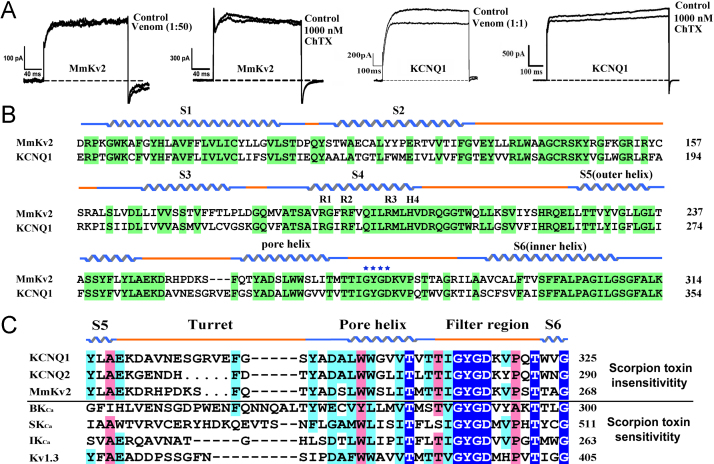
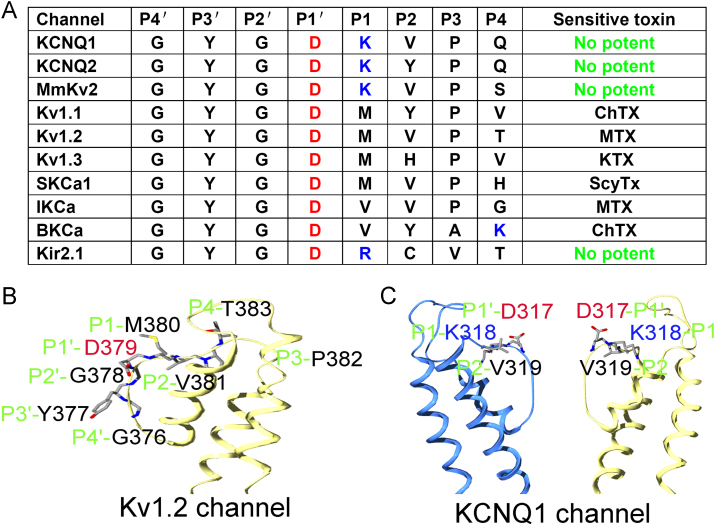
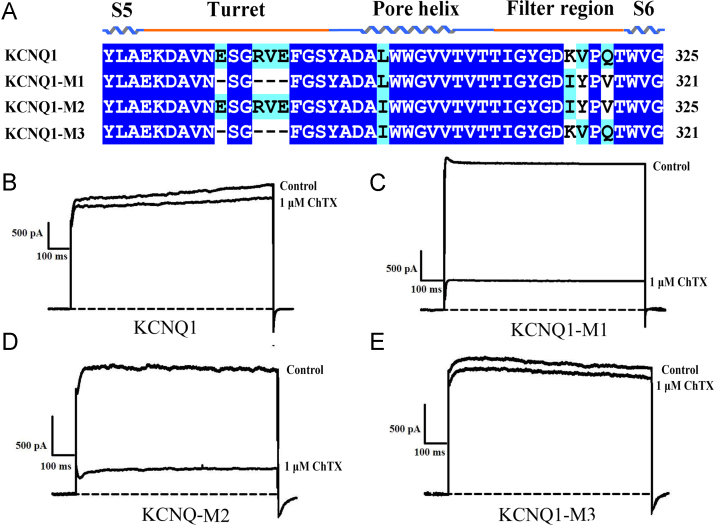
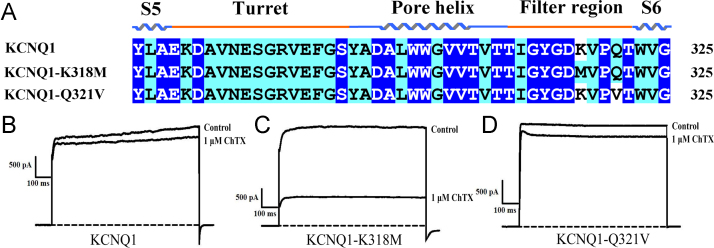
Although many studies concerning the sensitivity mechanism of scorpion toxin-potassium channel interactions have been reported, few have explored the biochemical insensitivity mechanisms of potassium channel receptors toward natural scorpion toxin peptides, such as the KCNQ1 channel. Here, by sequence alignment analyses of the human KCNQ1 channel and scorpion potassium channel MmKv2, which is completely insensitive to scorpion toxins, we proposed that the insensitivity mechanism of KCNQ1 toward natural scorpion toxins might involve two functional regions, the turret and filter regions. Based on this observation, a series of KCNQ1 mutants were constructed to study molecular mechanisms of the KCNQ1 channel insensitivity toward natural scorpion toxins. Electrophysiological studies of chimera channels showed that the channel filter region controls KCNQ1 insensitivity toward the classical scorpion toxin ChTX. Interestingly, further residue mutant experiments showed that a single basic residue in the filter region determined the insensitivity of KCNQ1 channels toward scorpion toxins. Our present work showed that amino acid residue diversification at common sites controls the sensitivity and insensitivity of potassium channels toward scorpion toxins. The unique insensitivity mechanism of KCNQ1 toward natural scorpion toxins will accelerate the rational design of potent peptide inhibitors toward this channel.
尽管已经报道了许多关于蝎毒素与钾通道相互作用的敏感性机制的研究,但很少有研究探讨钾通道受体对天然蝎毒素肽(如KCNQ1通道)的生化不敏感机制。在这里,通过对人类KCNQ1通道和对蝎毒素完全不敏感的蝎钾通道MmKv2进行序列比对分析,我们提出KCNQ1对天然蝎毒素的不敏感机制可能涉及两个功能区域,即炮塔区域和滤器区域。基于这一观察结果,构建了一系列KCNQ1突变体,以研究KCNQ1通道对天然蝎毒素不敏感的分子机制。嵌合通道的电生理研究表明,通道滤器区域控制着KCNQ1对经典蝎毒素ChTX的不敏感性。有趣的是,进一步的残基突变实验表明,滤器区域中的单个碱性残基决定了KCNQ1通道对蝎毒素的不敏感性。我们目前的工作表明,常见位点的氨基酸残基多样化控制着钾通道对蝎毒素的敏感性和不敏感性。KCNQ1对天然蝎毒素独特的不敏感机制将加速针对该通道的有效肽抑制剂的合理设计。