Environment and Infectious Risks Unit, Institut Pasteur, 75015 Paris, France.
MIVEGEC, Institut de Recherche pour le Développement, CNRS, Univ. Montpellier, 34394 Montpellier, France.
Int J Mol Sci. 2017 Nov 10;18(11):2384. doi: 10.3390/ijms18112384.
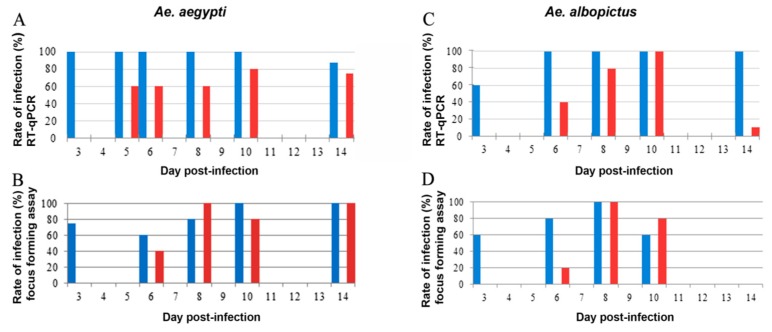
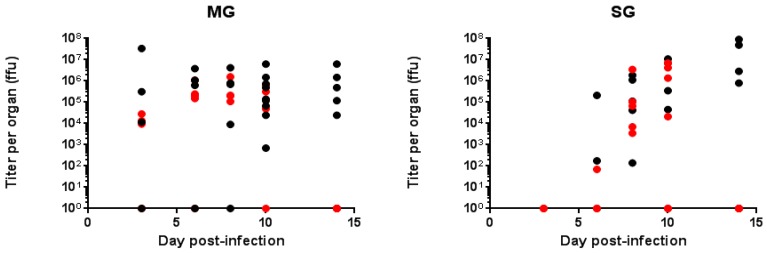
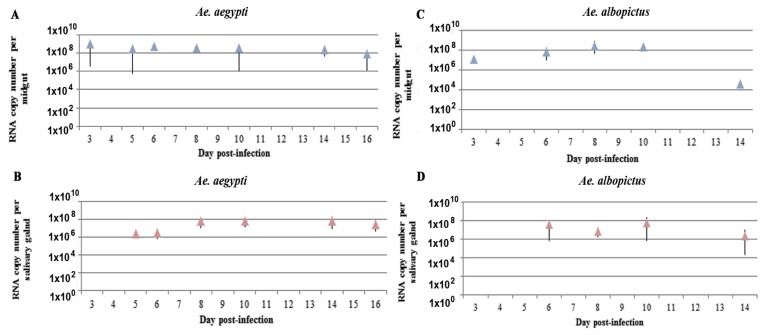
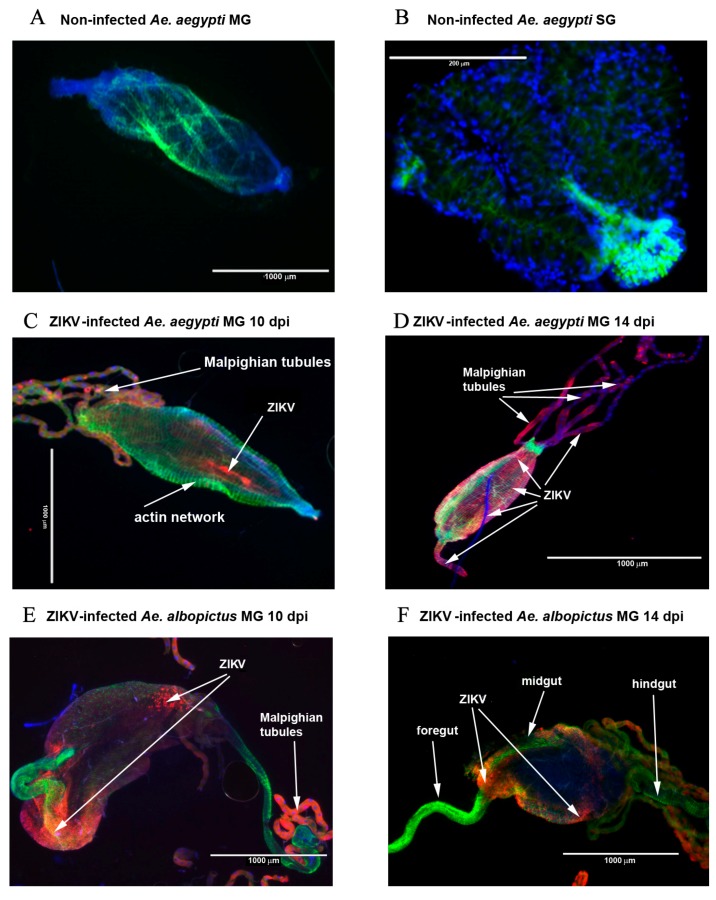
Disease caused by the Zika virus (ZIKV) is a public health emergency of international concern. Recent epidemics have emerged in different regions of the world and attest to the ability of the virus to spread wherever its vector, species mosquitoes, can be found. We have compared the transmission of ZIKV by (PAEA strain originating from Tahiti) and by a French population of to better assess their competence and the potential risk of the emergence of ZIKV in Europe. We assessed the transmission of ZIKV by in temperatures similar to those in Southern France during the summer. Our study shows that the extrinsic incubation period of for transmission was shorter than that of . Both vectors were able to transmit ZIKV from 10 to 14 days post-infection. , however, had a longer transmission period than the French population of . Although the salivary glands of both vectors are highly infected, transmission rates of ZIKV to saliva remain relatively low. These observations may suggest that the risk of emergence of ZIKV in Europe could be low.
寨卡病毒(ZIKV)引起的疾病是国际关注的公共卫生紧急事件。最近,该病毒在世界不同地区爆发,证明了该病毒在其传播媒介——蚊子——存在的任何地方都具有传播能力。我们比较了来自塔希提岛的(PAEA 株)和法国人群的传播能力,以更好地评估它们的能力和寨卡病毒在欧洲出现的潜在风险。我们评估了在类似于法国南部夏季的温度下,通过传播的寨卡病毒的传播。我们的研究表明,传播的外潜伏期比的短。两种载体都能够在感染后 10 到 14 天传播 ZIKV。然而,的传播期比法国人群长。尽管两种载体的唾液腺都受到高度感染,但 ZIKV 传播到唾液的比率仍然相对较低。这些观察结果可能表明寨卡病毒在欧洲出现的风险可能较低。