
全血 microRNA 表达谱可区分类风湿关节炎患者、其血清阳性一级亲属和健康无关联对照者。
Whole blood microRNA expression pattern differentiates patients with rheumatoid arthritis, their seropositive first-degree relatives, and healthy unrelated control subjects.
机构信息
Department of Internal Medicine, Rady Faculty of Health Sciences, University of Manitoba, Room 799, 715 McDermot Avenue, Winnipeg, MB, R3E 3P4, Canada.
Manitoba Centre for Proteomics and Systems Biology, University of Manitoba, Winnipeg, MB, Canada.
出版信息
Arthritis Res Ther. 2017 Nov 10;19(1):249. doi: 10.1186/s13075-017-1459-x.
BACKGROUND
Epigenetic mechanisms can integrate gene-environment interactions that mediate disease transition from preclinical to clinically overt rheumatoid arthritis (RA). To better understand their role, we evaluated microRNA (miRNA, miR) expression profile in indigenous North American patients with RA who were positive for anticitrullinated protein antibodies; their autoantibody-positive, asymptomatic first-degree relatives (FDRs); and disease-free healthy control subjects (HCs).
METHODS
Total RNA was isolated from whole blood samples obtained from HC (n = 12), patients with RA (n = 18), and FDRs (n = 12). Expression of 35 selected relevant miRNAs, as well as associated downstream messenger RNA (mRNA) targets of miR-103a-3p, was determined by qRT-PCR.
RESULTS
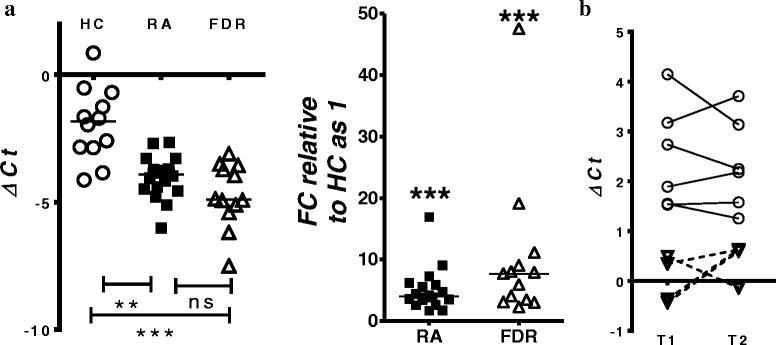
Whole blood expression profiling identified significantly differential miRNA expression in patients with RA (13 miRNAs) and FDRs (10 miRNAs) compared with HCs. Among these, expression of miR-103a-3p, miR-155, miR-146a-5p, and miR-26b-3p was significantly upregulated, whereas miR-346 was significantly downregulated, in both study groups. Expression of miR-103a-3p was consistently elevated in FDRs at two time points 1 year apart. We also confirmed increased miR-103a-3p expression in peripheral blood mononuclear cells from patients with RA compared with HCs. Predicted target analyses of differentially expressed miRNAs in patients with RA and FDRs showed overlapping biological networks. Consistent with these curated networks, mRNA expression of DICER1, AGO1, CREB1, DAPK1, and TP53 was downregulated significantly with miR-103a-3p expression in FDRs.
CONCLUSIONS
We highlight systematically altered circulating miRNA expression in at-risk FDRs prior to RA onset, a profile they shared with patients with RA. Prominently consistent miR-103a-3p expression indicates its utility as a prognostic biomarker for preclinical RA while highlighting biological pathways important for transition to clinically detectable disease.
背景
表观遗传机制可以整合基因-环境相互作用,介导类风湿关节炎(RA)从临床前向临床显性的疾病转变。为了更好地了解它们的作用,我们评估了在对瓜氨酸化蛋白抗体呈阳性的土生土长的北美 RA 患者、其自身抗体阳性、无症状的一级亲属(FDR)以及无疾病的健康对照者(HC)中微 RNA(miRNA,miR)表达谱。
方法
从 HC(n=12)、RA 患者(n=18)和 FDR(n=12)的全血样本中提取总 RNA。通过 qRT-PCR 测定 35 种选定的相关 miRNA 以及 miR-103a-3p 的下游信使 RNA(mRNA)靶标的表达。
结果
全血表达谱分析确定了 RA 患者(13 种 miRNA)和 FDR(10 种 miRNA)与 HC 相比,miRNA 表达存在显著差异。其中,miR-103a-3p、miR-155、miR-146a-5p 和 miR-26b-3p 的表达在两组中均显著上调,而 miR-346 的表达则显著下调。FDR 中 miR-103a-3p 的表达在相隔一年的两个时间点均升高。我们还证实,与 HC 相比,RA 患者外周血单核细胞中 miR-103a-3p 的表达增加。RA 患者和 FDR 中差异表达 miRNA 的预测靶分析显示出重叠的生物网络。与这些经过整理的网络一致,FDR 中 miR-103a-3p 表达与 DICER1、AGO1、CREB1、DAPK1 和 TP53 的 mRNA 表达显著下调。
结论
我们系统地强调了在 RA 发病前高危 FDR 中循环 miRNA 表达的改变,这一特征与 RA 患者相同。一致且显著的 miR-103a-3p 表达表明其可作为临床前 RA 的预后生物标志物,同时强调了向临床可检测疾病转变的重要生物学途径。


 Zotero 插件