Tweed E J, Allardice G M, McLoone P, Morrison D S
MRC/CSO Social and Public Health Sciences Unit, University of Glasgow, 200 Renfield Street, Glasgow, G2 3QB, UK; Directorate of Public Health, NHS Greater Glasgow and Clyde, West House, Gartnavel Royal Hospital, 1055 Great Western Road, Glasgow, G12 0XH, UK.
Directorate of Public Health, NHS Greater Glasgow and Clyde, West House, Gartnavel Royal Hospital, 1055 Great Western Road, Glasgow, G12 0XH, UK.
Public Health. 2018 Jan;154:1-10. doi: 10.1016/j.puhe.2017.10.005. Epub 2017 Nov 10.
To investigate the relationship between socio-economic circumstances and cancer incidence in Scotland in recent years.
Population-based study using cancer registry data.
Data on incident cases of colorectal, lung, female breast, and prostate cancer diagnosed between 2001 and 2012 were obtained from a population-based cancer registry covering a population of approximately 2.5 million people in the West of Scotland. Socio-economic circumstances were assessed based on postcode of residence at diagnosis, using the Scottish Index of Multiple Deprivation (SIMD). For each cancer, crude and age-standardised incidence rates were calculated by quintile of SIMD score, and the number of excess cases associated with socio-economic deprivation was estimated.
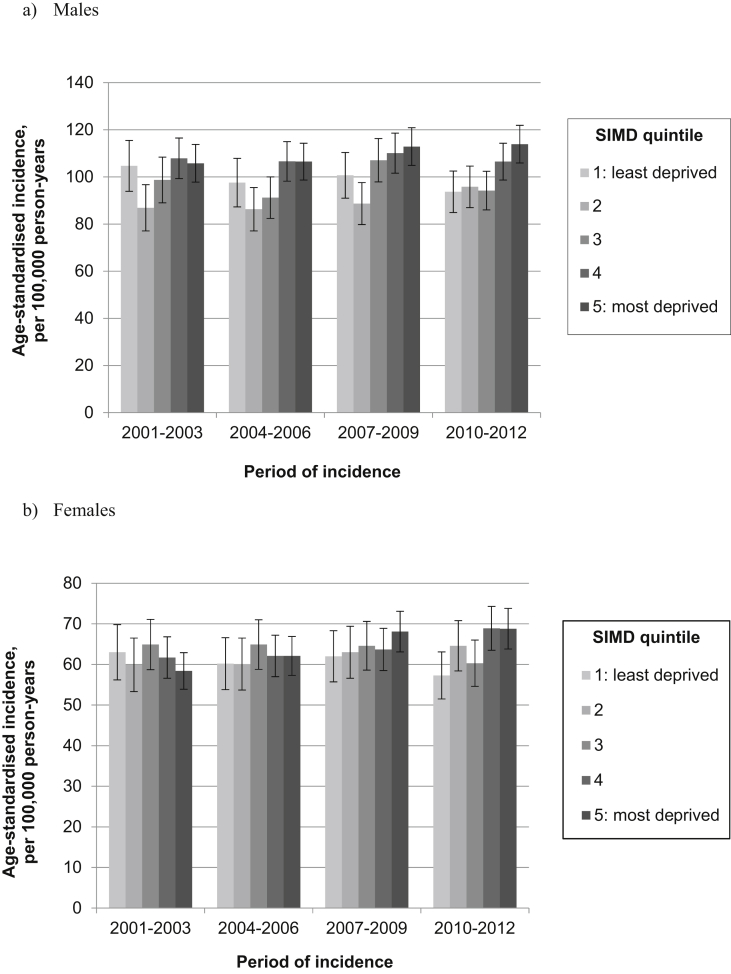
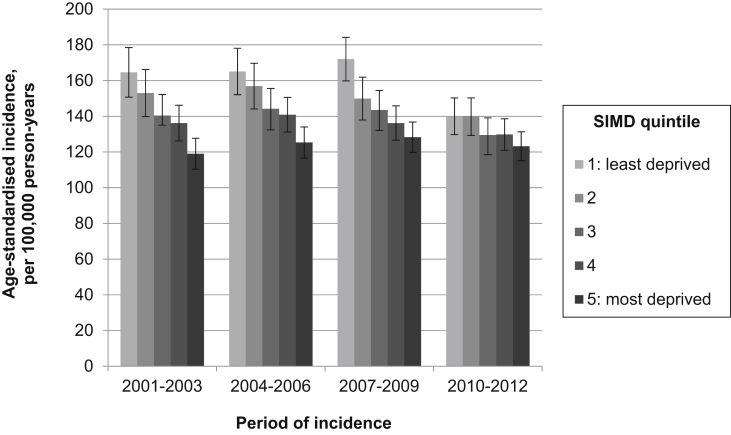
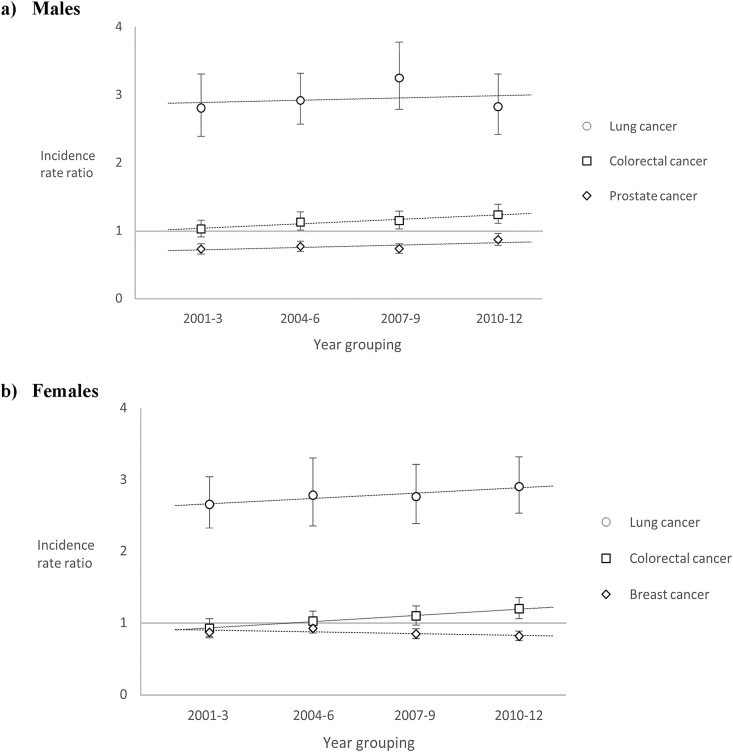
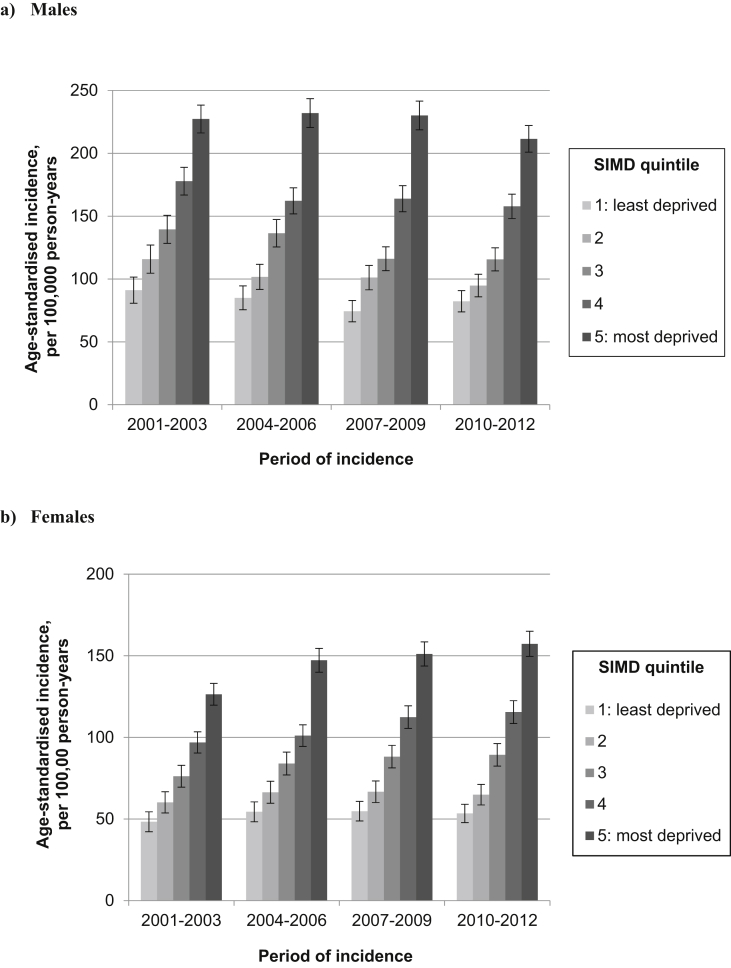
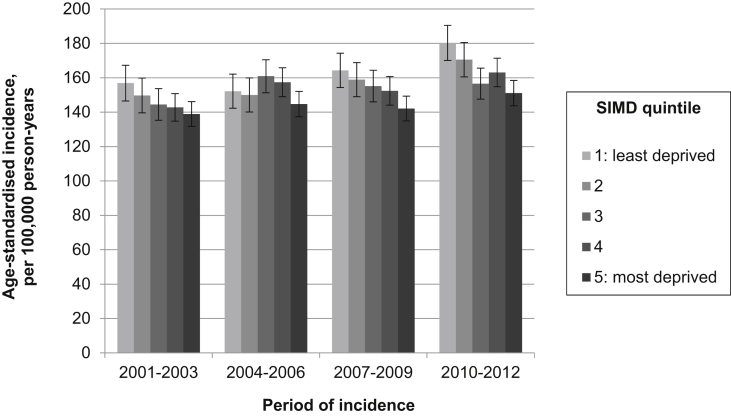
93,866 cases met inclusion criteria, comprising 21,114 colorectal, 31,761 lung, 23,757 female breast, and 15,314 prostate cancers. Between 2001 and 2006, there was no consistent association between socio-economic circumstances and colorectal cancer incidence, but 2006-2012 saw an emerging deprivation gradient in both sexes. The incidence rate ratio (IRR) for colorectal cancer between most deprived and least deprived increased from 1.03 (95% confidence interval [CI] 0.91-1.16) to 1.24 (95% CI 1.11-1.39) during the study period. The incidence of lung cancer showed the strongest relationship with socio-economic circumstances, with inequalities widening across the study period among women from IRR 2.66 (95% CI 2.33-3.05) to 2.91 (95% CI 2.54-3.33) in 2001-03 and 2010-12, respectively. Breast and prostate cancer showed an inverse relationship with socio-economic circumstances, with lower incidence among people living in more deprived areas.
Significant socio-economic inequalities remain in cancer incidence in the West of Scotland, and in some cases are increasing. In particular, this study has identified an emerging, previously unreported, socio-economic gradient in colorectal cancer incidence among women as well as men. Actions to prevent, mitigate, and undo health inequalities should be a public health priority.
调查近年来苏格兰社会经济状况与癌症发病率之间的关系。
基于人群的研究,使用癌症登记数据。
从覆盖苏格兰西部约250万人口的基于人群的癌症登记处获取2001年至2012年期间诊断出的结直肠癌、肺癌、女性乳腺癌和前列腺癌的发病病例数据。根据诊断时居住的邮政编码,使用苏格兰多重贫困指数(SIMD)评估社会经济状况。对于每种癌症,按SIMD评分五分位数计算粗发病率和年龄标准化发病率,并估计与社会经济剥夺相关的额外病例数。
93,866例病例符合纳入标准,包括21,114例结直肠癌、31,761例肺癌、23,757例女性乳腺癌和15,314例前列腺癌。在2001年至2006年期间,社会经济状况与结直肠癌发病率之间没有一致的关联,但在2006 - 2012年期间,两性中均出现了新的剥夺梯度。在研究期间,最贫困与最不贫困人群之间结直肠癌的发病率比(IRR)从1.03(95%置信区间[CI]0.91 - 1.16)增至1.24(95%CI 1.11 - 1.39)。肺癌发病率与社会经济状况的关系最为显著,在研究期间,女性中的不平等差距不断扩大,2001 - 2003年的IRR为2.66(95%CI 2.33 - 3.05),2010 - 2012年则为2.91(95%CI 2.54 - 3.33)。乳腺癌和前列腺癌与社会经济状况呈负相关,生活在更贫困地区的人群发病率较低。
苏格兰西部癌症发病率仍存在显著的社会经济不平等,在某些情况下还在加剧。特别是,本研究发现了男性和女性结直肠癌发病率中一种新出现的、此前未报告的社会经济梯度。预防、减轻和消除健康不平等的行动应成为公共卫生的优先事项。