Boini Krishna M, Hussain Tahir, Li Pin-Lan, Koka Sai
Department of Pharmacological and Pharmaceutical Sciences, College of Pharmacy, University of Houston, Houston, Texas, USA.
Department of Pharmacology and Toxicology, School of Medicine, Virginia Commonwealth University, Richmond, Virginia, USA.
Cell Physiol Biochem. 2017;44(1):152-162. doi: 10.1159/000484623. Epub 2017 Nov 6.
BACKGROUND/AIM: Plasma trimethylamine-N-oxide (TMAO), a product of intestinal microbial metabolism of dietary phosphatidylcholine has been recently associated with atherosclerosis and increased risk of cardiovascular diseases (CVD) in rodents and humans. However, the molecular mechanisms of how TMAO induces atherosclerosis and CVD progression are still unclear. The present study tested whether TMAO induces NLRP3 inflammasome formation and activation and thereby contributes to endothelial injury initiating atherogenesis.
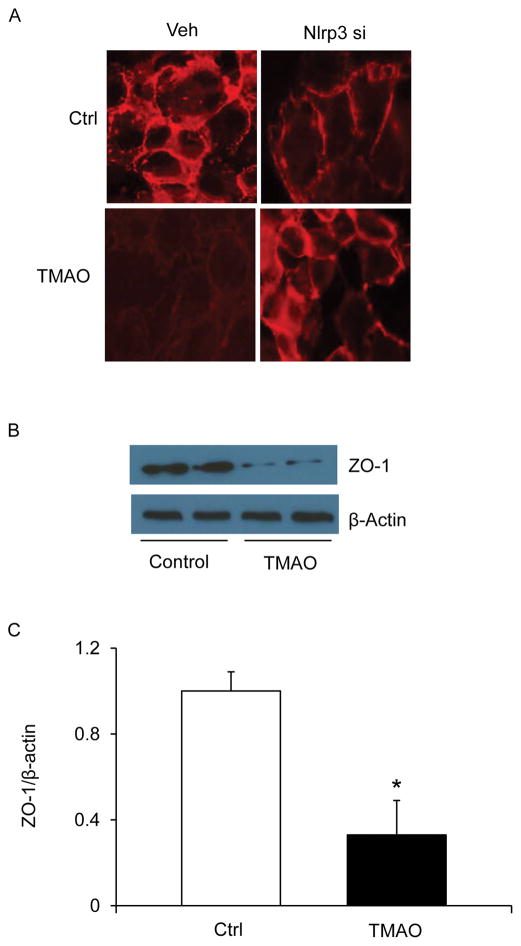
Inflammasome formation and activation was determined by confocal microscopy, caspase-1 activity was measured by colorimetric assay, IL-1β production was measured using ELISA, cell permeability was determined by microplate reader and ZO-1 expression was determined by western blot analysis and confocal microscopy. In in vivo experiments, TMAO was infused by osmotic pump implantation.
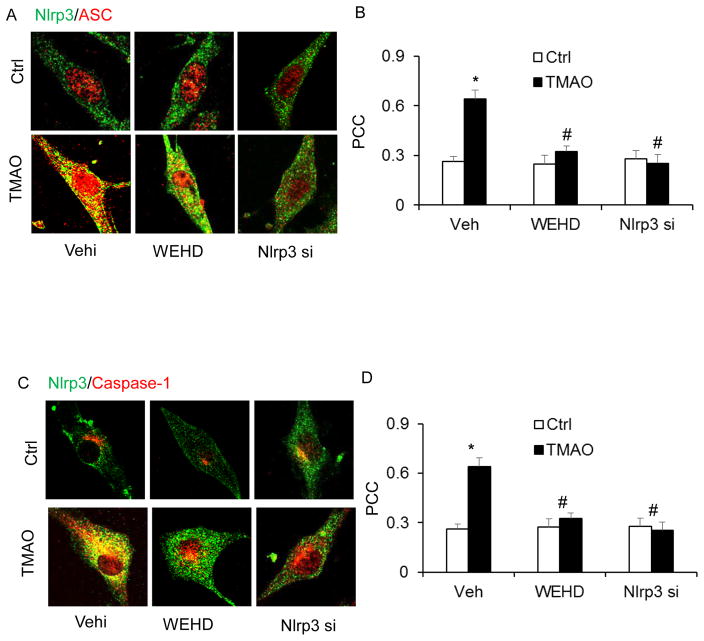
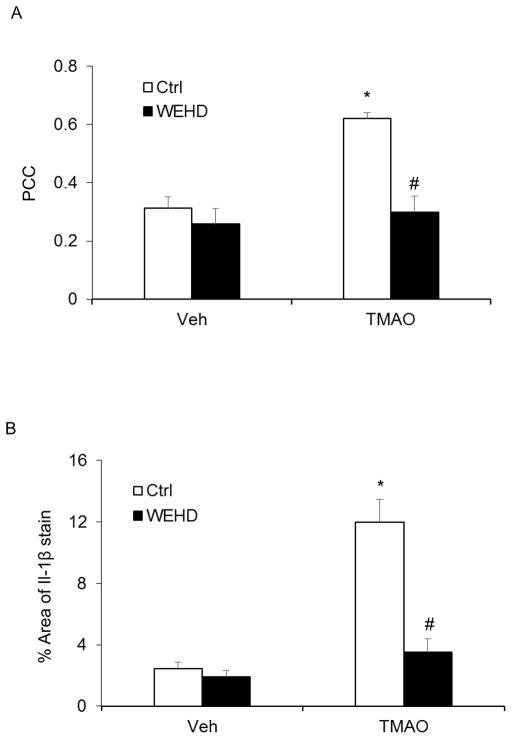
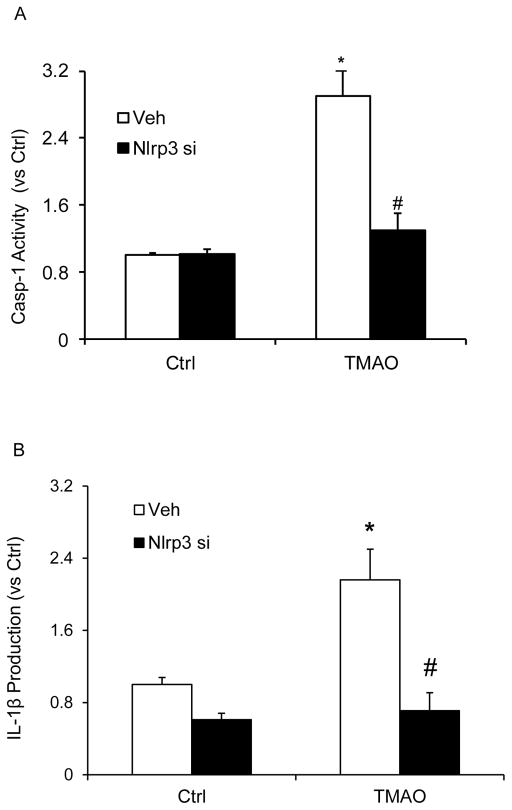
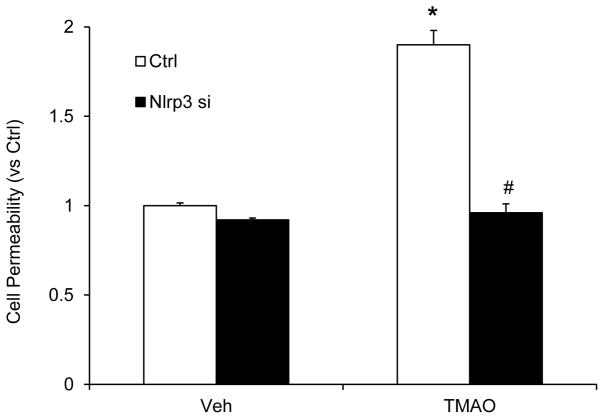
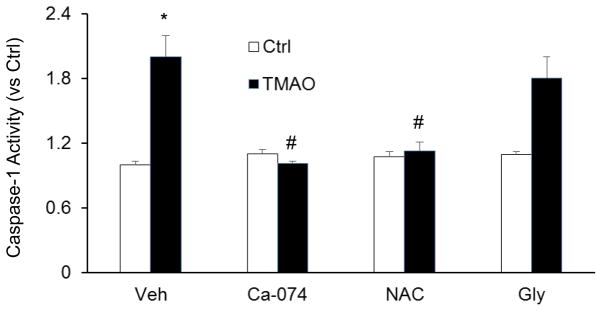
TMAO treatment significantly increased the colocalization of NLRP3 with Asc or NLRP3 with caspase-1, caspase-1 activity, IL-1β production, cell permeability in carotid artery endothelial cells (CAECs) compared to control cells. Pretreatment with caspase-1 inhibitor, WEHD or Nlrp3 siRNA abolished the TMAO-induced inflammasome formation, activation and cell permeability in these cells. In addition, we explored the mechanisms by which TMAO activates NLRP3 inflammasomes. TMAO-induced the activation of NLRP3 inflammasomes was associated with both redox regulation and lysosomal dysfunction. In animal experiments, direct infusion of TMAO in mice with partially ligated carotid artery were found to have increased NLRP3 inflammasome formation and IL-1β production in the intima of wild type mice.
The formation and activation of NLRP3 inflammasomes by TMAO may be an important initiating mechanism to turn on the endothelial inflammatory response leading to endothelial dysfunction.
背景/目的:血浆三甲胺-N-氧化物(TMAO)是膳食磷脂酰胆碱肠道微生物代谢产物,最近在啮齿动物和人类中发现其与动脉粥样硬化及心血管疾病(CVD)风险增加有关。然而,TMAO诱导动脉粥样硬化和CVD进展的分子机制仍不清楚。本研究检测TMAO是否诱导NLRP3炎性小体形成和激活,从而导致内皮损伤引发动脉粥样硬化。
通过共聚焦显微镜确定炎性小体形成和激活,用比色法测定半胱天冬酶-1活性,用酶联免疫吸附测定法测量白细胞介素-1β生成,用酶标仪测定细胞通透性,用蛋白质印迹分析和共聚焦显微镜确定紧密连接蛋白-1(ZO-1)表达。在体内实验中,通过渗透泵植入注入TMAO。
与对照细胞相比,TMAO处理显著增加了颈动脉内皮细胞(CAECs)中NLRP3与凋亡相关斑点样蛋白(Asc)或NLRP3与半胱天冬酶-1的共定位、半胱天冬酶-1活性、白细胞介素-1β生成及细胞通透性。用半胱天冬酶-1抑制剂WEHD或Nlrp3小干扰RNA预处理可消除TMAO诱导的这些细胞中炎性小体形成、激活及细胞通透性。此外,我们探讨了TMAO激活NLRP3炎性小体的机制。TMAO诱导的NLRP3炎性小体激活与氧化还原调节和溶酶体功能障碍均有关。在动物实验中,发现向部分结扎颈动脉的小鼠直接注入TMAO可增加野生型小鼠内膜中NLRP3炎性小体形成和白细胞介素-1β生成。
TMAO诱导NLRP3炎性小体形成和激活可能是开启内皮炎症反应导致内皮功能障碍的重要起始机制。