Li Ning, Liu Shaohui, Sun Mingjiao, Chen Wei, Xu Xiaogang, Zeng Zhu, Tang Yemin, Dong Yongquan, Chang Alex H, Zhao Qiong
Department of Thoracic Oncology, The First Affiliated Hospital, School of Medicine, Zhejiang University, Hangzhou, China.
Clinical Translational Research Center, Shanghai Pulmonary Hospital, Tongji University School of Medicine, Shanghai, China.
Transl Oncol. 2018 Feb;11(1):11-17. doi: 10.1016/j.tranon.2017.10.009. Epub 2017 Nov 10.
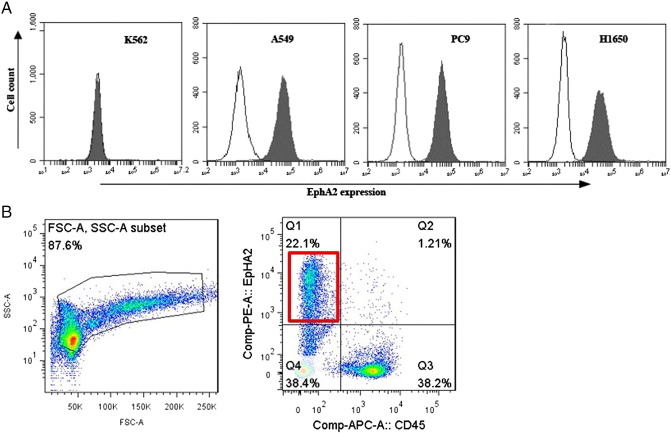
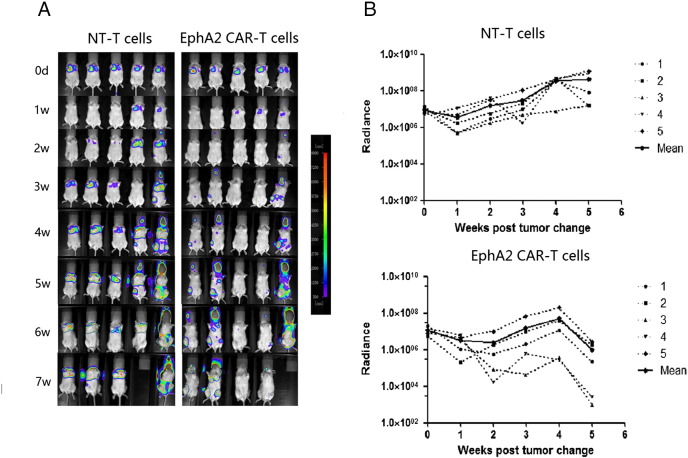
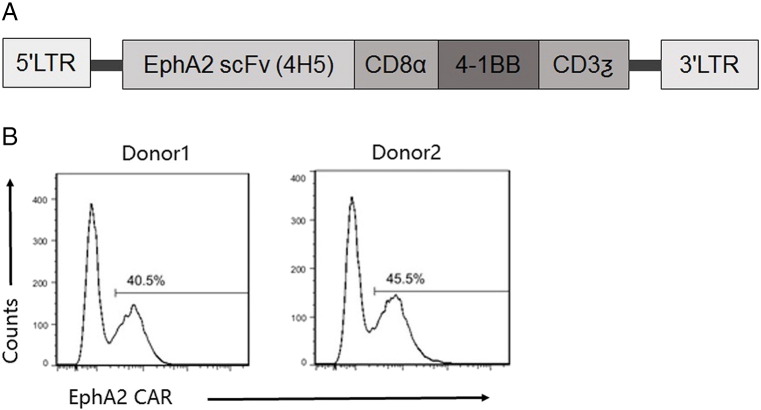
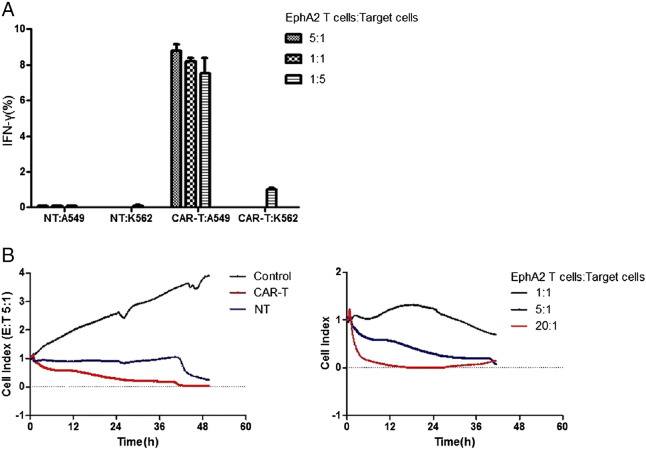
Erythropoietin-producing hepatocellular carcinoma A2 (EphA2) is overexpressed in more than 90% of non-small cell lung cancer (NSCLC) but not significantly in normal lung tissue. It is therefore an important tumor antigen target for chimeric antigen receptors (CAR)-T-based therapy in NSCLC. Here, we developed a specific CAR targeted to EphA2, and the anti-tumor effects of this CAR were investigated. A second generation CAR with co-stimulatory receptor 4-1BB targeted to EphA2 was developed. The functionality of EphA2-specific T cells in vitro was tested with flow cytometry and real-time cell electronic sensing system assays. The effect in vivo was evaluated in xenograft SCID Beige mouse model of EphA2 positive NSCLC. These EphA2-specifc T cells can cause tumor cell lysis by producing the cytokines IFN-γ when cocultured with EphA2-positive targets, and the cytotoxicity effects was specific in vitro. In vivo, the tumor signals of mice treated with EphA2-specifc T cells presented the tendency of decrease, and was much lower than the mice treated with non-transduced T cells. The anti-tumor effects of this CAR-T technology in vivo and vitro had been confirmed. Thus, EphA2-specific T-cell immunotherapy may be a promising approach for the treatment of EphA2-positive NSCLC.
促红细胞生成素产生肝细胞癌A2(EphA2)在超过90%的非小细胞肺癌(NSCLC)中过表达,但在正常肺组织中无明显过表达。因此,它是基于嵌合抗原受体(CAR)-T治疗NSCLC的重要肿瘤抗原靶点。在此,我们开发了一种靶向EphA2的特异性CAR,并研究了该CAR的抗肿瘤作用。开发了一种靶向EphA2并带有共刺激受体4-1BB的第二代CAR。通过流式细胞术和实时细胞电子传感系统分析测试了EphA2特异性T细胞在体外的功能。在EphA2阳性NSCLC的异种移植SCID米色小鼠模型中评估了其体内效果。这些EphA2特异性T细胞在与EphA2阳性靶标共培养时可通过产生细胞因子IFN-γ导致肿瘤细胞裂解,并且在体外细胞毒性作用具有特异性。在体内,用EphA2特异性T细胞治疗的小鼠的肿瘤信号呈现下降趋势,且远低于用未转导T细胞治疗的小鼠。已证实这种CAR-T技术在体内和体外的抗肿瘤作用。因此,EphA2特异性T细胞免疫疗法可能是治疗EphA2阳性NSCLC的一种有前景的方法。