Epidemiology Department, "Victor Babes" University of Medicine and Pharmacy, Timisoara, Romania.
Microbiology Department, "Victor Babes" University of Medicine and Pharmacy, 16 Victor Babes, Timisoara, Romania.
Ann Clin Microbiol Antimicrob. 2017 Nov 13;16(1):71. doi: 10.1186/s12941-017-0251-8.
Over recent decades, a dramatic increase in infections caused by multidrug-resistant pathogens has been observed worldwide. The aim of the present study was to investigate the relationship between local resistance bacterial patterns and antibiotic consumption in an intensive care unit in a Romanian university hospital.
A prospective study was conducted between 1st January 2012 and 31st December 2013. Data covering the consumption of antibacterial drugs and the incidence density for the main resistance phenotypes was collected on a monthly basis, and this data was aggregated quarterly. The relationship between the antibiotic consumption and resistance was investigated using cross-correlation, and four regression models were constructed, using the SPSS version 20.0 (IBM, Chicago, IL) and the R version 3.2.3 packages.
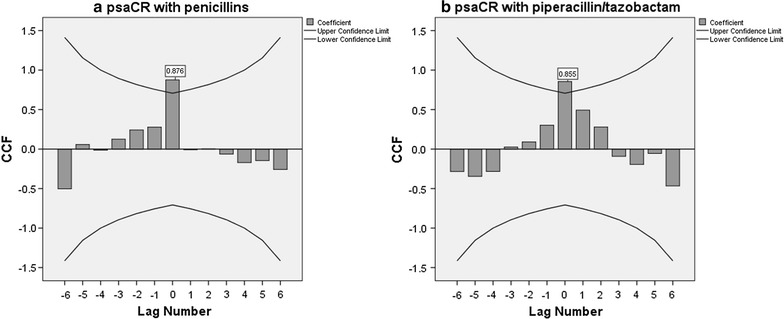
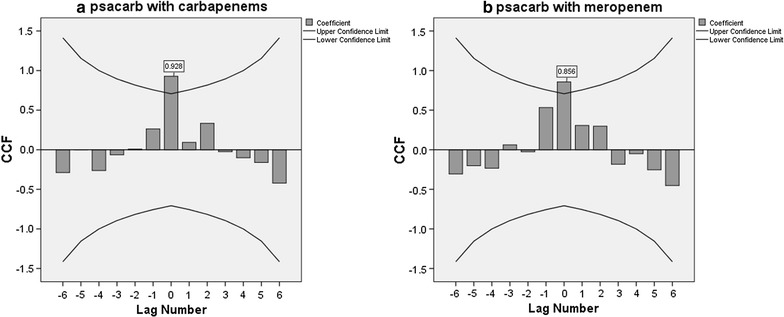
During the period studied, the incidence of combined-resistant and carbapenem-resistant P. aeruginosa strains increased significantly [(gradient = 0.78, R = 0.707, p = 0.009) (gradient = 0.74, R = 0.666, p = 0.013) respectively], mirroring the increase in consumption of β-lactam antibiotics with β-lactamase inhibitors (piperacillin/tazobactam) and carbapenems (meropenem) [(gradient = 10.91, R = 0.698, p = 0.010) and (gradient = 14.63, R = 0.753, p = 0.005) respectively]. The highest cross-correlation coefficients for zero time lags were found between combined-resistant vs. penicillins consumption and carbapenem-resistant P. aeruginosa strains vs. carbapenems consumption (0.876 and 0.928, respectively). The best model describing the relation between combined-resistant P. aeruginosa strains and penicillins consumption during a given quarter incorporates both the consumption and the incidence of combined-resistant strains in the hospital department during the previous quarter (multiple R = 0.953, p = 0.017). The best model for explaining the carbapenem resistance of P. aeruginosa strains based on meropenem consumption during a given quarter proved to be the adjusted model which takes into consideration both previous consumption and incidence density of strains during the previous quarter (Multiple R = 0.921, p = 0.037).
The cross-correlation coefficients and the fitted regression models provide additional evidence that resistance during the a given quarter depends not only on the consumption of antibacterial chemotherapeutic drugs in both that quarter and the previous one, but also on the incidence of resistant strains circulating during the previous quarter.
近几十年来,全球范围内观察到由多药耐药病原体引起的感染急剧增加。本研究的目的是调查罗马尼亚大学医院重症监护病房局部耐药细菌模式与抗生素消耗之间的关系。
2012 年 1 月 1 日至 2013 年 12 月 31 日进行了一项前瞻性研究。每月收集抗菌药物消耗和主要耐药表型的发病率密度数据,并每季度汇总。使用交叉相关分析研究抗生素消耗与耐药性之间的关系,并使用 SPSS 版本 20.0(IBM,芝加哥,IL)和 R 版本 3.2.3 包构建了四个回归模型。
在所研究的期间,联合耐药和碳青霉烯类耐药铜绿假单胞菌菌株的发生率显著增加[(梯度= 0.78,R = 0.707,p = 0.009)(梯度= 0.74,R = 0.666,p = 0.013)],反映了β-内酰胺类抗生素与β-内酰胺酶抑制剂(哌拉西林/他唑巴坦)和碳青霉烯类(美罗培南)消耗的增加[(梯度= 10.91,R = 0.698,p = 0.010)和(梯度= 14.63,R = 0.753,p = 0.005)]。零时间滞后的最高互相关系数分别为联合耐药对青霉素类药物的消耗和铜绿假单胞菌碳青霉烯类耐药菌株对碳青霉烯类药物的消耗(分别为 0.876 和 0.928)。描述给定季度联合耐药铜绿假单胞菌菌株与青霉素类药物消耗之间关系的最佳模型,同时考虑了上一季度医院科室中联合耐药菌株的消耗和发生率(多重 R = 0.953,p = 0.017)。解释给定季度铜绿假单胞菌菌株对美罗培南耐药性的最佳模型是调整模型,该模型考虑了上一季度菌株的消耗和密度以及上一季度的密度(多重 R = 0.921,p = 0.037)。
互相关系数和拟合回归模型提供了额外的证据,表明给定季度的耐药性不仅取决于该季度和上一季度抗菌化学疗法药物的消耗,还取决于上一季度循环耐药菌株的发生率。