Department of Medicine, Stanford Center for Clinical Research, Stanford University School of Medicine, CA (K.W.M.)
George Institute for Global Health, Faculty of Medicine, University of New South Wales, Sydney, Australia (B.N., V.P., Q.L.).
Circulation. 2018 Jan 23;137(4):323-334. doi: 10.1161/CIRCULATIONAHA.117.032038. Epub 2017 Nov 13.
Canagliflozin is a sodium glucose cotransporter 2 inhibitor that significantly reduces the composite of cardiovascular death, nonfatal myocardial infarction, or nonfatal stroke in patients with type 2 diabetes mellitus and elevated cardiovascular risk. The comparative effects among participants with and without a history of cardiovascular disease (secondary versus primary prevention) were prespecified for evaluation.
The CANVAS Program (Canagliflozin Cardiovascular Assessment Study) randomly assigned 10 142 participants with type 2 diabetes mellitus to canagliflozin or placebo. The primary prevention cohort comprised individuals ≥50 years of age with ≥2 risk factors for cardiovascular events but with no prior cardiovascular event, and the secondary prevention cohort comprised individuals ≥30 years of age with a prior cardiovascular event. The primary end point was a composite of cardiovascular death, nonfatal myocardial infarction, or nonfatal stroke. Secondary outcomes included heart failure hospitalization and a renal composite (40% reduction in estimated glomerular filtration rate, renal replacement therapy, or renal death).
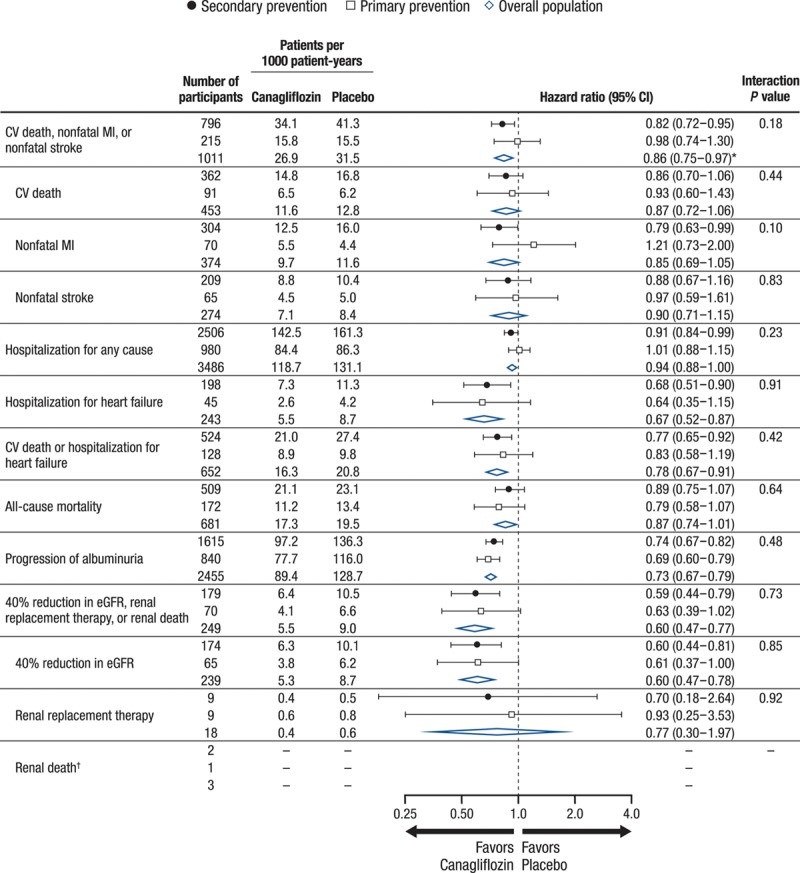
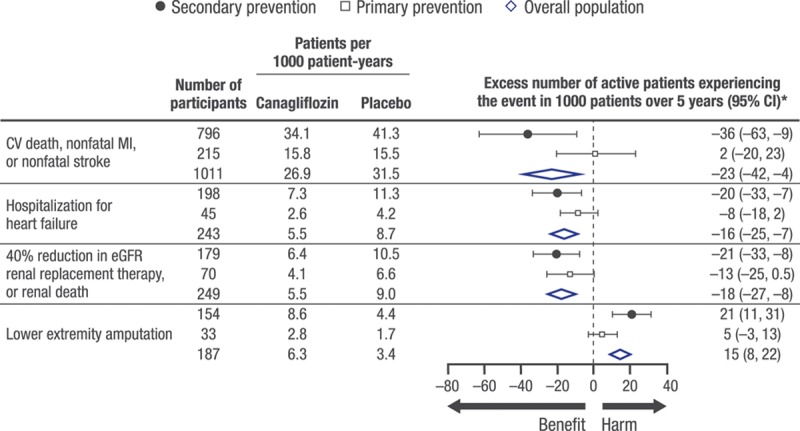
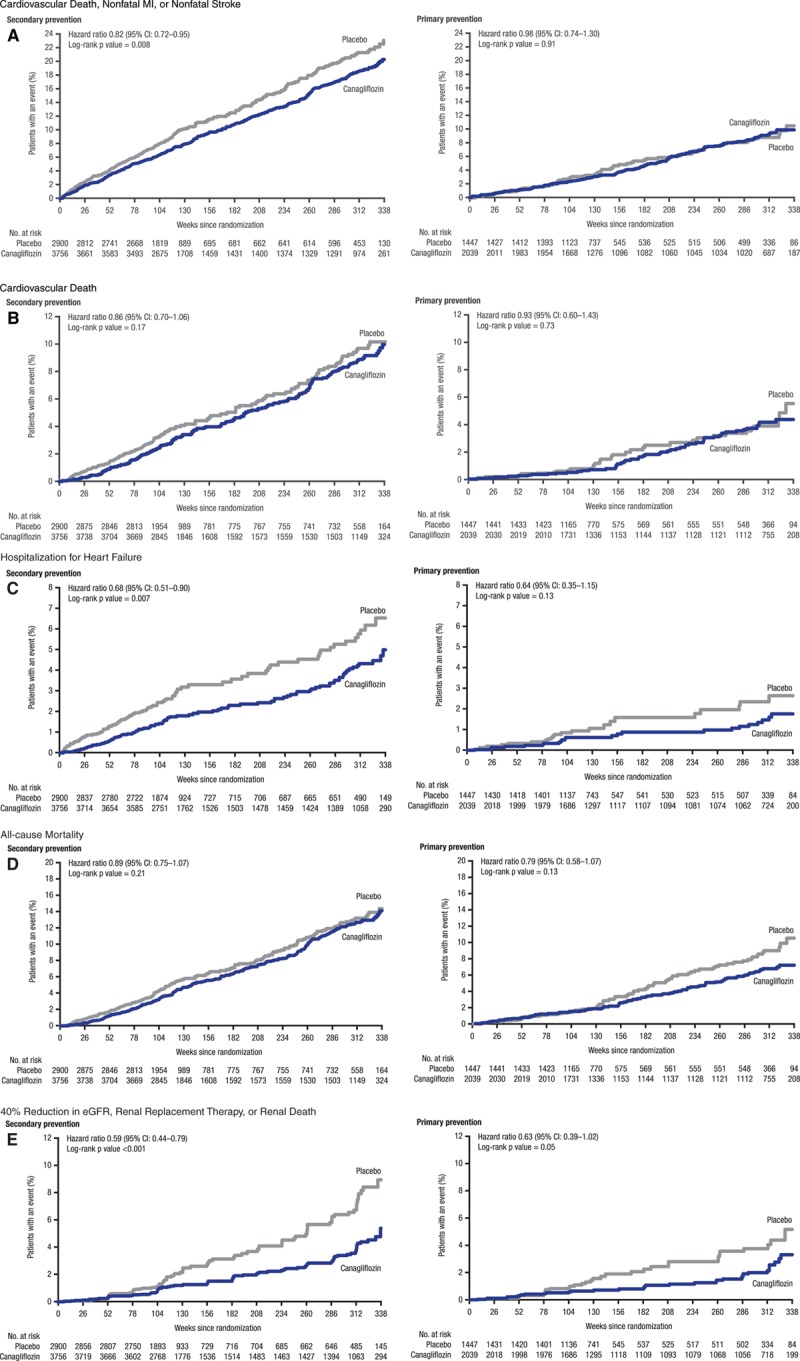
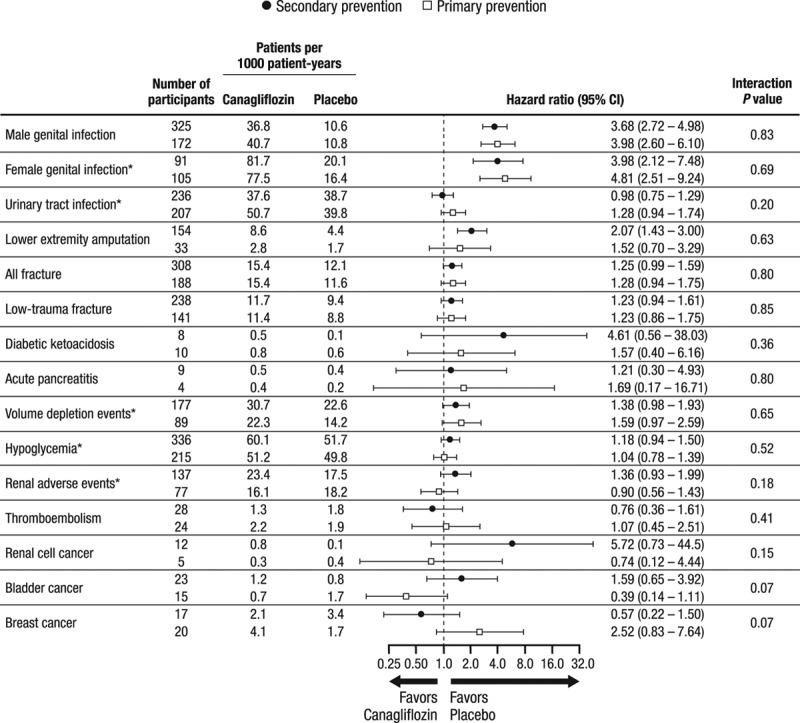
Primary prevention participants (N=3486; 34%) were younger (63 versus 64 years of age), were more often female (45% versus 31%), and had a longer duration of diabetes mellitus (14 versus 13 years) compared with secondary prevention participants (N=6656; 66%). The primary end point event rate was higher in the secondary prevention group compared with the primary prevention group (36.9 versus 15.7/1000 patient-years, <0.001). In the total cohort, the primary end point was reduced with canagliflozin compared with placebo (26.9 versus 31.5/1000 patient-years; hazard ratio [HR], 0.86; 95% confidence interval [CI], 0.75-0.97; <0.001 for noninferiority, =0.02 for superiority) with no statistical evidence of heterogeneity (interaction value=0.18) between the primary (HR, 0.98; 95% CI, 0.74-1.30) and secondary prevention (HR, 0.82; 95% CI, 0.72-0.95) cohorts. Renal outcomes (HR, 0.59; 95% CI, 0.44-0.79 versus HR, 0.63; 95% CI, 0.39-1.02; interaction value=0.73) and heart failure hospitalization (HR, 0.68; 95% CI, 0.51-0.90 versus HR, 0.64; 95% CI, 0.35-1.15; interaction value=0.91) were similarly reduced in the secondary and primary prevention cohorts, respectively. Lower extremity amputations were similarly increased in the secondary and primary prevention cohorts (HR, 2.07; 95% CI, 1.43-3.00 versus HR, 1.52; 95% CI, 0.70-3.29; interaction value=0.63).
Patients with type 2 diabetes mellitus and prior cardiovascular events had higher rates of cardiovascular outcomes compared with the primary prevention patients. Canagliflozin reduced cardiovascular and renal outcomes with no statistical evidence of heterogeneity of the treatment effect across the primary and secondary prevention groups. Additional studies will provide further insights into the effects of canagliflozin in these patient populations.
URL: https://www.clinicaltrials.gov. Unique identifiers: NCT01032629 and NCT01989754.
卡格列净是一种钠-葡萄糖协同转运蛋白 2 抑制剂,可显著降低伴有心血管风险升高的 2 型糖尿病患者的心血管死亡、非致死性心肌梗死或非致死性卒中复合终点。预先设定了评估有和无心血管疾病史(二级预防与一级预防)的参与者之间的比较效果。
CANVAS 项目(卡格列净心血管评估研究)将 10142 例 2 型糖尿病患者随机分为卡格列净组或安慰剂组。一级预防队列包括年龄≥50 岁且有≥2 个心血管事件风险因素但无既往心血管事件的患者,二级预防队列包括年龄≥30 岁且有既往心血管事件的患者。主要终点是心血管死亡、非致死性心肌梗死或非致死性卒中的复合终点。次要终点包括心力衰竭住院和肾脏复合终点(估计肾小球滤过率下降 40%、肾脏替代治疗或肾脏死亡)。
一级预防组(3486 例患者;34%)患者年龄较小(63 岁 vs 64 岁)、女性更多(45% vs 31%)、糖尿病病程更长(14 年 vs 13 年),与二级预防组(6656 例患者;66%)相比。与二级预防组相比,二级预防组的主要终点事件发生率更高(36.9 比 15.7/1000 患者年,<0.001)。在总队列中,与安慰剂相比,卡格列净降低了主要终点事件(36.9 比 31.5/1000 患者年;风险比[HR],0.86;95%置信区间[CI],0.75-0.97;非劣效性检验 P<0.001,优效性检验 P=0.02),且主要预防组(HR,0.98;95%CI,0.74-1.30)和二级预防组(HR,0.82;95%CI,0.72-0.95)之间没有统计学证据表明治疗效果存在异质性(交互 P 值=0.18)。肾脏结局(HR,0.59;95%CI,0.44-0.79 与 HR,0.63;95%CI,0.39-1.02;交互 P 值=0.73)和心力衰竭住院(HR,0.68;95%CI,0.51-0.90 与 HR,0.64;95%CI,0.35-1.15;交互 P 值=0.91)也分别在二级预防组和一级预防组中相似地降低。下肢截肢在二级预防组和一级预防组中的发生率也相似增加(HR,2.07;95%CI,1.43-3.00 与 HR,1.52;95%CI,0.70-3.29;交互 P 值=0.63)。
与一级预防患者相比,有既往心血管事件的 2 型糖尿病患者的心血管结局发生率更高。卡格列净降低了心血管和肾脏结局,且主要预防组和二级预防组之间没有统计学证据表明治疗效果存在异质性。进一步的研究将提供更多关于卡格列净在这些患者群体中的效果的见解。
网址:https://www.clinicaltrials.gov。唯一标识符:NCT01032629 和 NCT01989754。