Department of Rheumatology, The First Affiliated Hospital of Nanjing Medical University, Jiangsu, China.
Department of Cardiology, The First Affiliated Hospital of Nanjing Medical University, Jiangsu, China.
Clin Rheumatol. 2018 Jan;37(1):169-177. doi: 10.1007/s10067-017-3899-8. Epub 2017 Nov 13.
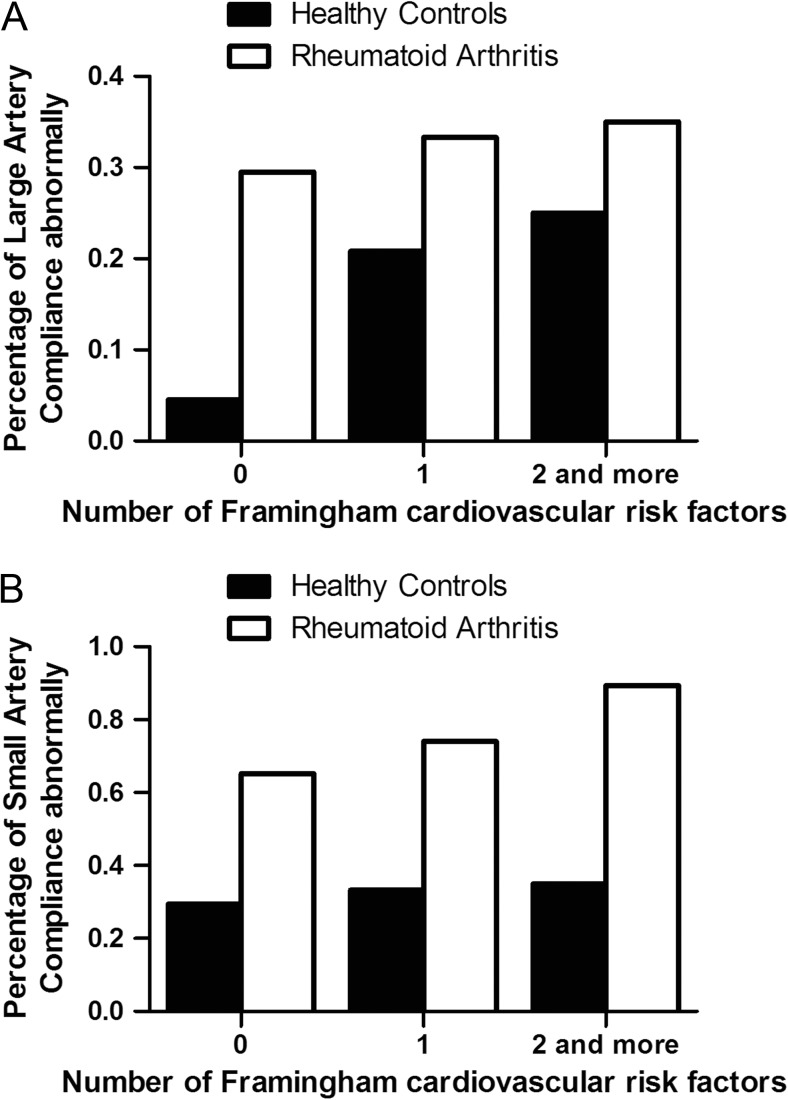
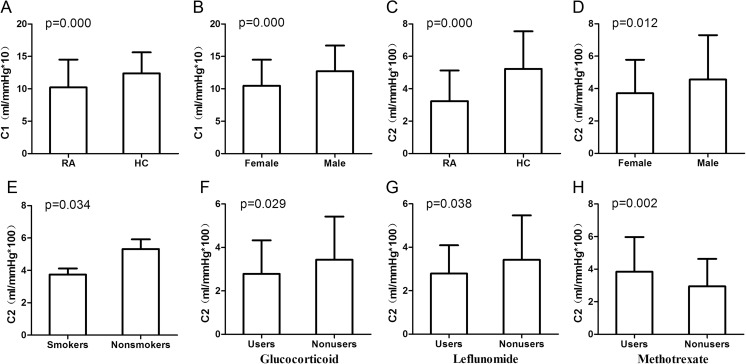
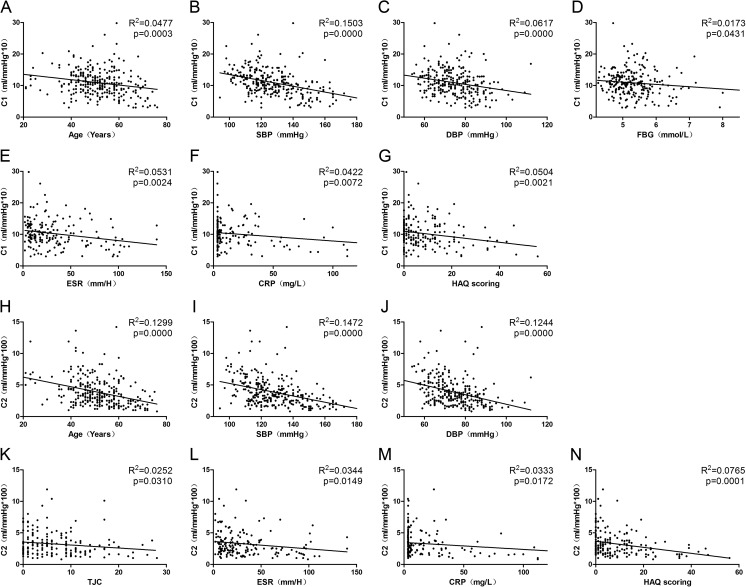
Atherosclerosis is one of the most common complications of rheumatoid arthritis (RA). The objective of this study is to evaluate differences in large artery compliance (C1) and small artery compliance (C2) between RA and controls and evaluating factors associated with reduced compliance in the RA population. The profiling of large and small arterial compliance was analyzed in 185 RA patients and 88 healthy controls using Cardiovascular Profiling Instrument. The correlations of arterial compliance and the relevant clinical data were determined in these subjects. Then correlation analysis and regression analysis were performed to find whether rheumatoid arthritis patients have more risk factors than healthy controls in artery compliance and to explore the possible element involved in RA patients including traditional cardiovascular risk factors, RA disease-related factors, and the therapy. Compared with healthy controls, levels of C1 and C2 were significantly decreased in RA patients. Having adjusted the traditional risk factors associated with atherosclerosis, C1 and C2 decline was still a significant indicator in RA patients [odds ratio = 7.411(95%CI 3.275, 16.771) and 10.184(95%CI 4.546, 22.817)]. Using multi-factor regression analysis to adjust traditional risk factors for arterial compliance, we found that the levels of ESR was correlated with the abnormal large artery compliance [odds ratio = 1.021(95%CI 1.007, 1.035)]. The HAQ values and the current usage of leflunomide were correlated with the abnormal small artery compliance in RA patients [odds ratio = 1.161(95%CI 1.046, 1.289) and 6.170(95%CI 1.510, 25.215)]. The values of C1 and C2 are indicators of artery compliance in RA patients. ESR, HAQ values, and the usage of leflunomide might be possible risk factors of artery compliance. The evaluation of artery compliance could be an easy and reliable test that could help us to screen and predict cardiovascular disorders in RA patients.
动脉粥样硬化是类风湿关节炎(RA)最常见的并发症之一。本研究旨在评估 RA 患者与对照组之间大动脉顺应性(C1)和小动脉顺应性(C2)的差异,并评估 RA 人群中与顺应性降低相关的因素。使用心血管轮廓分析仪器对 185 例 RA 患者和 88 名健康对照者的大动脉和小动脉顺应性进行了分析。在这些受试者中确定了动脉顺应性与相关临床数据的相关性。然后进行了相关分析和回归分析,以确定 RA 患者的动脉顺应性是否比健康对照组有更多的危险因素,并探讨 RA 患者中可能涉及的因素,包括传统心血管危险因素、RA 相关疾病因素和治疗方法。与健康对照组相比,RA 患者的 C1 和 C2 水平显著降低。在调整了与动脉粥样硬化相关的传统危险因素后,C1 和 C2 的下降仍然是 RA 患者的一个显著指标[比值比=7.411(95%可信区间 3.275-16.771)和 10.184(95%可信区间 4.546-22.817)]。使用多因素回归分析调整动脉顺应性的传统危险因素,我们发现 ESR 水平与大动脉顺应性异常相关[比值比=1.021(95%可信区间 1.007-1.035)]。HAQ 值和当前使用来氟米特与 RA 患者小动脉顺应性异常相关[比值比=1.161(95%可信区间 1.046-1.289)和 6.170(95%可信区间 1.510-25.215)]。C1 和 C2 值是 RA 患者动脉顺应性的指标。ESR、HAQ 值和来氟米特的使用可能是动脉顺应性的潜在危险因素。动脉顺应性的评估可能是一种简单可靠的检测方法,可以帮助我们筛查和预测 RA 患者的心血管疾病。