Acuña Stephanie Maia, Aoki Juliana Ide, Laranjeira-Silva Maria Fernanda, Zampieri Ricardo Andrade, Fernandes Juliane Cristina Ribeiro, Muxel Sandra Marcia, Floeter-Winter Lucile Maria
Departamento de Fisiologia, Instituto de Biociências, Universidade de São Paulo, São Paulo, Brazil.
PLoS One. 2017 Nov 14;12(11):e0187186. doi: 10.1371/journal.pone.0187186. eCollection 2017.
Arginase is an enzyme that converts L-arginine to urea and L-ornithine, an essential substrate for the polyamine pathway supporting Leishmania (Leishmania) amazonensis replication and its survival in the mammalian host. L-arginine is also the substrate of macrophage nitric oxide synthase 2 (NOS2) to produce nitric oxide (NO) that kills the parasite. This competition can define the fate of Leishmania infection.
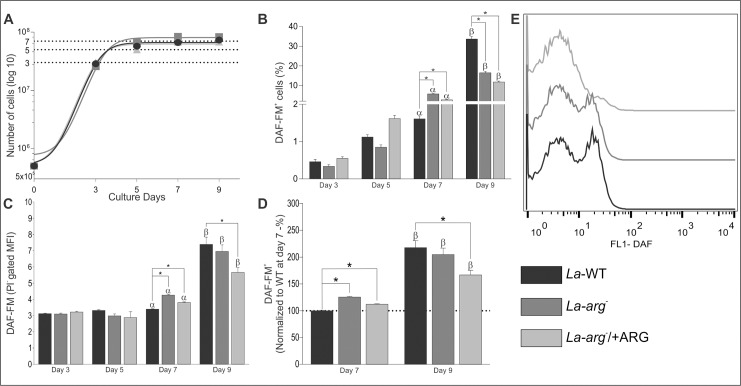
METHODOLOGY/PRINCIPAL FINDINGS: The transcriptomic profiling identified a family of oxidoreductases in L. (L.) amazonensis wild-type (La-WT) and L. (L.) amazonensis arginase knockout (La-arg-) promastigotes and axenic amastigotes. We highlighted the identification of an oxidoreductase that could act as nitric oxide synthase-like (NOS-like), due to the following evidences: conserved domain composition, the participation of NO production during the time course of promastigotes growth and during the axenic amastigotes differentiation, regulation dependence on arginase activity, as well as reduction of NO amount through the NOS activity inhibition. NO quantification was measured by DAF-FM labeling analysis in a flow cytometry.
CONCLUSIONS/SIGNIFICANCE: We described an arginase-dependent NOS-like activity in L. (L.) amazonensis and its role in the parasite growth. The increased detection of NO production in the mid-stationary and late-stationary growth phases of La-WT promastigotes could suggest that this production is an important factor to metacyclogenesis triggering. On the other hand, La-arg- showed an earlier increase in NO production compared to La-WT, suggesting that NO production can be arginase-dependent. Interestingly, La-WT and La-arg- axenic amastigotes produced higher levels of NO than those observed in promastigotes. As a conclusion, our work suggested that NOS-like is expressed in Leishmania in the stationary growth phase promastigotes and amastigotes, and could be correlated to metacyclogenesis and amastigotes growth in a dependent way to the internal pool of L-arginine and arginase activity.
精氨酸酶是一种将L-精氨酸转化为尿素和L-鸟氨酸的酶,L-鸟氨酸是支持亚马逊利什曼原虫(Leishmania)复制及其在哺乳动物宿主中存活的多胺途径的必需底物。L-精氨酸也是巨噬细胞一氧化氮合酶2(NOS2)产生一氧化氮(NO)以杀死寄生虫的底物。这种竞争可以决定利什曼原虫感染的命运。
方法/主要发现:转录组分析在亚马逊利什曼原虫野生型(La-WT)和亚马逊利什曼原虫精氨酸酶敲除(La-arg-)前鞭毛体和无细胞培养的无鞭毛体中鉴定出一个氧化还原酶家族。基于以下证据,我们强调鉴定出一种可作为一氧化氮合酶样(NOS样)的氧化还原酶:保守的结构域组成、前鞭毛体生长过程和无细胞培养的无鞭毛体分化过程中NO产生的参与情况、对精氨酸酶活性的调节依赖性,以及通过抑制NOS活性减少NO量。通过流式细胞术中的DAF-FM标记分析来测量NO定量。
结论/意义:我们描述了亚马逊利什曼原虫中一种依赖精氨酸酶的NOS样活性及其在寄生虫生长中的作用。在La-WT前鞭毛体的生长中期和后期静止期检测到的NO产生增加,这可能表明这种产生是触发循环前期发育的一个重要因素。另一方面,与La-WT相比,La-arg-的NO产生增加得更早,这表明NO产生可能依赖于精氨酸酶。有趣的是,La-WT和La-arg-无细胞培养的无鞭毛体产生的NO水平高于在前鞭毛体中观察到的水平。总之,我们的工作表明,NOS样在利什曼原虫的静止期前鞭毛体和无鞭毛体中表达,并且可能以依赖L-精氨酸内部池和精氨酸酶活性的方式与循环前期发育和无鞭毛体生长相关。