• 文献检索
  • 文档翻译
  • 深度研究
  • 学术资讯
  • Suppr Zotero 插件Zotero 插件
  • 邀请有礼
  • 套餐&价格
  • 历史记录
应用&插件
Suppr Zotero 插件Zotero 插件浏览器插件Mac 客户端Windows 客户端微信小程序
定价
高级版会员购买积分包购买API积分包
服务
文献检索文档翻译深度研究API 文档MCP 服务
关于我们
关于 Suppr公司介绍联系我们用户协议隐私条款
关注我们

Suppr 超能文献

核心技术专利:CN118964589B侵权必究
粤ICP备2023148730 号-1Suppr @ 2026

文献检索

告别复杂PubMed语法,用中文像聊天一样搜索,搜遍4000万医学文献。AI智能推荐,让科研检索更轻松。

立即免费搜索

文件翻译

保留排版,准确专业,支持PDF/Word/PPT等文件格式,支持 12+语言互译。

免费翻译文档

深度研究

AI帮你快速写综述,25分钟生成高质量综述,智能提取关键信息,辅助科研写作。

立即免费体验

低游离三碘甲状腺原氨酸水平可预测急性缺血性脑卒中患者的症状性颅内出血及溶栓治疗更差的短期预后。

Low free triiodothyronine levels predict symptomatic intracranial hemorrhage and worse short-term outcome of thrombolysis in patients with acute ischemia stroke.

作者信息

Qiu Mingjing, Fang Min, Liu Xueyuan

机构信息

Department of Neurology, Shanghai Tenth People's Hospital of Tongji University, Shanghai, China.

出版信息

Medicine (Baltimore). 2017 Nov;96(45):e8539. doi: 10.1097/MD.0000000000008539.

DOI:10.1097/MD.0000000000008539
PMID:29137061
原文链接:https://pmc.ncbi.nlm.nih.gov/articles/PMC5690754/
Abstract

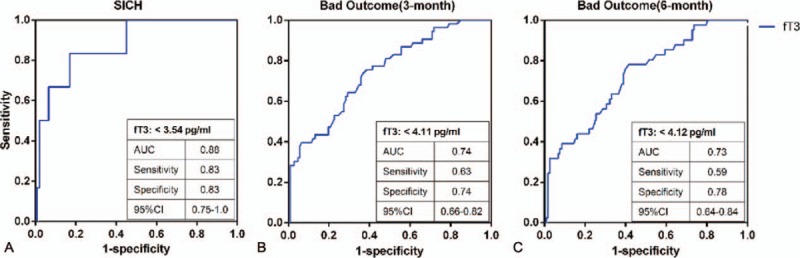
The aim of the study was to determine whether thyroid hormones level on admission in patients with ischemic stroke, treated with intravenous recombinant tissue type plasminogen activator (rtPA), was associated with symptomatic intracranial hemorrhage (sICH) and worse outcomes at 3 months.Patients with acute ischemic stroke (AIS) receiving intravenous rtPA thrombolytic treatment on our stroke unit between January 2015 and June 2016 were included in this study. Serum-free triiodothyronine (fT3), free thyroxine (fT4), total triiodothyronine (tT3), total thyroxine (tT4), and thyroid-stimulating hormone (TSH) were detected on admission. The endpoints were sICH, and poor functional outcomes at 3 and 6 months.In all, 159 patients (106 males; mean age 65.36 ± 10.02 years) were included. FT3 was independently associated with sICH (odds ratio [OR] 0.204, 95% confidence interval [CI] 0.065-0.642) and poor outcomes at 3 months (OR 0.396, 95% CI 0.180-1.764). The cut-off values of fT3 for sICH was 3.54 pg/mL (sensitivity 83%; specificity 83%; area under the curve 0.88). FT3 values ≤3.54 pg/mL increased risk for sICH by 3.16-fold (95% CI 0.75-1.0) compared with fT3 values >3.54 pg/mL.Low fT3 levels at admission were independently associated with sICH and worse outcomes at 3 months in AIS patients receiving rtPA thrombolytic therapy.

摘要

本研究的目的是确定接受静脉注射重组组织型纤溶酶原激活剂(rtPA)治疗的缺血性中风患者入院时的甲状腺激素水平是否与症状性颅内出血(sICH)及3个月时的不良预后相关。本研究纳入了2015年1月至2016年6月期间在我们的卒中单元接受静脉rtPA溶栓治疗的急性缺血性中风(AIS)患者。入院时检测血清游离三碘甲状腺原氨酸(fT3)、游离甲状腺素(fT4)、总三碘甲状腺原氨酸(tT3)、总甲状腺素(tT4)和促甲状腺激素(TSH)。终点指标为sICH以及3个月和6个月时的功能预后不良。

总共纳入了159例患者(106例男性;平均年龄65.36±10.02岁)。fT3与sICH独立相关(比值比[OR]0.204,95%置信区间[CI]0.065 - 0.642)以及3个月时的不良预后(OR 0.396,95%CI 0.180 - 1.764)。sICH的fT3临界值为3.54 pg/mL(敏感性83%;特异性83%;曲线下面积0.88)。与fT3值>3.54 pg/mL相比,fT3值≤3.54 pg/mL使sICH风险增加3.16倍(95%CI 0.75 - 1.0)。

在接受rtPA溶栓治疗的AIS患者中,入院时低fT3水平与sICH及3个月时的不良预后独立相关。
https://cdn.ncbi.nlm.nih.gov/pmc/blobs/65aa/5690754/773903c29260/medi-96-e8539-g005.jpg
https://cdn.ncbi.nlm.nih.gov/pmc/blobs/65aa/5690754/36424dbba2e8/medi-96-e8539-g003.jpg
https://cdn.ncbi.nlm.nih.gov/pmc/blobs/65aa/5690754/773903c29260/medi-96-e8539-g005.jpg
https://cdn.ncbi.nlm.nih.gov/pmc/blobs/65aa/5690754/36424dbba2e8/medi-96-e8539-g003.jpg
https://cdn.ncbi.nlm.nih.gov/pmc/blobs/65aa/5690754/773903c29260/medi-96-e8539-g005.jpg

相似文献

1
Low free triiodothyronine levels predict symptomatic intracranial hemorrhage and worse short-term outcome of thrombolysis in patients with acute ischemia stroke.低游离三碘甲状腺原氨酸水平可预测急性缺血性脑卒中患者的症状性颅内出血及溶栓治疗更差的短期预后。
Medicine (Baltimore). 2017 Nov;96(45):e8539. doi: 10.1097/MD.0000000000008539.
2
Low free triiodothyronine levels are related to symptomatic intracranial hemorrhage and poor functional outcomes after intravenous thrombolysis in acute ischemic stroke patients.急性缺血性卒中患者静脉溶栓后,低游离三碘甲状腺原氨酸水平与症状性颅内出血及不良功能预后相关。
Neurol Res. 2016 May;38(5):429-33. doi: 10.1080/01616412.2016.1178480. Epub 2016 Apr 28.
3
Prediction of Symptomatic Intracranial Hemorrhage after Intravenous Thrombolysis in Acute Ischemic Stroke: The Symptomatic Intracranial Hemorrhage Score.急性缺血性卒中静脉溶栓后症状性颅内出血的预测:症状性颅内出血评分
J Stroke Cerebrovasc Dis. 2017 Nov;26(11):2622-2629. doi: 10.1016/j.jstrokecerebrovasdis.2017.06.030. Epub 2017 Aug 18.
4
Predictors of in-hospital mortality and the risk of symptomatic intracerebral hemorrhage after thrombolytic therapy with recombinant tissue plasminogen activator in acute ischemic stroke.重组组织型纤溶酶原激活剂溶栓治疗急性缺血性脑卒中后院内死亡率及症状性颅内出血的风险预测因素。
J Stroke Cerebrovasc Dis. 2014 Jan;23(1):7-11. doi: 10.1016/j.jstrokecerebrovasdis.2012.04.004. Epub 2012 May 11.
5
Symptomatic intracranial hemorrhage following intravenous thrombolysis for acute ischemic stroke: a critical review of case definitions.症状性颅内出血:急性缺血性脑卒中静脉溶栓治疗后之关键回顾。
Cerebrovasc Dis. 2012;34(2):106-14. doi: 10.1159/000339675. Epub 2012 Aug 1.
6
Renal Dysfunction Associated with Symptomatic Intracranial Hemorrhage after Intravenous Thrombolysis.静脉溶栓后与症状性颅内出血相关的肾功能障碍。
J Stroke Cerebrovasc Dis. 2019 Nov;28(11):104363. doi: 10.1016/j.jstrokecerebrovasdis.2019.104363. Epub 2019 Sep 6.
7
Symptomatic Intracerebral Hemorrhage after Intravenous Thrombolysis: Predictive Factors and Validation of Prediction Models.症状性颅内出血后静脉溶栓治疗:预测因素和预测模型的验证。
J Stroke Cerebrovasc Dis. 2019 Nov;28(11):104360. doi: 10.1016/j.jstrokecerebrovasdis.2019.104360. Epub 2019 Sep 14.
8
Nomogram to Predict Symptomatic Intracranial Hemorrhage after Intravenous Thrombolysis in Acute Ischemic Stroke in Asian Population.亚洲人群急性缺血性脑卒中静脉溶栓后症状性颅内出血的预测列线图
Curr Neurovasc Res. 2021;18(5):543-551. doi: 10.2174/1567202619666211223150907.
9
Targeting recombinant tissue-type plasminogen activator in acute ischemic stroke based on risk of intracranial hemorrhage or poor functional outcome: an analysis of the third international stroke trial.基于颅内出血风险或功能预后不良对急性缺血性卒中患者使用重组组织型纤溶酶原激活剂进行靶向治疗:第三次国际卒中试验分析
Stroke. 2014 Apr;45(4):1000-6. doi: 10.1161/STROKEAHA.113.004362. Epub 2014 Mar 6.
10
Leukoaraiosis, Cerebral Hemorrhage, and Outcome After Intravenous Thrombolysis for Acute Ischemic Stroke: A Meta-Analysis (v1).脑白质疏松症、脑出血与急性缺血性卒中静脉溶栓后的结局:一项荟萃分析(第1版)
Stroke. 2016 Sep;47(9):2364-72. doi: 10.1161/STROKEAHA.116.014096. Epub 2016 Aug 4.

引用本文的文献

1
Thyroid hormones and neurological impairments during the first two days after stroke: A pilot study.中风后前两天甲状腺激素与神经功能障碍:一项初步研究。
Heliyon. 2025 Jan 11;11(2):e41921. doi: 10.1016/j.heliyon.2025.e41921. eCollection 2025 Jan 30.
2
Investigating the Predictive Value of Thyroid Hormone Levels for Stroke Prognosis.探讨甲状腺激素水平对卒中预后的预测价值。
Neurol Int. 2023 Aug 2;15(3):926-953. doi: 10.3390/neurolint15030060.
3
Risk factors of hemorrhagic transformation in acute ischaemic stroke: A systematic review and meta-analysis.

本文引用的文献

1
Differences in Brain Glucose Metabolism During Preparation for I Ablation in Thyroid Cancer Patients: Thyroid Hormone Withdrawal Versus Recombinant Human Thyrotropin.甲状腺癌患者进行碘消融术前脑葡萄糖代谢的差异:甲状腺激素撤减与重组人促甲状腺素对比
Thyroid. 2017 Jan;27(1):23-28. doi: 10.1089/thy.2016.0293. Epub 2016 Nov 28.
2
Thyroid Function Within the Reference Range and the Risk of Stroke: An Individual Participant Data Analysis.甲状腺功能处于参考范围内与中风风险:个体参与者数据分析。
J Clin Endocrinol Metab. 2016 Nov;101(11):4270-4282. doi: 10.1210/jc.2016-2255. Epub 2016 Sep 7.
3
Associations between Thyroid Stimulating Hormone Levels and Both Severity and Early Outcome of Patients with Ischemic Stroke.
急性缺血性卒中出血性转化的危险因素:一项系统评价和荟萃分析。
Front Neurol. 2023 Feb 20;14:1079205. doi: 10.3389/fneur.2023.1079205. eCollection 2023.
4
Cardiovascular and Neuronal Consequences of Thyroid Hormones Alterations in the Ischemic Stroke.缺血性卒中中甲状腺激素改变的心血管和神经后果
Metabolites. 2022 Dec 23;13(1):22. doi: 10.3390/metabo13010022.
5
Brain to periphery in acute ischemic stroke: Mechanisms and clinical significance.急性缺血性脑卒中的脑-外周机制及临床意义。
Front Neuroendocrinol. 2021 Oct;63:100932. doi: 10.1016/j.yfrne.2021.100932. Epub 2021 Jul 14.
6
Low triiodothyronine syndrome is associated with hemorrhagic transformation in patients with acute ischaemic stroke.低三碘甲状腺原氨酸综合征与急性缺血性脑卒中患者的出血性转化相关。
Aging (Albany NY). 2019 Aug 27;11(16):6385-6397. doi: 10.18632/aging.102195.
7
Low T3 Syndrome as a Predictor of Poor Prognosis in Patients With Pyogenic Liver Abscess.低T3综合征作为化脓性肝脓肿患者预后不良的预测指标
Front Endocrinol (Lausanne). 2019 Aug 6;10:541. doi: 10.3389/fendo.2019.00541. eCollection 2019.
促甲状腺激素水平与缺血性脑卒中患者的严重程度及早期预后的相关性
Eur Neurol. 2016;76(3-4):125-131. doi: 10.1159/000449055. Epub 2016 Aug 27.
4
Alteration of Thyroid-Related Hormones within Normal Ranges and Early Functional Outcomes in Patients with Acute Ischemic Stroke.急性缺血性脑卒中患者甲状腺相关激素在正常范围内的变化及早期功能转归
Int J Endocrinol. 2016;2016:3470490. doi: 10.1155/2016/3470490. Epub 2016 Jun 8.
5
Low free triiodothyronine levels are related to symptomatic intracranial hemorrhage and poor functional outcomes after intravenous thrombolysis in acute ischemic stroke patients.急性缺血性卒中患者静脉溶栓后,低游离三碘甲状腺原氨酸水平与症状性颅内出血及不良功能预后相关。
Neurol Res. 2016 May;38(5):429-33. doi: 10.1080/01616412.2016.1178480. Epub 2016 Apr 28.
6
Low triiodothyronine: A new facet of inflammation in acute ischemic stroke.低三碘甲状腺原氨酸:急性缺血性脑卒中炎症的新方面。
Clin Chim Acta. 2016 Jul 1;458:63-7. doi: 10.1016/j.cca.2016.04.023. Epub 2016 Apr 22.
7
Anti-edema action of thyroid hormone in MCAO model of ischemic brain stroke: Possible association with AQP4 modulation.甲状腺激素在缺血性脑卒中超急性大脑中动脉闭塞(MCAO)模型中的抗水肿作用:与水通道蛋白4(AQP4)调节的可能关联
J Neurol Sci. 2015 Jul 15;354(1-2):37-45. doi: 10.1016/j.jns.2015.04.042. Epub 2015 May 1.
8
What causes intracerebral bleeding after thrombolysis for acute ischaemic stroke? Recent insights into mechanisms and potential biomarkers.溶栓治疗急性缺血性脑卒中后为何会发生脑出血?对发病机制和潜在生物标志物的最新认识。
J Neurol Neurosurg Psychiatry. 2015 Oct;86(10):1127-36. doi: 10.1136/jnnp-2014-309705. Epub 2015 Mar 26.
9
Paediatric arterial ischaemic stroke and cerebral sinovenous thrombosis. First report from the Italian Registry of Pediatric Thrombosis (R. I. T. I., Registro Italiano Trombosi Infantili).儿童动脉缺血性中风和脑静脉窦血栓形成。来自意大利儿科血栓登记处(R.I.T.I.,意大利儿科血栓登记处)的首份报告。
Thromb Haemost. 2015 Jun;113(6):1270-7. doi: 10.1160/TH14-05-0431. Epub 2015 Mar 12.
10
Neuroprotective actions of thyroid hormones and low-T3 syndrome as a biomarker in acute cerebrovascular disorders.甲状腺激素的神经保护作用及低T3综合征作为急性脑血管疾病生物标志物的研究
Expert Rev Neurother. 2015 Mar;15(3):315-26. doi: 10.1586/14737175.2015.1013465. Epub 2015 Feb 11.