Yang Jia-Sin, Lin Chiao-Wen, Hsieh Yi-Hsien, Chien Ming-Hsien, Chuang Chun-Yi, Yang Shun-Fa
Department of Medical Research, Chung Shan Medical University Hospital, Taichung, Taiwan.
Institute of Medicine, Chung Shan Medical University, Taichung, Taiwan.
Oncotarget. 2017 Aug 12;8(47):83088-83099. doi: 10.18632/oncotarget.20236. eCollection 2017 Oct 10.
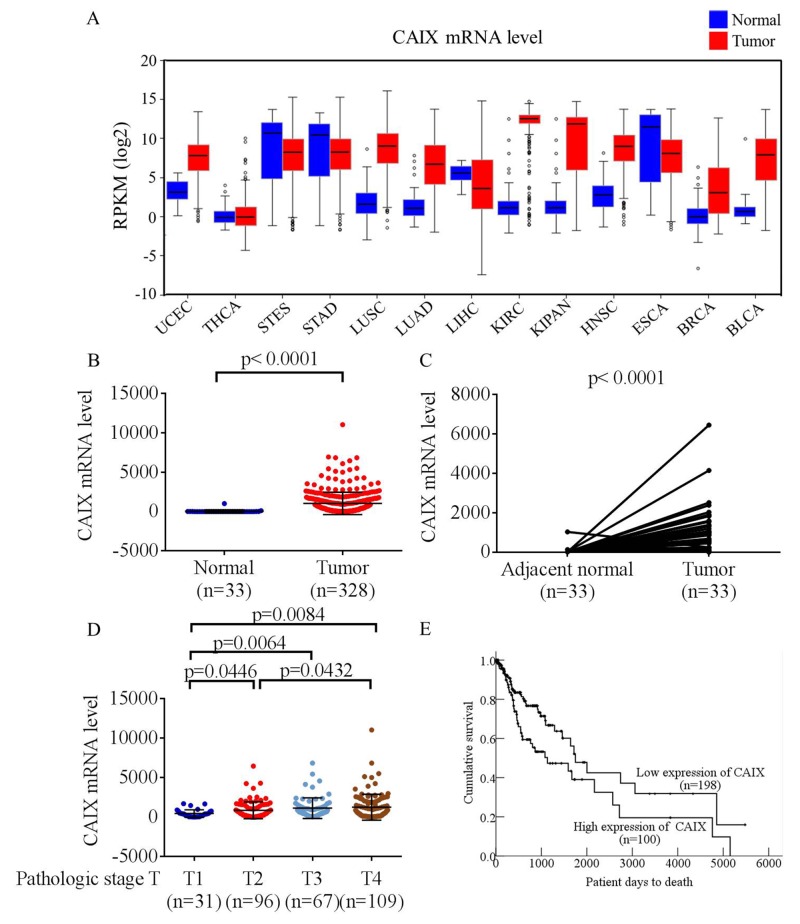
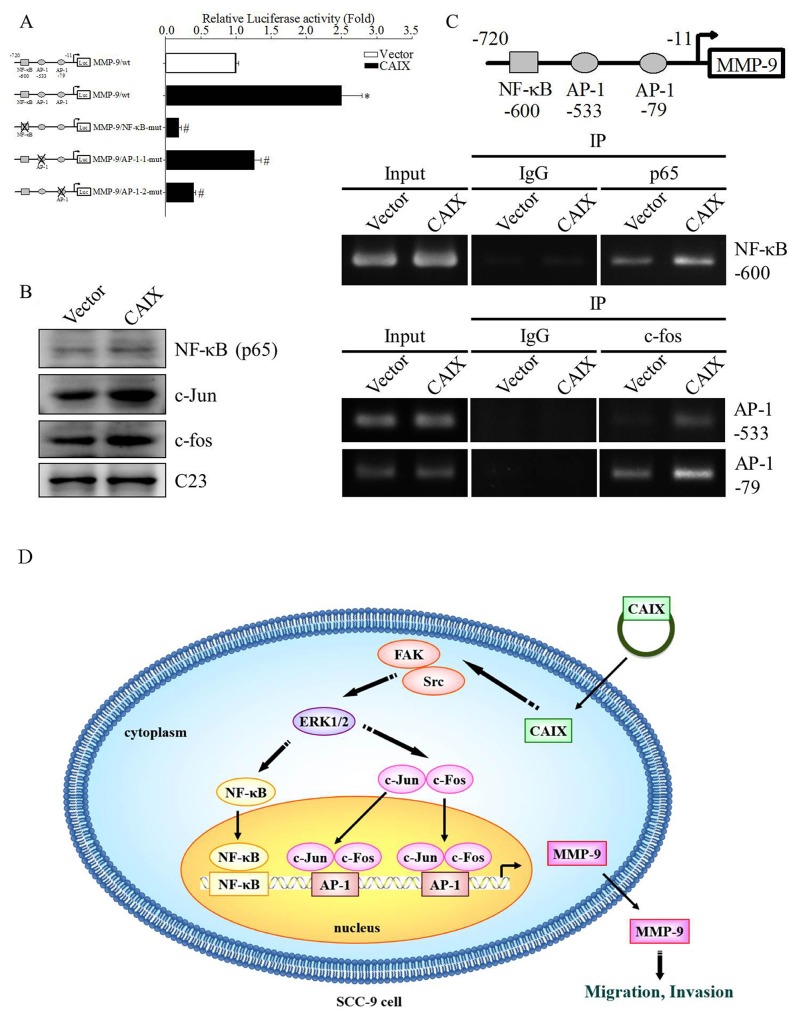
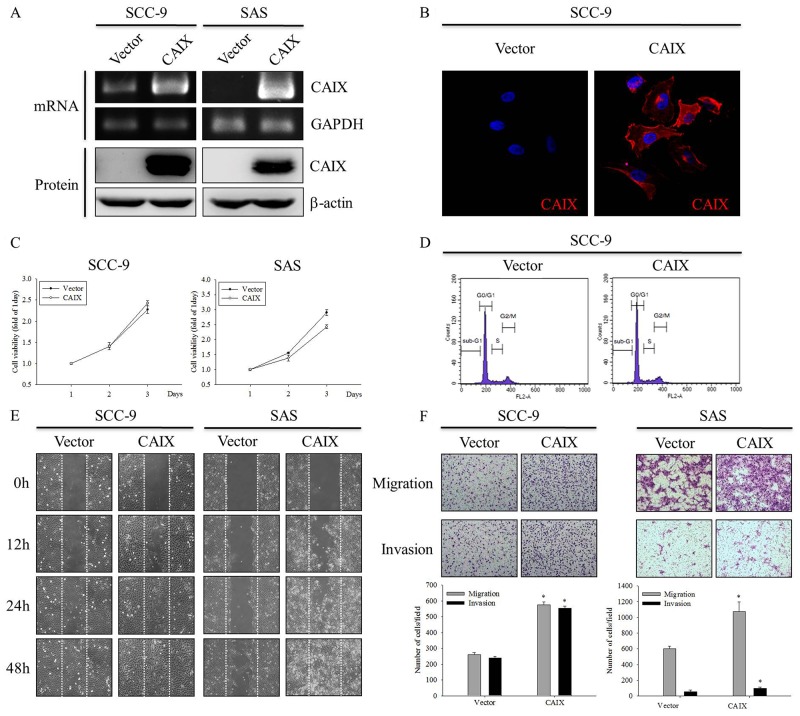
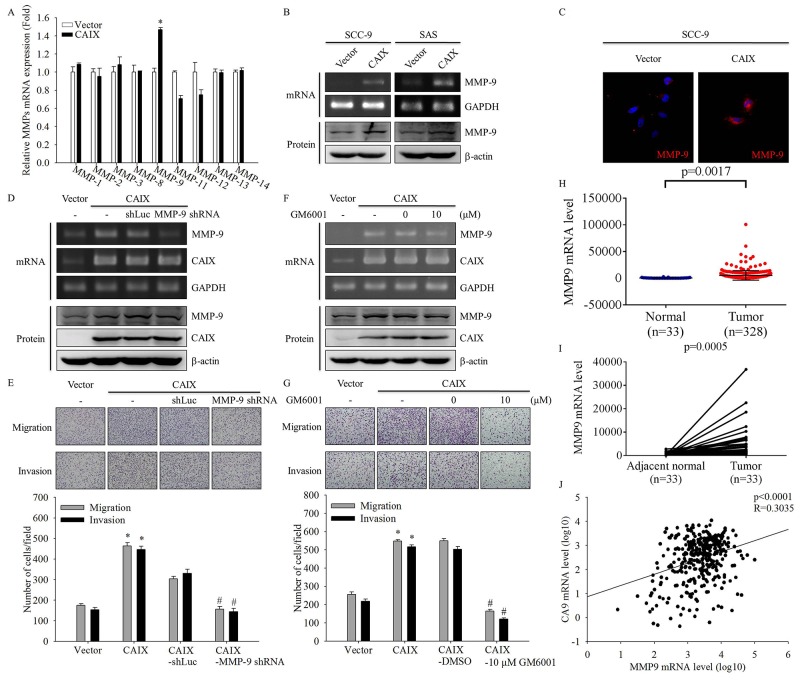
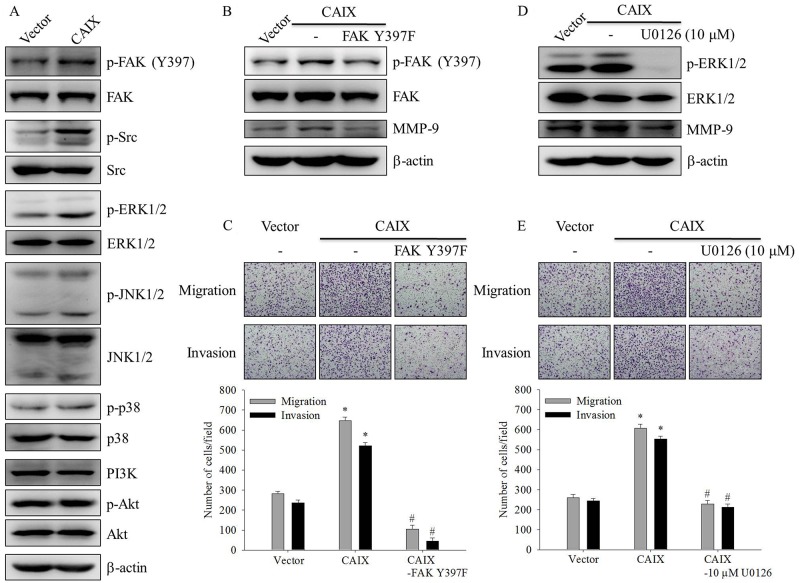
Oral cancer is a solid malignant tumor that is prone to occur following hypoxia. There are no clear studies showing a link between hypoxia and oral carcinogenesis. Carbonic anhydrase IX (CAIX), which is a hypoxia-induced transmembrane protein, is highly expressed in various types of human cancer. However, the effects of CAIX on the metastasis of human oral cancer cells and the underlying molecular mechanisms have not been clarified. In this study, we observed that CAIX overexpression increased the migratory and invasive abilities of SCC-9 and SAS cells. In addition, CAIX overexpression increased the mRNA and protein expression of matrix metalloproteinase-9 (MMP-9) and the phosphorylation of focal adhesion kinase (FAK), steroid receptor coactivator (Src), and extracellular signal-regulated kinase 1/2 signaling proteins. CAIX overexpression also increased the binding capacity of nuclear factor-κB (NF-κB), c-Jun, and c-Fos on the MMP-9 gene promoter. In addition, treatment with MMP-9 short hairpin RNA, an MMP inhibitor (GM6001), an FAK mutant, or an MEK inhibitor (U0126) inhibited CAIX-induced cell motility in SCC-9 cells. Moreover, data sets from The Cancer Genome Atlas demonstrated that CAIX expression was significantly associated with advanced progression and poor survival in oral cancer. In conclusion, it can be inferred that CAIX overexpression induces MMP-9 gene expression, which consequently induces the metastasis of oral cancer cells.
口腔癌是一种实体恶性肿瘤,在缺氧后容易发生。目前尚无明确研究表明缺氧与口腔癌发生之间存在联系。碳酸酐酶IX(CAIX)是一种缺氧诱导的跨膜蛋白,在多种人类癌症中高表达。然而,CAIX对人口腔癌细胞转移的影响及其潜在分子机制尚未阐明。在本研究中,我们观察到CAIX过表达增加了SCC-9和SAS细胞的迁移和侵袭能力。此外,CAIX过表达增加了基质金属蛋白酶-9(MMP-9)的mRNA和蛋白表达以及粘着斑激酶(FAK)、类固醇受体辅激活因子(Src)和细胞外信号调节激酶1/2信号蛋白的磷酸化。CAIX过表达还增加了核因子-κB(NF-κB)、c-Jun和c-Fos对MMP-9基因启动子的结合能力。此外,用MMP-9短发夹RNA、MMP抑制剂(GM6001)、FAK突变体或MEK抑制剂(U0126)处理可抑制CAIX诱导的SCC-9细胞的运动性。此外,来自癌症基因组图谱的数据集表明,CAIX表达与口腔癌的晚期进展和不良生存显著相关。总之,可以推断CAIX过表达诱导MMP-9基因表达,从而诱导口腔癌细胞转移。