Peng Ling, Wang Yina, Hong Yun, Ye Xianghua, Shi Peng, Zhang Junyan, Zhao Qiong
Department of Thoracic Oncology, The First Affiliated Hospital, School of Medicine, Zhejiang University, Hangzhou, Zhejiang Province, China.
Department of Pharmacy, The First Affiliated Hospital, School of Medicine, Zhejiang University, Hangzhou, Zhejiang Province, China.
Oncotarget. 2017 Sep 19;8(47):83280-83291. doi: 10.18632/oncotarget.21059. eCollection 2017 Oct 10.
BRAF inhibitor and dual BRAF/MEK inhibitors have been approved for the treatment of BRAF-mutated melanoma. Cutaneous squamous cell carcinoma (cuSCC) is an adverse event associated with these drugs. The contribution of BRAF inhibitor and dual BRAF/MEK inhibitors to cuSCC are still unknown. We performed this meta-analysis to determine the overall incidence and relative risk of cuSCC in cancer patients treated with these drugs.
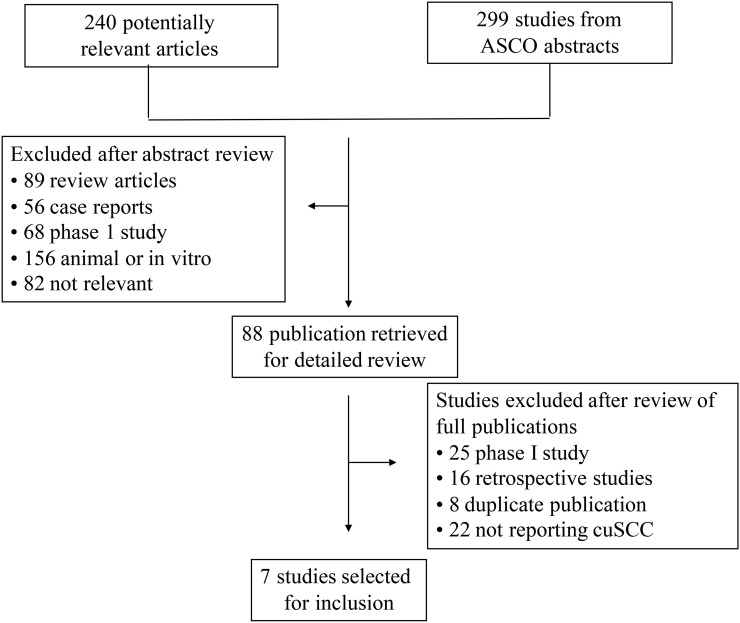
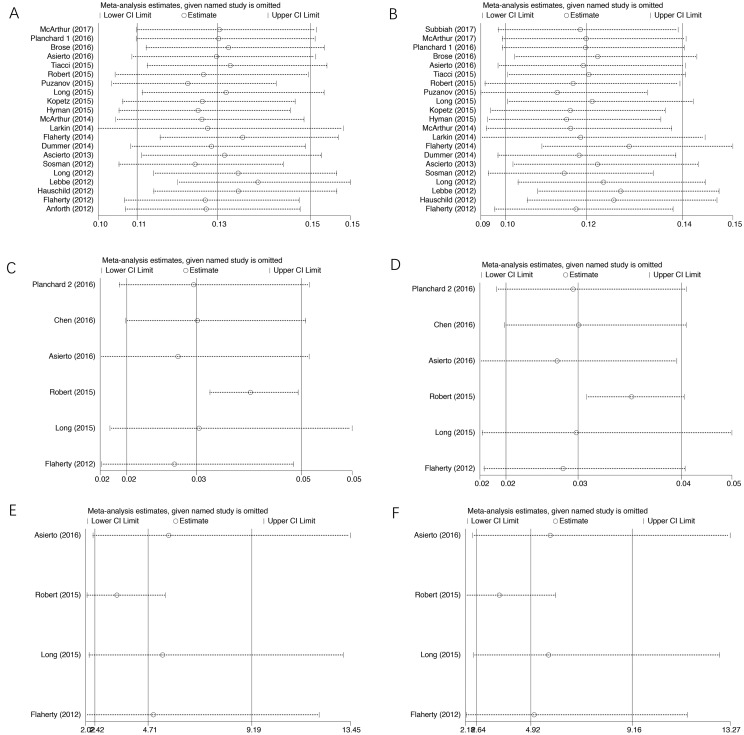
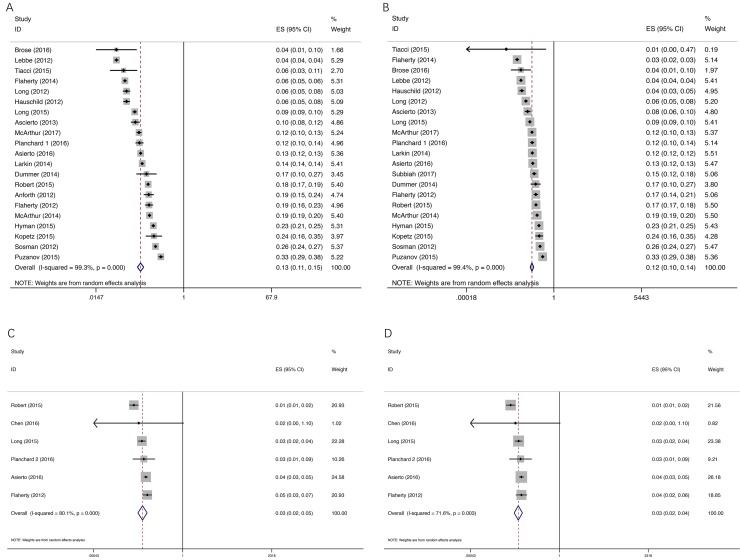
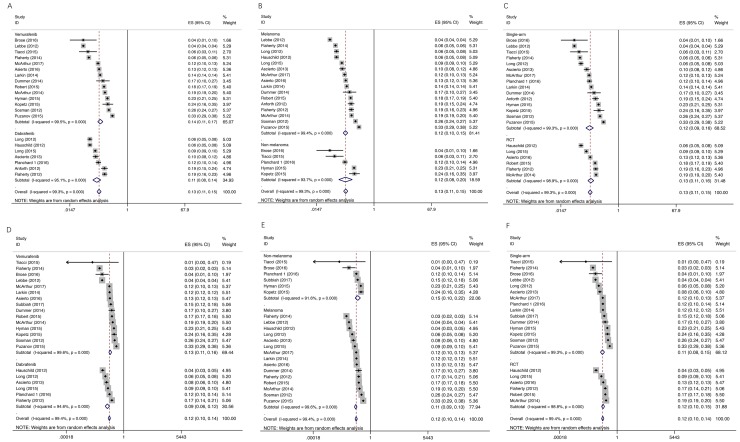
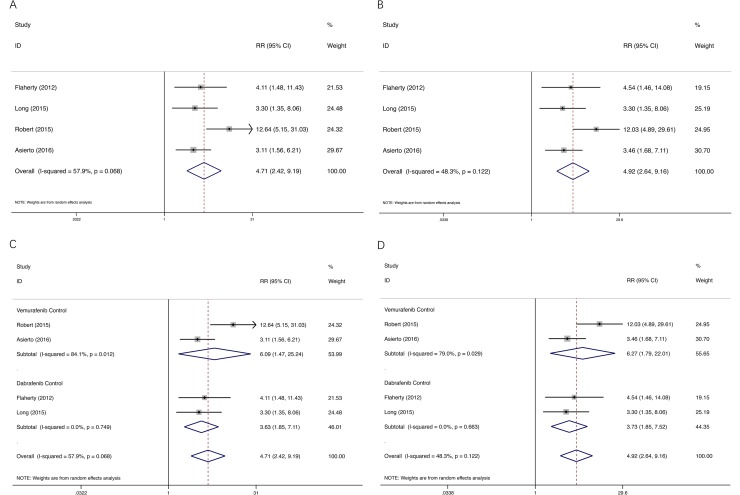
A total of 7,442 patients from 24 primary studies were included. The incidences of all-grade and high-grade cuSCC in cancer patients treated with BRAF inhibitor were 12.5% (95% CI: 10.8-14.6%) and 11.6% (95% CI: 9.8-13.8%), and dual BRAF/MEK inhibitors were 3.0% (95% CI: 2.0-4.5%) and 2.8% (95% CI: 1.9-4.0%), respectively. On subgroup analysis and meta-regression, the incidence of cuSCC did not vary with tumor type, study design and specific drug used. The use of single agent BRAF inhibitor significantly increased the risk of developing cuSCC comparing with dual BRAF/MEK inhibitors for all-grade (RR 4.72, 95% CI: 2.42-9.20) and high-grade (RR 4.92, 95% CI: 2.64-9.16) in cancer patients.
The databases of PubMed, Embase and abstracts published in ASCO proceedings were searched for relevant studies from January 2000 to June 2017. Summary incidences, relative risks (RRs) and 95% confidence intervals (CIs) were calculated by using either random effects or fixed effect models according to the heterogeneity of included studies.
BRAF inhibitor significantly increases the risk of developing cuSCC compared with dual BRAF/MEK inhibitors in cancer patients. Clinicians should be aware of the risks of cuSCC with the administration of these drugs in cancer patients.
BRAF抑制剂和BRAF/MEK双重抑制剂已被批准用于治疗BRAF突变的黑色素瘤。皮肤鳞状细胞癌(cuSCC)是与这些药物相关的不良事件。BRAF抑制剂和BRAF/MEK双重抑制剂对cuSCC的影响仍不清楚。我们进行了这项荟萃分析,以确定接受这些药物治疗的癌症患者中cuSCC的总体发生率和相对风险。
共纳入来自24项初步研究的7442例患者。接受BRAF抑制剂治疗的癌症患者中,所有级别和高级别cuSCC的发生率分别为12.5%(95%CI:10.8-14.6%)和11.6%(95%CI:9.8-13.8%),而接受BRAF/MEK双重抑制剂治疗的分别为3.0%(95%CI:2.0-4.5%)和2.8%(95%CI:1.9-4.0%)。在亚组分析和荟萃回归中,cuSCC的发生率在肿瘤类型、研究设计和使用的特定药物方面没有差异。与BRAF/MEK双重抑制剂相比,使用单一BRAF抑制剂显著增加了癌症患者发生所有级别(RR 4.72,95%CI:2.42-9.20)和高级别(RR 4.92,95%CI:2.64-9.16)cuSCC的风险。
检索了PubMed、Embase数据库以及发表于美国临床肿瘤学会(ASCO)会议论文集的摘要,以获取2000年1月至2017年6月的相关研究。根据纳入研究的异质性,使用随机效应或固定效应模型计算汇总发生率、相对风险(RRs)和95%置信区间(CIs)。
与BRAF/MEK双重抑制剂相比,BRAF抑制剂显著增加了癌症患者发生cuSCC的风险。临床医生在癌症患者使用这些药物时应注意cuSCC的风险。