Otsubo Takeshi, Yamada Kazuhiko, Hagiwara Teruki, Oshima Kenshiro, Iida Kei, Nishikata Koro, Toyoda Tetsuro, Igari Toru, Nohara Kyoko, Yamashita Satoshi, Hattori Masahira, Dohi Taeko, Kawamura Yuki I
Department of Gastroenterology, The Research Center for Hepatitis and Immunology, Research Institute, National Center for Global Health and Medicine, Chiba, Japan.
Department of Surgery, National Center for Global Health and Medicine, Tokyo, Japan.
Oncotarget. 2017 Sep 28;8(48):84434-84448. doi: 10.18632/oncotarget.21375. eCollection 2017 Oct 13.
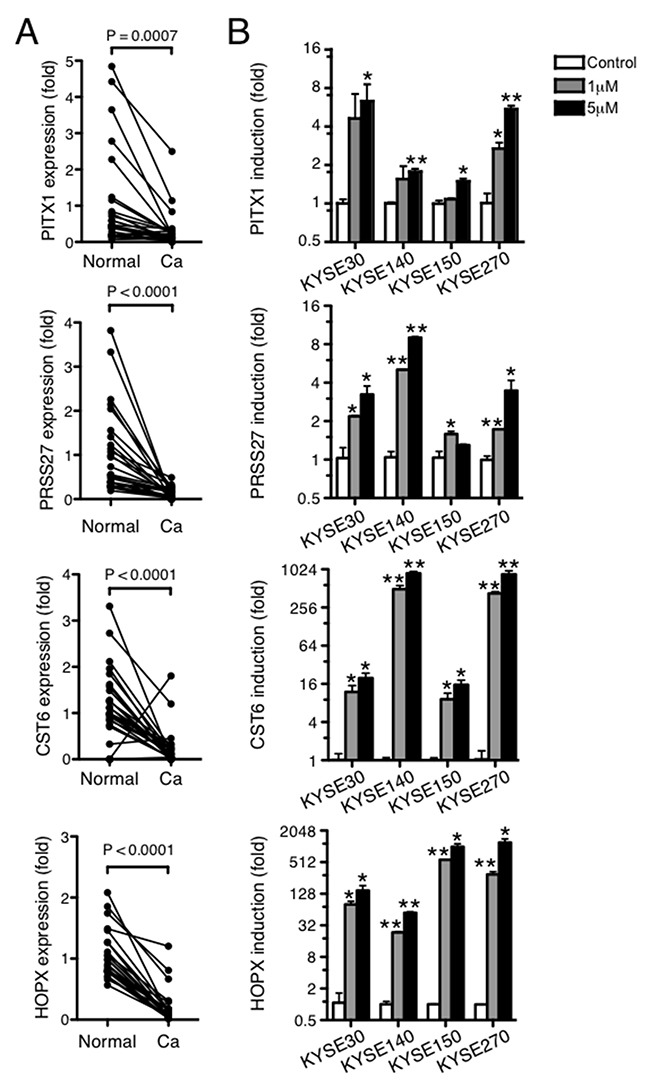
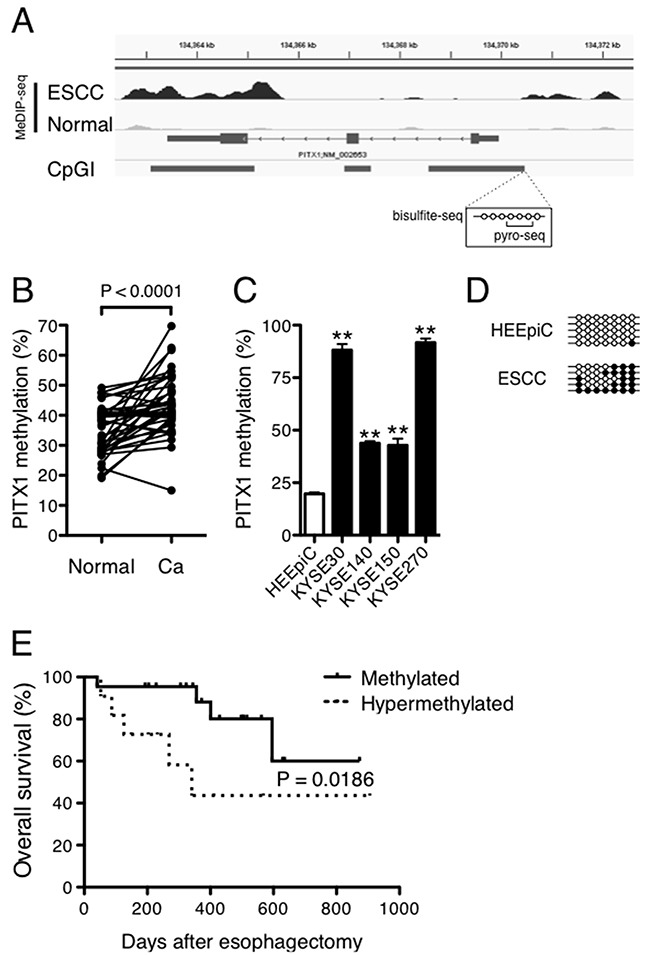
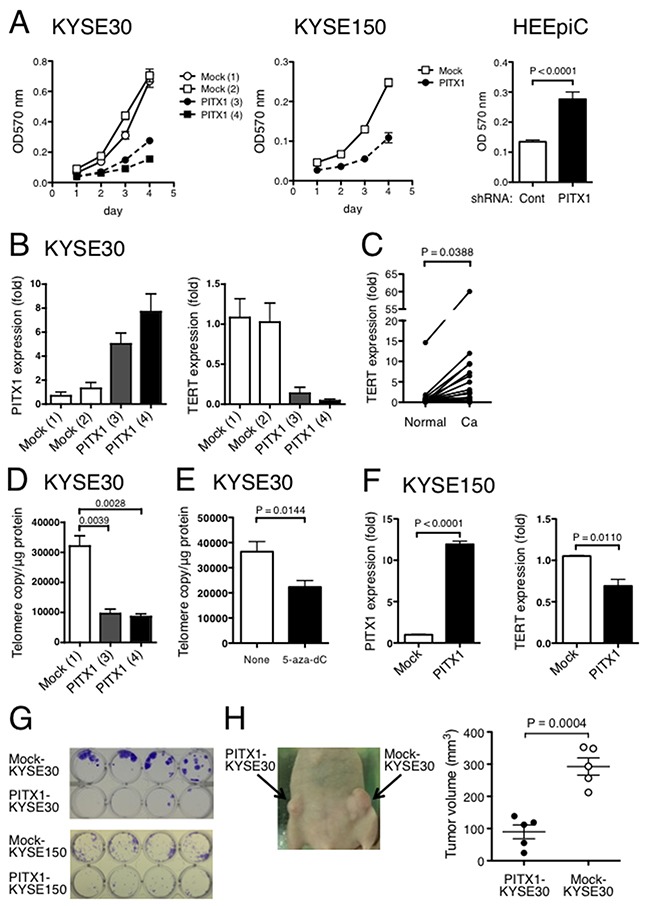
Esophageal squamous cell carcinoma (ESCC) is associated with the accumulation of genetic and epigenetic changes in the background mucosa. Dysregulated DNA methylation is known to lead to the inactivation of tumor suppressor genes and the activation of oncogenes. To identify the genes whose expression is perturbed by abnormal DNA methylation in ESCC, integrative transcriptomics by serial analysis of gene expression (SAGE) and methylome sequencing by methyl-DNA immunoprecipitation (MeDIP) analysis were performed. We found 159 genes with significantly decreased expression in ESCC compared to that in noncancerous esophageal mucosa. MeDIP-seq analysis identified hypermethylation in the promoter region of 56 of these genes. Using surgically resected tissues of 40 cases, we confirmed that the paired-like homeodomain 1 gene was hypermethylated in ESCC compared to that in normal tissues ( < 0.0001) by pyrosequencing. PITX1 overexpression in ESCC cell lines inhibited cell growth and colony formation, whereas PITX1 knockdown accelerated cell growth. A PITX1-transfected ESCC cell line, KYSE30, formed smaller tumors in nude mice than in mock-transfected cells. Hypermethylation of was associated with tumor depth ( = 0.0011) and advanced tumor stage ( = 0.0052) and predicted poor survival in ESCC (hazard ratio, 0.1538; 95% confidence interval, 0.03159-0.7488; = 0.0169). In this study, we found a novel tumor suppressor gene of ESCC, PITX1, which is silenced by DNA hypermethylation. Downregulation of PITX1 contributes to the growth and progression of ESCC. Hypermethylation of the in ESCC correlated with tumor progression and advanced stage cancer, and may predict a poor prognosis.
食管鳞状细胞癌(ESCC)与背景黏膜中遗传和表观遗传变化的积累有关。已知DNA甲基化失调会导致肿瘤抑制基因失活和癌基因激活。为了鉴定在ESCC中因异常DNA甲基化而表达受到干扰的基因,我们进行了基因表达系列分析(SAGE)的综合转录组学研究以及甲基化DNA免疫沉淀(MeDIP)分析的甲基化组测序。我们发现,与非癌性食管黏膜相比,ESCC中有159个基因的表达显著降低。MeDIP-seq分析确定其中56个基因的启动子区域存在高甲基化。利用40例手术切除组织,我们通过焦磷酸测序证实,与正常组织相比,ESCC中配对样同源结构域1基因存在高甲基化(<0.0001)。ESCC细胞系中PITX1过表达抑制细胞生长和集落形成,而PITX1敲低则加速细胞生长。转染PITX1的ESCC细胞系KYSE30在裸鼠中形成的肿瘤比 mock转染细胞形成的肿瘤小。PITX1的高甲基化与肿瘤深度(=0.0011)和肿瘤晚期(=0.0052)相关,并预测ESCC患者预后不良(风险比,0.1538;95%置信区间,0.03159 - 0.7488;=0.0169)。在本研究中,我们发现了一种新的ESCC肿瘤抑制基因PITX1,它因DNA高甲基化而沉默。PITX1的下调促进了ESCC的生长和进展。ESCC中PITX1的高甲基化与肿瘤进展和晚期癌症相关,可能预示预后不良。