Zhang Yan, Che Meng, Yuan Jing, Yu Yun, Cao Chang, Qin Xiao-Yan, Cheng Yong
Center on Translational Neuroscience, College of Life and Environmental Sciences, Minzu University of China, Beijing 100081, China.
Oncotarget. 2017 Sep 19;8(48):84489-84496. doi: 10.18632/oncotarget.21060. eCollection 2017 Oct 13.
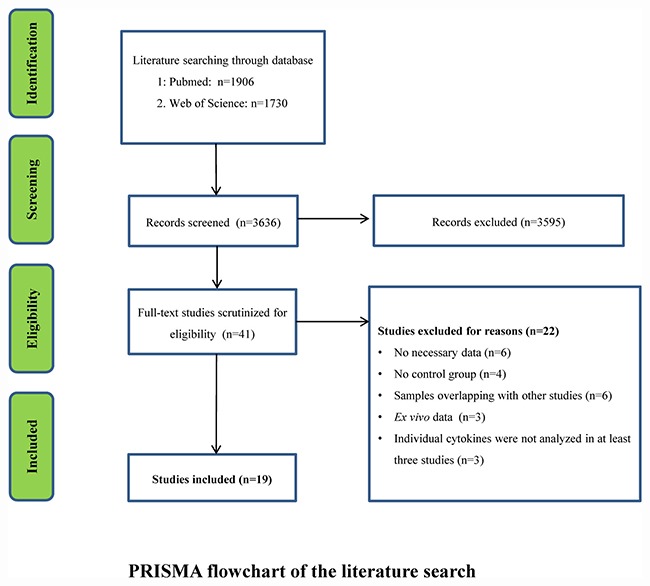
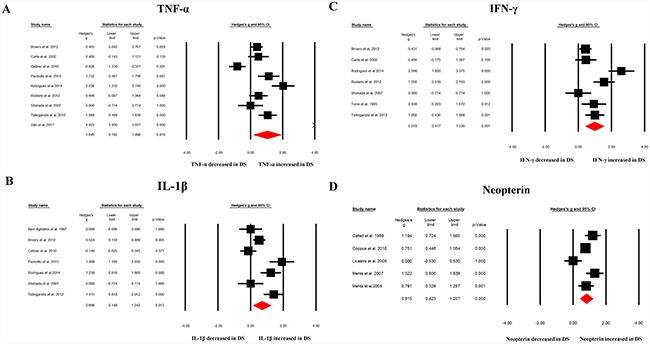
Evidence suggests that immune system alterations in Down syndrome (DS) may be early events that drive neuropathological and cognitive changes of Alzheimer's disease. The primary objective of this meta-analysis was to investigate whether there is an abnormal cytokine profile in DS patients when compared with healthy control (HC) subjects. A systematic search of Pubmed and Web of Science identified 19 studies with 957 DS patients and 541 HC subjects for this meta-analysis. Random effects meta-analysis demonstrated that patients with DS had significantly increased circulating tumor necrosis factor-α (Hedges' g = 1.045, 95% confidence interval (CI) = 0.192 to 1.898, = 0.016), interleukin (IL)-1β (Hedges' g = 0.696, 95% confidence CI = 0.149 to 1.242, = 0.013), interferon-γ (Hedges' g = 0.978, 95% CI = 0.417 to 1.539, = 0.001) and neopterin (Hedges' g = 0.815, 95% CI = 0.423 to 1.207, < 0.001) levels compared to HC subjects. No significant differences were found between patients with DS and controls for concentrations of IL-4, IL-6, IL8 and IL-10. In addition, most of the cytokine data in this meta-analysis were from children with DS and HC, and subgroup analysis showed that children with DS had elevated tumor necrosis factor-α, IL-1β and interferon-γ levels when compared with controls. Taken together, these results demonstrated that patients (children) with DS are accompanied by increased circulating cytokine tumor necrosis factor-α, IL-1β and interferon-γ levels, strengthening the clinical evidence that patients (children) with DS are accompanied by an abnormal inflammatory response.
有证据表明,唐氏综合征(DS)患者的免疫系统改变可能是引发阿尔茨海默病神经病理和认知变化的早期事件。本荟萃分析的主要目的是研究与健康对照(HC)受试者相比,DS患者是否存在异常的细胞因子谱。通过对PubMed和Web of Science进行系统检索,确定了19项研究,共纳入957例DS患者和541例HC受试者进行本荟萃分析。随机效应荟萃分析表明,与HC受试者相比,DS患者的循环肿瘤坏死因子-α水平显著升高(Hedges' g = 1.045,95%置信区间(CI)= 0.192至1.898,P = 0.016)、白细胞介素(IL)-1β水平显著升高(Hedges' g = 0.696,95%置信CI = 0.149至1.242,P = 0.013)、干扰素-γ水平显著升高(Hedges' g = 0.978,95% CI = 0.417至1.539,P = 0.001)以及蝶呤水平显著升高(Hedges' g = 0.815,95% CI = 0.423至1.207,P < 0.001)。DS患者与对照组在IL-4、IL-6、IL-8和IL-10浓度方面未发现显著差异。此外,本荟萃分析中的大多数细胞因子数据来自DS儿童和HC儿童,亚组分析显示,与对照组相比,DS儿童的肿瘤坏死因子-α、IL-1β和干扰素-γ水平升高。综上所述,这些结果表明,DS患者(儿童)的循环细胞因子肿瘤坏死因子-α、IL-1β和干扰素-γ水平升高,强化了DS患者(儿童)伴有异常炎症反应的临床证据。