Konno Tomoyuki, Aota Yoichi, Kuniya Hiroshi, Saito Tomoyuki, Qu Ning, Hayashi Shogo, Kawata Shinichi, Itoh Masahiro
Department of Orthopaedic Surgery, Yokohama City University Graduate School of Medicine.
Department of Spine & Spinal Cord Surgery, Yokohama Brain and Spine Center, Yokohama.
J Pain Res. 2017 Nov 1;10:2539-2545. doi: 10.2147/JPR.S142115. eCollection 2017.
The superior cluneal nerve (SCN) may become entrapped where it pierces the thoracolumbar fascia over the iliac crest; this can cause low back pain (LBP) and referred pain radiating into the posterior thigh, calf, and occasionally the foot, producing the condition known as "pseudo-sciatica." Because the SCN was thought to be a cutaneous branch of the lumbar dorsal rami, originating from the dorsal roots of L1-L3, previous anatomical studies failed to explain why SCN causes "pseudo-sciatica". The purpose of the present anatomical study was to better elucidate the anatomy and improve the understanding of "pseudo-sciatica" from SCN entrapment.
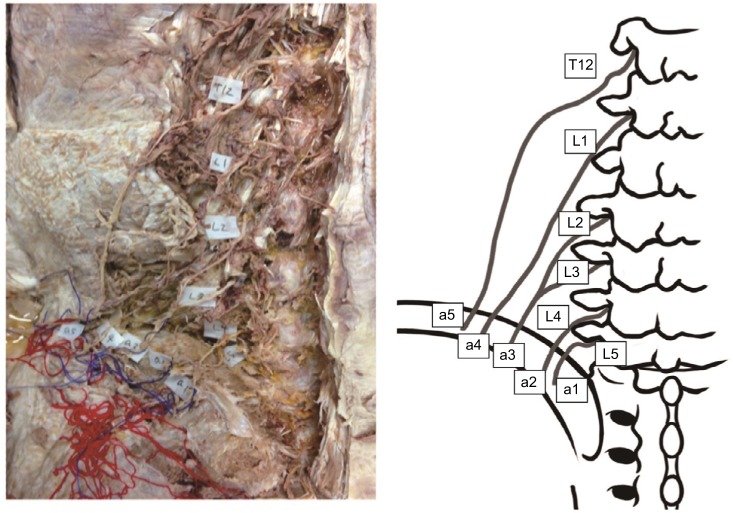
SCN branches were dissected from their origin to termination in subcutaneous tissue in 16 cadavers (5 male and 11 female) with a mean death age of 88 years (range 81-101 years). Special attention was paid to identify SCNs from their emergence from nerve roots and passage through the fascial attachment to the iliac crest.
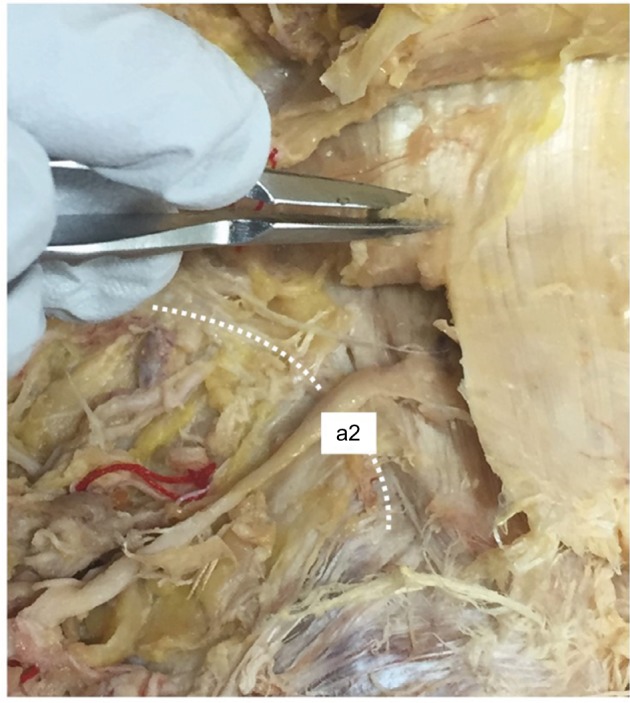
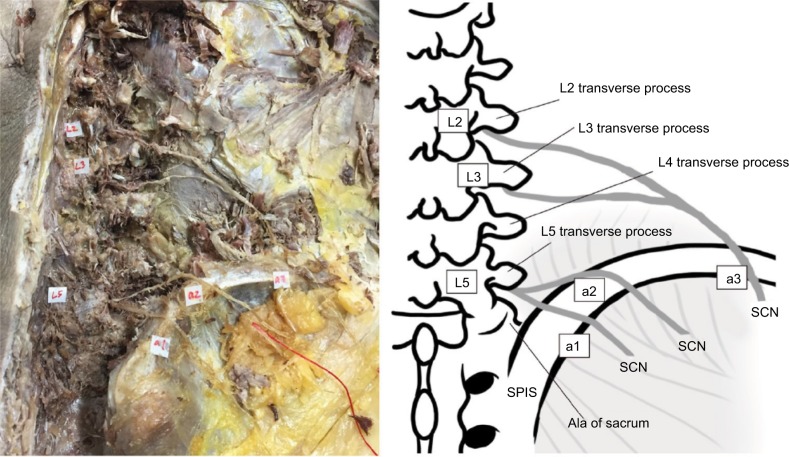
Eighty-one SCN branches were identified originating from T12 to L5 nerve roots with 13 branches passing through the osteofibrous tunnel. These 13 branches originated from L3 (two sides), L4 (six sides), and L5 (five sides). Ten of the 13 branches showed macroscopic entrapment in the tunnel.
The majority of SCNs at risk of nerve entrapment originated from the lower lumbar nerve. These anatomical results may explain why patients with SCN entrapment often evince leg pain or tingling that mimics sciatica.
臀上皮神经(SCN)在穿经髂嵴上方的胸腰筋膜处可能会受到卡压;这可导致下腰痛(LBP)以及放射至大腿后部、小腿,偶尔还会放射至足部的牵涉痛,从而产生“假性坐骨神经痛”这种病症。由于SCN被认为是腰背部皮支,起源于L1 - L3的背根,以往的解剖学研究未能解释为何SCN会导致“假性坐骨神经痛”。本解剖学研究的目的是更好地阐明其解剖结构,并增进对SCN卡压所致“假性坐骨神经痛”的理解。
在16具尸体(5男11女)上,从SCN分支的起始端至皮下组织内的终末端进行解剖,这些尸体的平均死亡年龄为88岁(范围81 - 101岁)。特别留意从神经根发出并穿经附着于髂嵴的筋膜处来识别SCN。
共识别出81条SCN分支,其起源于T12至L5神经根,其中13条分支穿经骨纤维隧道。这13条分支分别起源于L3(双侧)、L4(6侧)和L5(5侧)。13条分支中有10条在隧道内呈现出宏观上的卡压。
大多数有神经卡压风险的SCN起源于下腰神经。这些解剖学结果或许可以解释为何SCN卡压患者常常表现出类似坐骨神经痛的腿部疼痛或刺痛。