Tran John, Campisi Emma, Roa Agudelo Alexandria, Agur Anne Mr, Loh Eldon
Department of Physical Medicine and Rehabilitation, Parkwood Institute, London, Ontario, N6C 0A7, Canada.
Lawson Health Research Institute, London, Ontario, N6C 2R5, Canada.
Interv Pain Med. 2024 Mar 7;3(1):100401. doi: 10.1016/j.inpm.2024.100401. eCollection 2024 Mar.
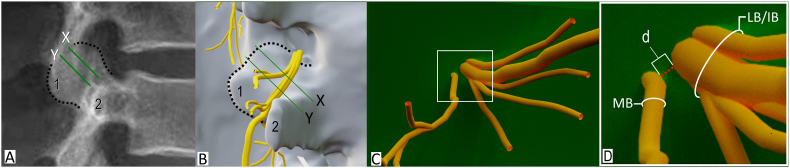
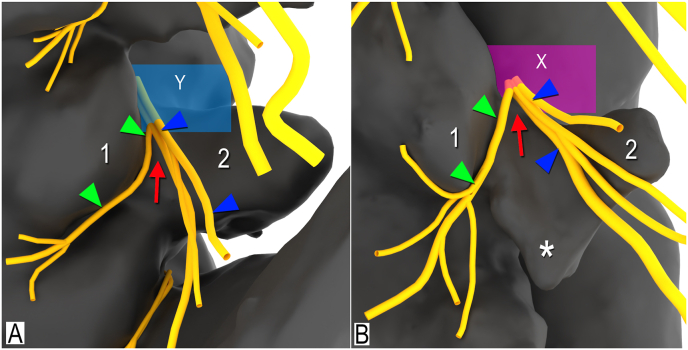
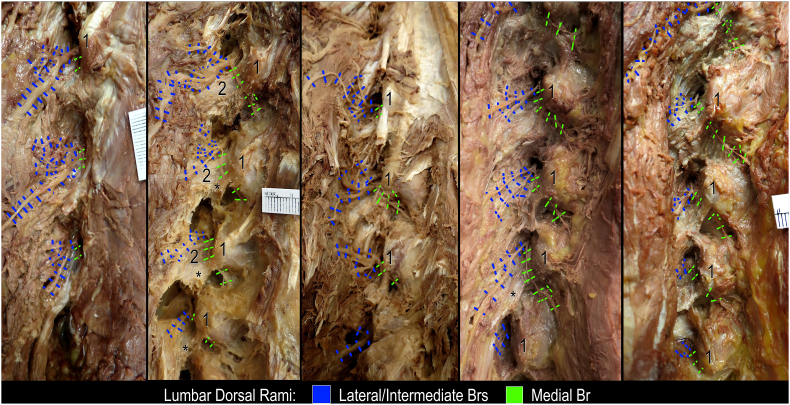
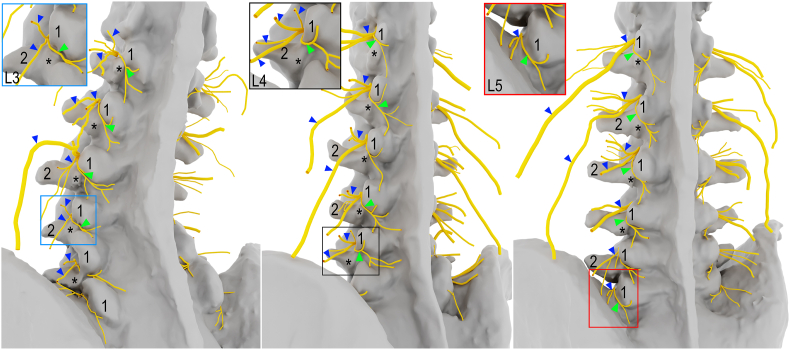
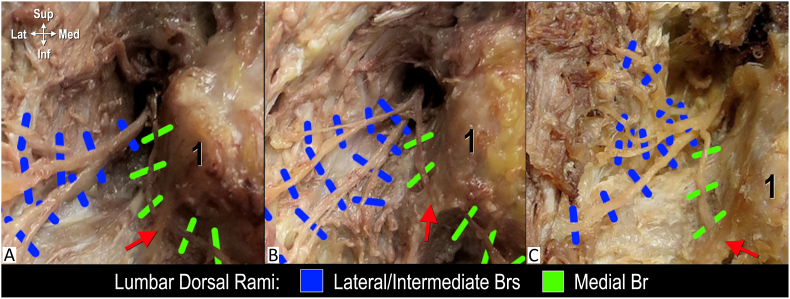
Lumbar medial branch denervation is commonly used to treat chronic facetogenic low back pain. Controversy exists regarding risk to adjacent neural structures. The objectives of this cadaveric study were to: (1) dissect, digitize, and model in 3D the branches of the first (L1) to fifth (L5) lumbar dorsal rami located near the junction of the transverse process and lateral neck of the superior articular process; and (2) quantify the minimal distance between the lateral/intermediate and medial branches at the anterior quarter and midpoint of the lateral neck of the superior articular process.
Eighteen formalin-embalmed specimens were dissected, digitized and modeled in 3D. The high-fidelity 3D models were used to compare branching patterns and quantify the mean minimal distance between the lateral/intermediate and medial branches of the lumbar dorsal ramus at the anterior quarter and midpoint of the lateral neck of the superior articular process. A Two-way ANOVA was performed to determine if difference of mean distances was significant.
There was variability in the branching pattern of the lumbar dorsal rami. In 46 cases (51.1%) the lumbar dorsal ramus divided into 2 branches, in 41 cases (45.6%) into 3, and in 3 cases (3.3%) 4. The mean minimal distance between the lateral/intermediate and medial branches was significantly greater at the midpoint (3.2 ± 2.5 mm) than the anterior quarter (1.2 ± 1.8 mm) of the lateral neck of superior articular process.
Minimal distance measurements between the branches of the lumbar dorsal rami at the anterior quarter and midpoint of the lateral neck of the superior articular process were computed. When placing the distal end of the needle tip at the anterior quarter of the lateral neck of the superior articular process, the smaller mean minimal distance between the branches suggests there is a greater risk for inadvertent denervation of the lateral/intermediate branches. Further anatomical and clinical investigations are required.
腰椎内侧支去神经术常用于治疗慢性小关节源性下腰痛。关于其对相邻神经结构的风险存在争议。本尸体研究的目的是:(1)对位于横突与上关节突外侧颈交界处附近的第一(L1)至第五(L5)腰背支进行解剖、数字化并建立三维模型;(2)量化上关节突外侧颈前四分之一处及中点处外侧/中间支与内侧支之间的最小距离。
对18个用福尔马林防腐的标本进行解剖、数字化并建立三维模型。使用高保真三维模型比较分支模式,并量化上关节突外侧颈前四分之一处及中点处腰背支外侧/中间支与内侧支之间的平均最小距离。进行双向方差分析以确定平均距离差异是否显著。
腰背支的分支模式存在变异性。在46例(51.1%)中,腰背支分为2支,41例(45.6%)分为3支,3例(3.3%)分为4支。上关节突外侧颈中点处外侧/中间支与内侧支之间的平均最小距离(3.2±2.5毫米)显著大于外侧颈前四分之一处(1.2±1.8毫米)。
计算了上关节突外侧颈前四分之一处及中点处腰背支各分支之间的最小距离。当将针尖远端置于上关节突外侧颈前四分之一处时,各分支之间较小的平均最小距离表明外侧/中间支意外去神经的风险更大。需要进一步的解剖学和临床研究。