School of Social Work, University of Alabama, Tuscaloosa, AL.
Social Work, College of Arts and Sciences, University of Alabama at Birmingham, Birmingham, AL.
J Acquir Immune Defic Syndr. 2018 Mar 1;77(3):257-263. doi: 10.1097/QAI.0000000000001590.
There are multiple dimensions of HIV-related stigma that can compromise the mental and physical health of people living with HIV. We focused on the dimension of experienced stigma, defined as exposure to acts of discrimination, devaluation, and prejudice, and investigated its relationship with HIV health and psychosocial outcomes.
We examined associations between experienced stigma in the community and health care settings and psychosocial and health outcomes for people living with HIV (N = 203) receiving care at an urban HIV clinic in the Southeastern United States. We also investigated whether those effects are unique to experienced stigma or are mediated by other dimensions of HIV-related stigma.
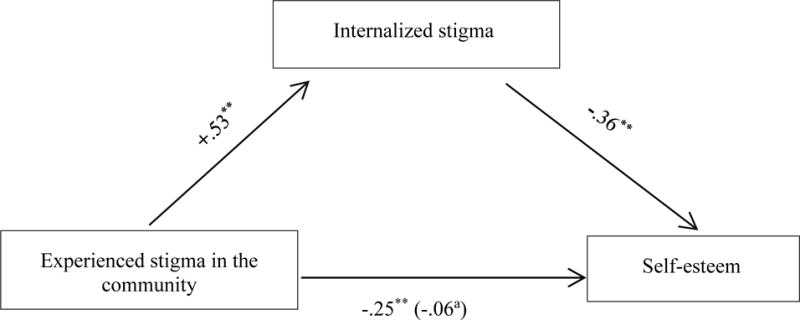
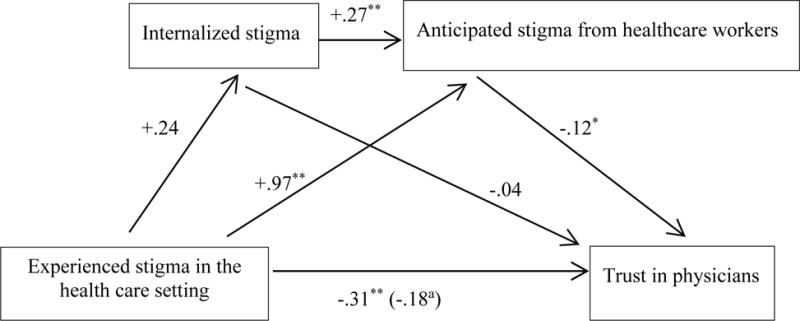
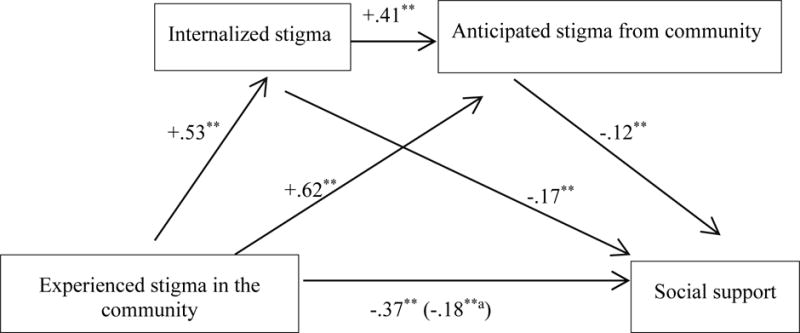
Experienced stigma was associated with suboptimal clinical outcomes such as viral nonsuppression, as well as poor affective, cognitive, and mental health outcomes (self-esteem, depressive symptoms, avoidance coping, and blame coping) and interpersonal outcomes such as social support and physician trust. Furthermore, serial mediation models suggested significant indirect effects of experienced stigma through internalized stigma and anticipated stigma from various theoretically expected sources of stigma (eg, community members, friends and family, and health care workers), with varying effects depending on the source.
These findings suggest nuanced mechanisms for the effects of experienced HIV-related stigma, especially in health care settings, and may be used to inform stigma-reduction interventions. Interventions designed to address experienced stigma in health care settings might be more tailored to specific outcomes, such as depression and physician trust, than interventions designed to address experienced stigma in the community.
艾滋病相关耻辱感有多个维度,可能会损害艾滋病毒感染者的身心健康。我们关注的是经历过的耻辱感维度,即经历歧视、贬低和偏见的行为,并调查其与艾滋病毒健康和心理社会结果的关系。
我们研究了美国东南部一家城市艾滋病毒诊所接受治疗的艾滋病毒感染者(N=203)在社区和医疗环境中经历的耻辱感与心理社会和健康结果之间的关联。我们还调查了这些影响是否仅与经历过的耻辱感有关,还是与艾滋病相关耻辱感的其他维度有关。
经历过的耻辱感与不理想的临床结果有关,如病毒未抑制,以及不良的情感、认知和心理健康结果(自尊、抑郁症状、回避应对和指责应对)和人际关系结果,如社会支持和医生信任。此外,序列中介模型表明,经历过的耻辱感通过内化的耻辱感和来自各种理论预期的耻辱感来源(如社区成员、朋友和家人以及医疗保健工作者)的预期耻辱感产生显著的间接影响,其影响因来源而异。
这些发现表明,经历过的艾滋病相关耻辱感的影响存在细微的机制,特别是在医疗环境中,这可能被用来为减少耻辱感的干预措施提供信息。在医疗环境中设计以解决经历过的耻辱感的干预措施可能比在社区中设计以解决经历过的耻辱感的干预措施更能针对特定的结果,如抑郁和医生信任。