Genievskaya Yuliya, Abugalieva Saule, Zhubanysheva Aibatsha, Turuspekov Yerlan
Institute of Plant Biology and Biotechnology, Almaty, Kazakhstan, 050040.
Aktobe breeding station, Aktobe region, Kazakhstan, 030014.
BMC Plant Biol. 2017 Nov 14;17(Suppl 1):177. doi: 10.1186/s12870-017-1132-1.
Sand rice (Agriophyllum squarrosum (L.) Moq.) is an annual shrub-like plant adapted to the mobile sand dunes in desert and semi-desert regions of Asia. It has a balanced nutrient composition with relatively high concentration of lipids and proteins, which results in its nutrition being similar to legumes. Sand rice's proteins contain the full range of essential amino acids. However, calories content is more similar to wheat. These features together with desert stress resistance make sand rice a potential food crop resilient to ongoing climate change. It is also an important fodder crop (on young stages of growth) for cattle in arid regions of Kazakhstan. In our work, sand rice samples were collected from two distant regions of Kazakhstan as a part of the nation-wide project to determine genetic variation of the native flora.
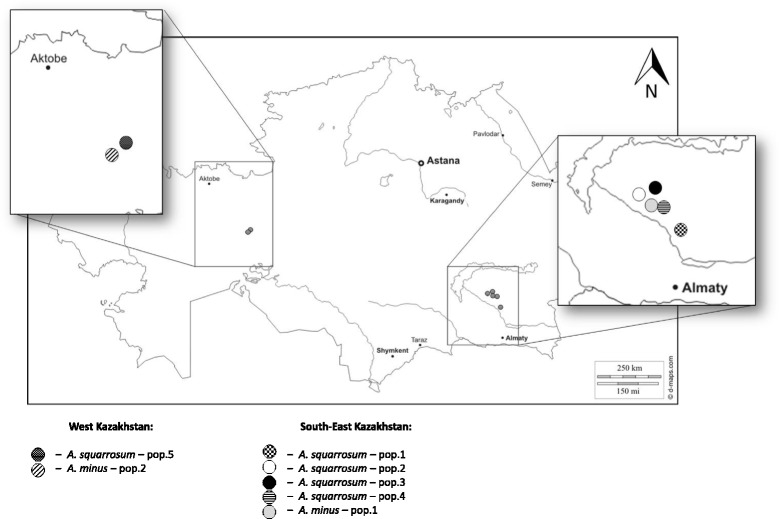
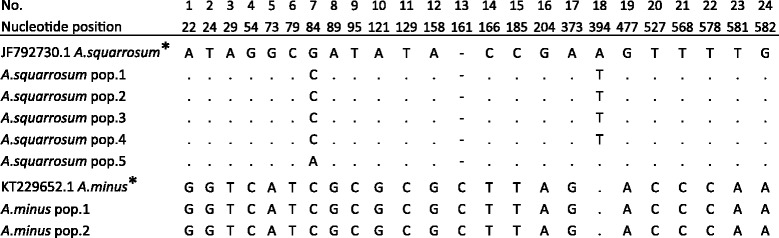
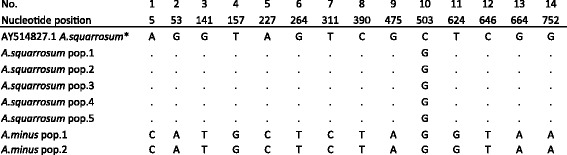
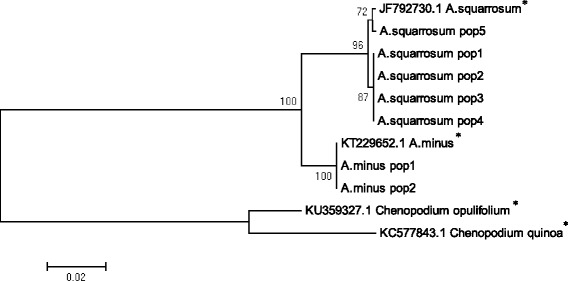
Samples were collected in western and southeastern parts of Kazakhstan separated by distances of up to 1300 km. Sequences of the nuclear ribosomal DNA ITS1-5.8S-ITS2 region and the chloroplast matK gene confirmed the identity of species defined by morphological traits. Comparison with GenBank sequences revealed polymorphic sequence positions among Kazakh populations and GenBank references, and suggested a distinction among local populations of sand rice. The phylogenetic analysis of nucleotide sequences showed a clear partition of A. squarrosum (L.) Moq. from Agriophyllum minus Fisch. & C.A. Mey, which grows in the same sand dunes environment.
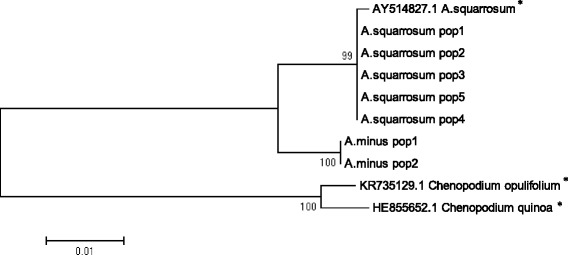
DNA barcoding analyses of ITS and matK sequences showed a segregation of A. squarrosum from A. minus into separate clades in Maximum-Likelhood dendrograms. ITS analysis can be successfully used to characterize A. squarrosum populations growing quite distant from each other. The data obtained in this work provide the basis for further investigations on A. squarrosum population structure and may play a role in the screening of sand rice plants growing in desert and semi-desert environments of Central Asia and China.
沙米(Agriophyllum squarrosum (L.) Moq.)是一种一年生灌木状植物,适应亚洲沙漠和半沙漠地区的流动沙丘。它营养成分均衡,脂质和蛋白质浓度相对较高,其营养与豆类相似。沙米的蛋白质含有全部必需氨基酸。然而,热量含量与小麦更相似。这些特性以及沙漠抗逆性使沙米成为一种潜在的粮食作物,能够适应持续的气候变化。它也是哈萨克斯坦干旱地区牛的重要饲料作物(在生长初期)。在我们的研究中,作为全国范围内确定本地植物群遗传变异项目的一部分,从哈萨克斯坦两个遥远地区采集了沙米样本。
样本采集于哈萨克斯坦的西部和东南部,两地相距达1300公里。核糖体DNA ITS1 - 5.8S - ITS2区域和叶绿体matK基因的序列证实了由形态特征定义的物种身份。与GenBank序列的比较揭示了哈萨克种群与GenBank参考序列之间的多态性序列位置,并表明沙米本地种群之间存在差异。核苷酸序列的系统发育分析表明,沙米(Agriophyllum squarrosum (L.) Moq.)与生长在相同沙丘环境中的小沙米(Agriophyllum minus Fisch. & C.A. Mey)明显分开。
ITS和matK序列的DNA条形码分析表明,在最大似然树状图中,沙米与小沙米被分隔到不同的分支中。ITS分析可成功用于表征彼此相距甚远的沙米种群。本研究获得的数据为进一步研究沙米种群结构提供了基础,并可能在筛选中亚和中国沙漠及半沙漠环境中生长的沙米植物方面发挥作用。