Bourguinat Catherine, Lefebvre Francois, Sandoval Johanna, Bondesen Brenda, Moreno Yovany, Prichard Roger K
Institute of Parasitology, McGill University, 21, 111 Lakeshore Road, Sainte Anne de Bellevue, QC, H9X3V9, Canada.
Canadian Centre for Computational Genomics, McGill University and Genome Quebec Innovation Centre, Montreal, QC, Canada.
Parasit Vectors. 2017 Nov 9;10(Suppl 2):494. doi: 10.1186/s13071-017-2437-5.
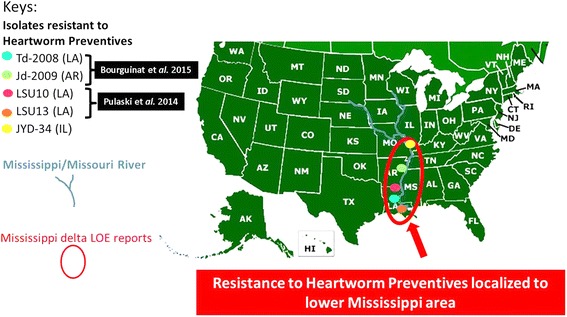
Macrocyclic lactone (ML) anthelmintics are used for chemoprophylaxis for heartworm infection in dogs and cats. Cases of dogs becoming infected with heartworms, despite apparent compliance to recommended chemoprophylaxis with approved preventives, has led to such cases being considered as suspected lack of efficacy (LOE). Recently, microfilariae collected from a small number of LOE isolates were used as a source of infection of new host dogs and confirmed to have reduced susceptibility to ML in controlled efficacy studies using L3 challenge in dogs. A specific Dirofilaria immitis laboratory isolate named JYD-34 has also been confirmed to have less than 100% susceptibility to ML-based preventives. For preventive claims against heartworm disease, evidence of 100% efficacy is required by FDA-CVM. It was therefore of interest to determine whether JYD-34 has a genetic profile similar to other documented LOE and confirmed reduced susceptibility isolates or has a genetic profile similar to known ML-susceptible isolates.
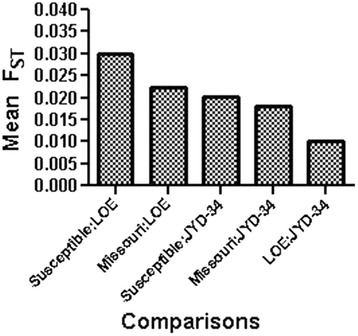
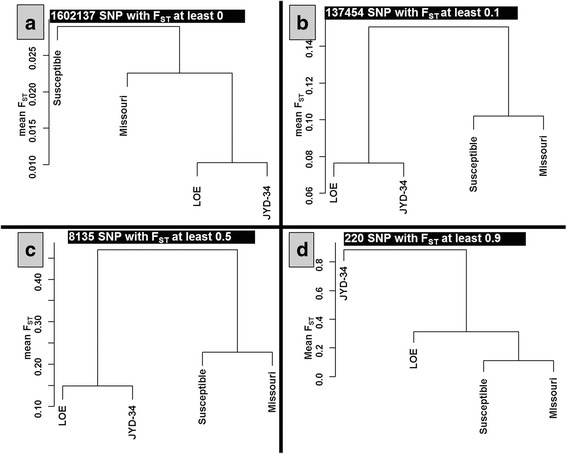
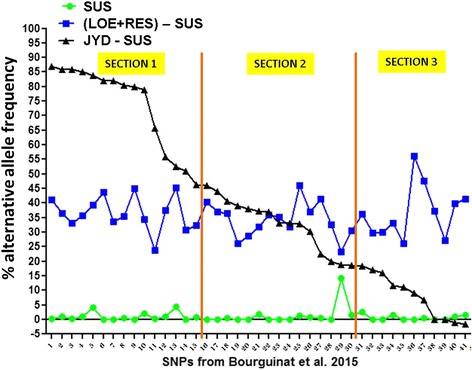
In this study, the 90Mbp whole genome of the JYD-34 strain was sequenced. This genome was compared using bioinformatics tools to pooled whole genomes of four well-characterized susceptible D. immitis populations, one susceptible Missouri laboratory isolate, as well as the pooled whole genomes of four LOE D. immitis populations. Fixation indexes (F), which allow the genetic structure of each population (isolate) to be compared at the level of single nucleotide polymorphisms (SNP) across the genome, have been calculated. Forty-one previously reported SNP, that appeared to differentiate between susceptible and LOE and confirmed reduced susceptibility isolates, were also investigated in the JYD-34 isolate.
The F analysis, and the analysis of the 41 SNP that appeared to differentiate reduced susceptibility from fully susceptible isolates, confirmed that the JYD-34 isolate has a genome similar to previously investigated LOE isolates, and isolates confirmed to have reduced susceptibility, and to be dissimilar to the susceptible isolates.
These results provide additional evidence for the link between genotype and the reduced susceptibility phenotype observed in such isolates as JYD-34. Further work on other isolates showing reduced susceptibility to ML is required to demonstrate the value of genetic analysis in predicting the response to ML chemoprophylaxis. The authors suggest that genetic analysis may be useful in helping to interpret the results of in vivo efficacy testing of ML heartworm preventives against D. immitis isolates.
大环内酯类驱虫药用于犬猫心丝虫感染的化学预防。尽管明显遵守了使用批准的预防药物进行推荐的化学预防措施,但仍有犬感染心丝虫的病例,这导致此类病例被视为疑似缺乏疗效(LOE)。最近,从少数LOE分离株中收集的微丝蚴被用作新宿主犬感染的来源,并在使用犬L3攻击的对照疗效研究中证实对大环内酯类药物的敏感性降低。一种名为JYD - 34的特定犬恶丝虫实验室分离株也已被证实在基于大环内酯类的预防药物方面敏感性低于100%。对于预防心丝虫病的声明,美国食品药品监督管理局兽药中心(FDA - CVM)要求有100%疗效的证据。因此,确定JYD - 34是否具有与其他已记录的LOE以及已证实敏感性降低的分离株相似的基因特征,或者是否具有与已知大环内酯类敏感分离株相似的基因特征,是很有意义的。
在本研究中,对JYD - 34菌株的90Mbp全基因组进行了测序。使用生物信息学工具将该基因组与四个特征明确的敏感犬恶丝虫群体的合并全基因组、一个敏感密苏里实验室分离株以及四个LOE犬恶丝虫群体的合并全基因组进行比较。计算了固定指数(F),它可以在全基因组的单核苷酸多态性(SNP)水平上比较每个群体(分离株)的遗传结构。还在JYD - 34分离株中研究了41个先前报道的SNP,这些SNP似乎可以区分敏感和LOE以及已证实敏感性降低的分离株。
F分析以及对41个似乎能区分敏感性降低和完全敏感分离株的SNP的分析证实,JYD - 34分离株的基因组与先前研究的LOE分离株以及已证实敏感性降低的分离株相似,与敏感分离株不同。
这些结果为基因型与在JYD - 34等分离株中观察到的敏感性降低表型之间的联系提供了额外证据。需要对其他对大环内酯类药物敏感性降低的分离株进行进一步研究,以证明遗传分析在预测对大环内酯类化学预防反应方面的价值。作者建议遗传分析可能有助于解释大环内酯类心丝虫预防药对犬恶丝虫分离株的体内疗效测试结果。