Lange Berit, Cohn Jennifer, Roberts Teri, Camp Johannes, Chauffour Jeanne, Gummadi Nina, Ishizaki Azumi, Nagarathnam Anupriya, Tuaillon Edouard, van de Perre Philippe, Pichler Christine, Easterbrook Philippa, Denkinger Claudia M
Division of Infectious Diseases, Department of Medicine II, Medical Center - University of Freiburg, Faculty of Medicine, University of Freiburg, Germany, Freiburg, Germany.
Centre for Chronic Immunodeficiency, Medical Center - University of Freiburg, Faculty of Medicine, University of Freiburg, Germany, Freiburg, Germany.
BMC Infect Dis. 2017 Nov 1;17(Suppl 1):700. doi: 10.1186/s12879-017-2777-y.
Dried blood spots (DBS) are a convenient tool to enable diagnostic testing for viral diseases due to transport, handling and logistical advantages over conventional venous blood sampling. A better understanding of the performance of serological testing for hepatitis C (HCV) and hepatitis B virus (HBV) from DBS is important to enable more widespread use of this sampling approach in resource limited settings, and to inform the 2017 World Health Organization (WHO) guidance on testing for HBV/HCV.
We conducted two systematic reviews and meta-analyses on the diagnostic accuracy of HCV antibody (HCV-Ab) and HBV surface antigen (HBsAg) from DBS samples compared to venous blood samples. MEDLINE, EMBASE, Global Health and Cochrane library were searched for studies that assessed diagnostic accuracy with DBS and agreement between DBS and venous sampling. Heterogeneity of results was assessed and where possible a pooled analysis of sensitivity and specificity was performed using a bivariate analysis with maximum likelihood estimate and 95% confidence intervals (95%CI). We conducted a narrative review on the impact of varying storage conditions or limits of detection in subsets of samples. The QUADAS-2 tool was used to assess risk of bias.
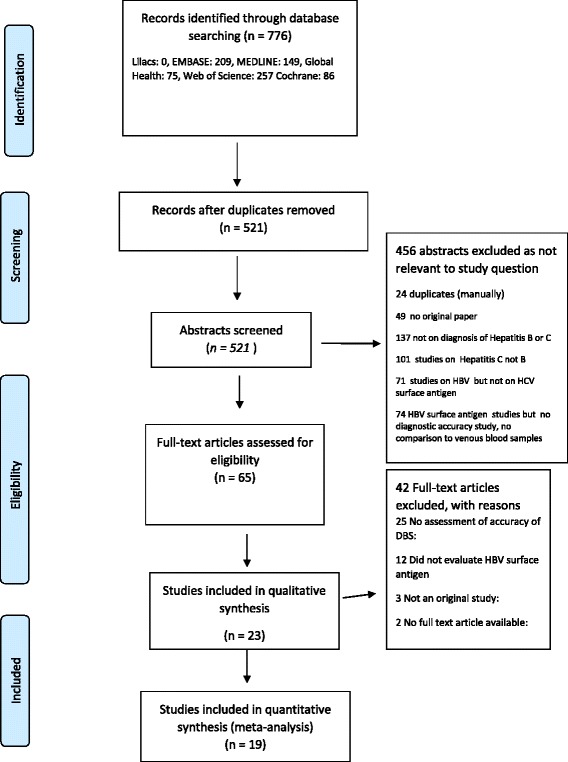
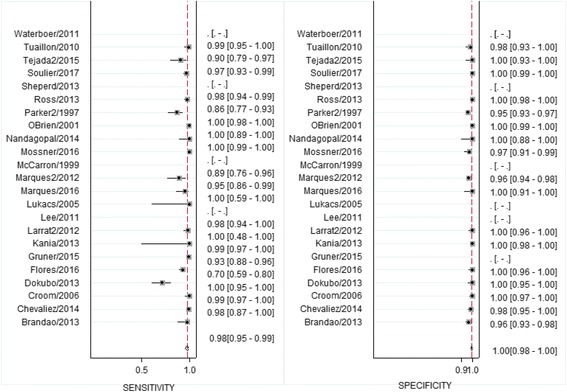
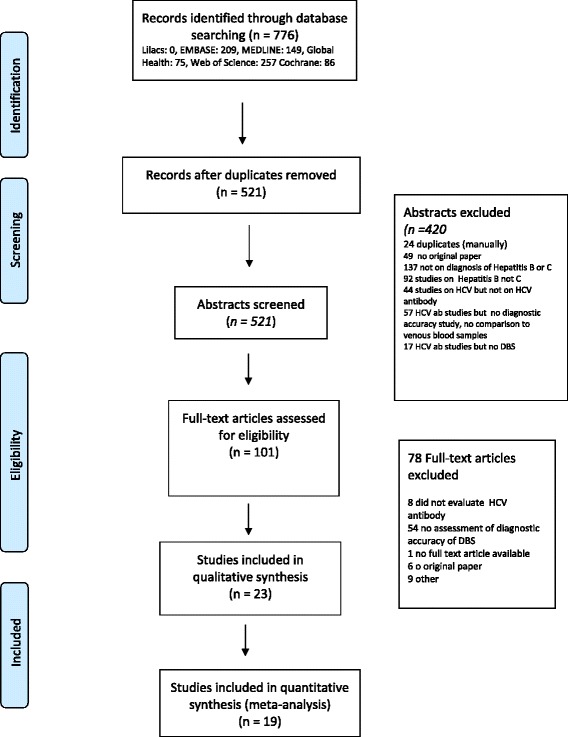
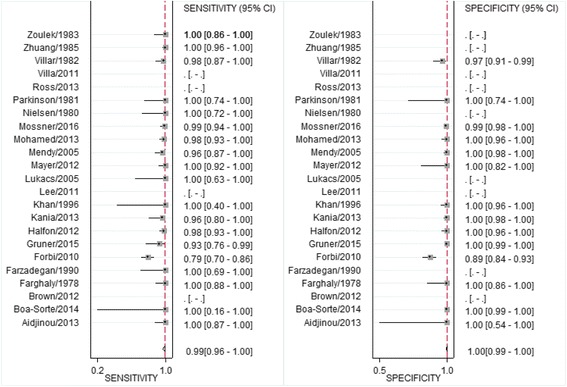
For the diagnostic accuracy of HBsAg from DBS compared to venous blood, 19 studies were included in a quantitative meta-analysis, and 23 in a narrative review. Pooled sensitivity and specificity were 98% (95%CI:95%-99%) and 100% (95%CI:99-100%), respectively. For the diagnostic accuracy of HCV-Ab from DBS, 19 studies were included in a pooled quantitative meta-analysis, and 23 studies were included in a narrative review. Pooled estimates of sensitivity and specificity were 98% (CI95%:95-99) and 99% (CI95%:98-100), respectively. Overall quality of studies and heterogeneity were rated as moderate in both systematic reviews.
HCV-Ab and HBsAg testing using DBS compared to venous blood sampling was associated with excellent diagnostic accuracy. However, generalizability is limited as no uniform protocol was applied and most studies did not use fresh samples. Future studies on diagnostic accuracy should include an assessment of impact of environmental conditions common in low resource field settings. Manufacturers also need to formally validate their assays for DBS for use with their commercial assays.
干血斑(DBS)是一种便捷工具,相较于传统静脉采血,它在运输、处理和后勤方面具有优势,可用于病毒性疾病的诊断检测。更好地了解DBS用于丙型肝炎(HCV)和乙型肝炎病毒(HBV)血清学检测的性能,对于在资源有限的环境中更广泛地使用这种采样方法以及为2017年世界卫生组织(WHO)关于HBV/HCV检测的指南提供参考至关重要。
我们对DBS样本与静脉血样本相比的HCV抗体(HCV-Ab)和HBV表面抗原(HBsAg)的诊断准确性进行了两项系统评价和荟萃分析。检索MEDLINE、EMBASE、全球卫生和Cochrane图书馆,查找评估DBS诊断准确性以及DBS与静脉采样一致性的研究。评估结果的异质性,并在可能的情况下,使用最大似然估计和95%置信区间(95%CI)的双变量分析对敏感性和特异性进行汇总分析。我们对不同储存条件或样本子集中检测限的影响进行了叙述性综述。使用QUADAS-2工具评估偏倚风险。
对于DBS与静脉血相比的HBsAg诊断准确性,19项研究纳入定量荟萃分析,23项纳入叙述性综述。汇总敏感性和特异性分别为98%(95%CI:95%-99%)和100%(95%CI:99-100%)。对于DBS的HCV-Ab诊断准确性,19项研究纳入汇总定量荟萃分析,23项研究纳入叙述性综述。敏感性和特异性的汇总估计分别为98%(CI95%:95-99)和99%(CI95%:98-100)。两项系统评价中研究的总体质量和异质性均被评为中等。
与静脉采血相比,使用DBS进行HCV-Ab和HBsAg检测具有出色的诊断准确性。然而,由于未应用统一方案且大多数研究未使用新鲜样本,其普遍性有限。未来关于诊断准确性的研究应包括评估低资源现场环境中常见环境条件的影响。制造商还需要正式验证其用于DBS的检测方法与商业检测方法的兼容性。