Knafl Daniela, Müller Markus, Pajenda Sahra, Genc Zeynep, Hecking Manfred, Wagner Ludwig
Department of Internal Medicine I, Division of Infectious Diseases and Tropical Medicine, Medical University of Vienna, Vienna, Austria.
Department of Internal Medicine II, Division of Angiology, Medical University of Vienna, Vienna, Austria.
PLoS One. 2017 Nov 16;12(11):e0188316. doi: 10.1371/journal.pone.0188316. eCollection 2017.
Acute kidney injury (AKI) is frequently observed in serious infections, following nephrotoxic medication, surgery and trauma. Here we tested whether the detection of two recently identified biomarkers for AKI, Tissue Inhibitor of Metalloproteinase-2 (TIMP-2) and Insulin-Like Growth Factor Binding Protein 7 (IGFBP7), depends on the expression of these proteins in cells of the urinary sediment.
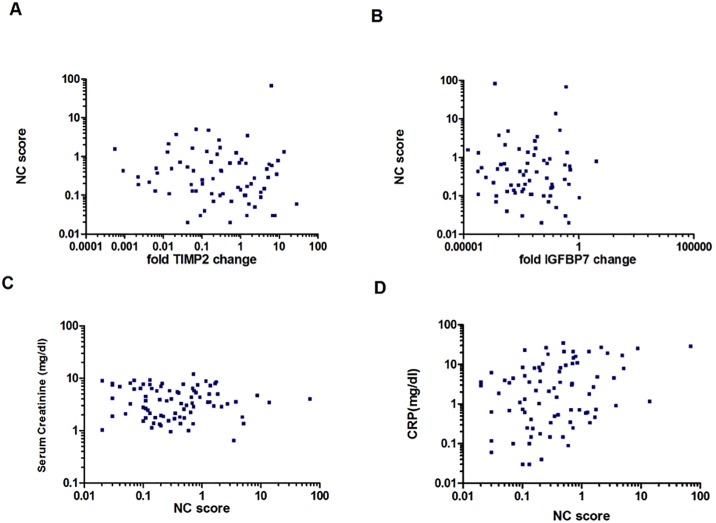
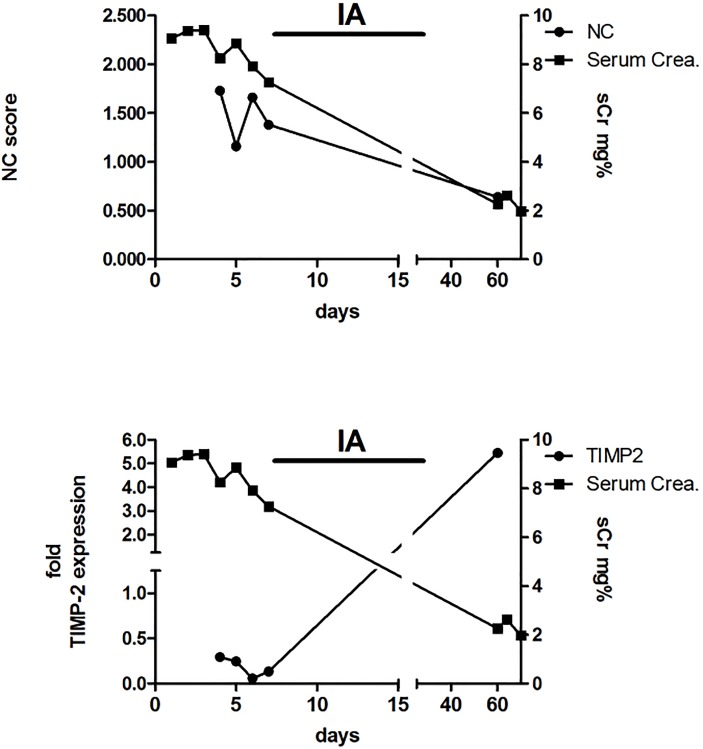
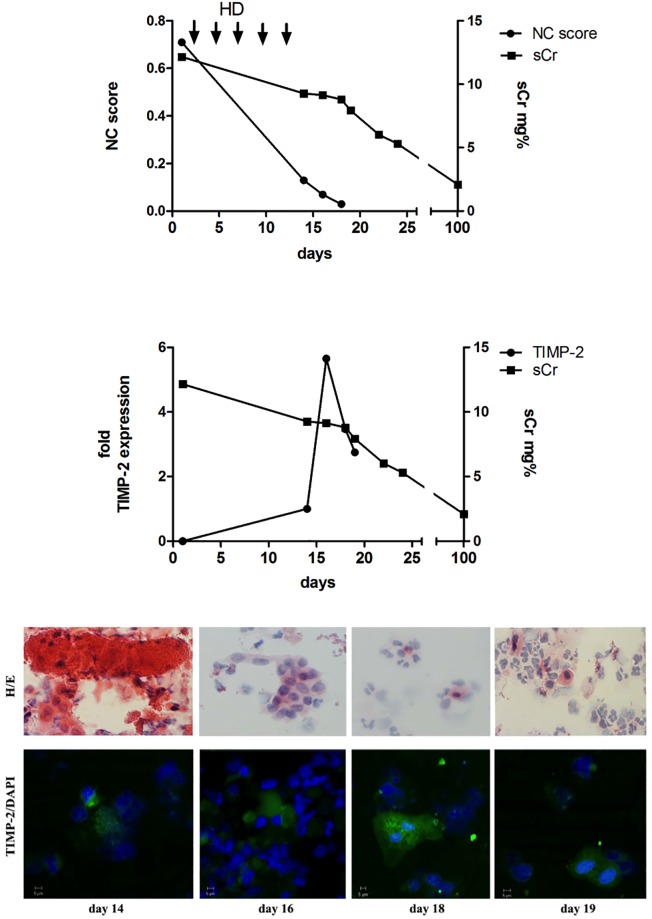
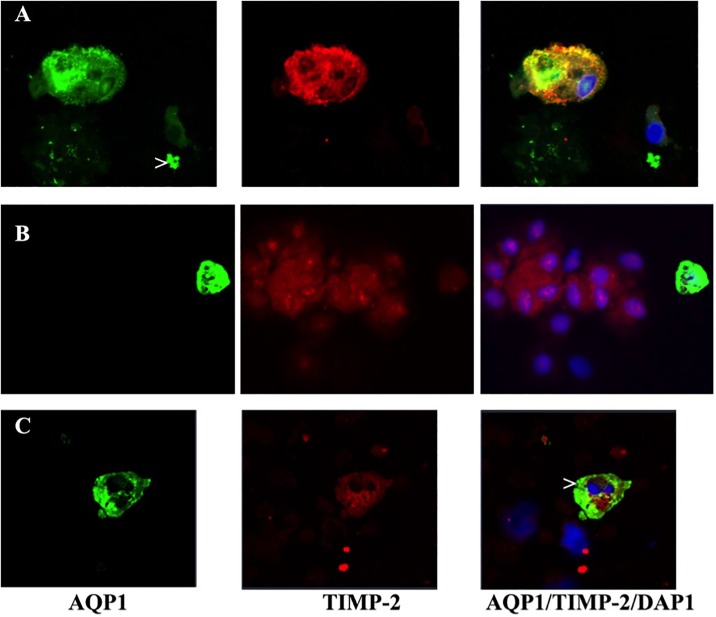
We collected urine samples of 33 kidney transplant recipients and 14 non-transplanted patients who all had AKI (stages 1-3 according to KDIGO), and measured [IGFBP7]x[TIMP-2] using the NephroCheck® Astute1 40 ™ meter. Concomitantly, we analyzed IGFBP7 and TIMP-2 mRNA expression by quantitative polymerase chain reaction (qPCR) from urinary sediment of the same patients, and correlated the results with [IGFBP7]x[TIMP-2] (protein), by linear regression analysis. We also determined the association between [IGFBP7]x[TIMP-2] and estimated glomerular filtration rate (eGFR), and between IGFBP7 and TIMP-2 mRNA expression and markers of inflammation. Light microscopy and confocal immunofluorescence served to illustrate changes in the urinary sediment over the time course of renal function improvement.
Of the 47 analyzed AKI patients, 14 presented with ascending urinary tract infection. Serum creatinine (sCr), blood urea nitrogen (BUN) and eGFR in all patients were 3.9±2.28 mg/dL, 47.59±23.1 mg/dL and 22.88±16.0 mL/min/1.73m2, respectively, on average ±standard deviation. [IGFBP7]x[TIMP-2] was 2.33±9.95 (ng/ml)2/1000, and did not associate with IGFBP7 and TIMP-2 gene expression (r = -0.0220, p = 0.4216; respectively r = 0.0972, p = 0.1909). [IGFBP7]x[TIMP-2] did not associate with eGFR; IGFBP7 and TIMP-2 mRNA expression. Improvement of renal function went along with disappearance of casts, decrease in aquaporin1 positive renal epithelial cells and leukocytes from the urinary sediment.
The gene expression pattern of IGFBP7 and TIMP-2 from urinary sediment, which contains desquamated renal tubular epithelial cells, did not correlate with [IGFBP7]x[TIMP-2] protein, indicating that IGFBP7 and TIMP-2 measured in the NephroCheck® test originated predominantly from intact but stressed cells of the kidney itself.
急性肾损伤(AKI)常见于严重感染、肾毒性药物使用后、手术及创伤后。在此,我们测试了两种最近鉴定出的AKI生物标志物——金属蛋白酶组织抑制剂-2(TIMP-2)和胰岛素样生长因子结合蛋白7(IGFBP7)的检测是否取决于这些蛋白在尿沉渣细胞中的表达。
我们收集了33例肾移植受者和14例非移植患者的尿液样本,这些患者均患有AKI(根据KDIGO标准为1-3期),并使用NephroCheck® Astute1 40 ™ 检测仪测量[IGFBP7]×[TIMP-2]。同时,我们通过定量聚合酶链反应(qPCR)分析了同一患者尿沉渣中IGFBP7和TIMP-2 mRNA的表达,并通过线性回归分析将结果与[IGFBP7]×[TIMP-2](蛋白)进行关联。我们还确定了[IGFBP7]×[TIMP-2]与估计肾小球滤过率(eGFR)之间的关联,以及IGFBP7和TIMP-2 mRNA表达与炎症标志物之间的关联。光学显微镜和共聚焦免疫荧光用于阐明肾功能改善过程中尿沉渣的变化。
在47例分析的AKI患者中,14例出现上尿路感染。所有患者的血清肌酐(sCr)、血尿素氮(BUN)和eGFR平均±标准差分别为3.9±2.28 mg/dL、47.59±23.1 mg/dL和22.88±16.0 mL/min/1.73m²。[IGFBP7]×[TIMP-2]为2.33±9.95(ng/ml)²/1000,与IGFBP7和TIMP-2基因表达无关联(r = -0.0220,p = 0.4216;分别为r = 0.0972,p = 0.1909)。[IGFBP7]×[TIMP-2]与eGFR、IGFBP7和TIMP-2 mRNA表达均无关联。肾功能的改善伴随着管型的消失、水通道蛋白1阳性肾上皮细胞及尿沉渣中白细胞的减少。
尿沉渣中含有脱落肾小管上皮细胞,其IGFBP7和TIMP-2的基因表达模式与[IGFBP7]×[TIMP-2]蛋白无相关性,这表明NephroCheck®检测中测得的IGFBP7和TIMP-2主要来源于肾脏自身完整但处于应激状态的细胞。