Fathi Hosnieh, Clark Andrew, Hill Nathan R, Dusheiko Geoffrey
Almirall Ltd, London, UB11 1BT, UK.
Bristol-Myers Squibb Pharmaceuticals Ltd, London, UB8 1DH, UK.
BMC Infect Dis. 2017 Nov 16;17(1):722. doi: 10.1186/s12879-017-2820-z.
Six distinct genetic variants (genotypes 1 - 6) of hepatitis C virus (HCV) exist globally. Certain genotypes are more prevalent in particular countries or regions than in others but, globally, genotype 3 (GT3) is the second most common. Patients infected with HCV GT1, 2, 4, 5 or 6 recover to a greater extent, as measured by sustained virological response (SVR), following treatment with regimens based on direct-acting antivirals (DAAs) than after treatment with older regimens based on pegylated interferon (Peg-IFN). GT3, however, is regarded as being more difficult to treat as it is a relatively aggressive genotype, associated with greater liver damage and cancer risk; some subgroups of patients with GT3 infection are less responsive to current licensed DAA treatments. Newer DAAs have become available or are in development.
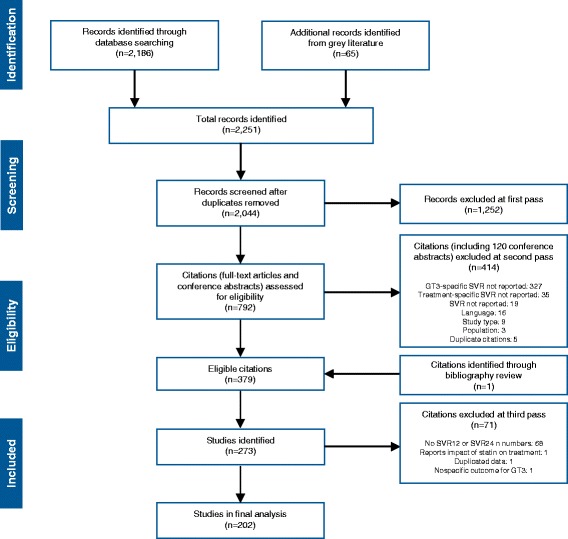
According to PRISMA guidance, we conducted a systematic review (and descriptive statistical analysis) of data in the public domain from relevant clinical trial or observational (real-world) study publications within a 5-year period (February 2011 to May 2016) identified by PubMed, Medline In-Process, and Embase searches. This was supplemented with a search of five non-indexed literature sources, comprising annual conferences of the AASLD, APASL, CROI, EASL, and WHO, restricted to a 1-year period (April 2015 to May 2016).
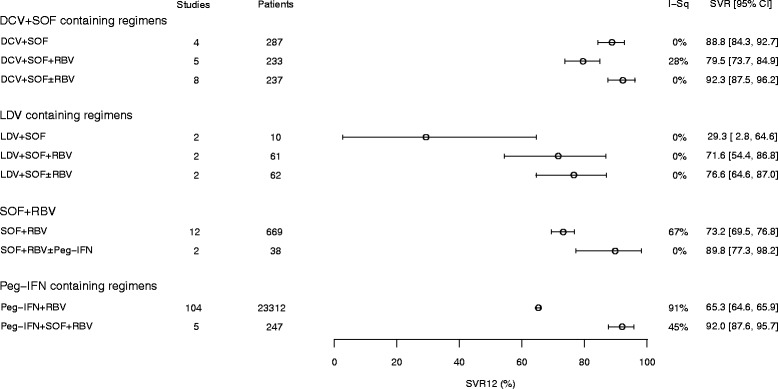
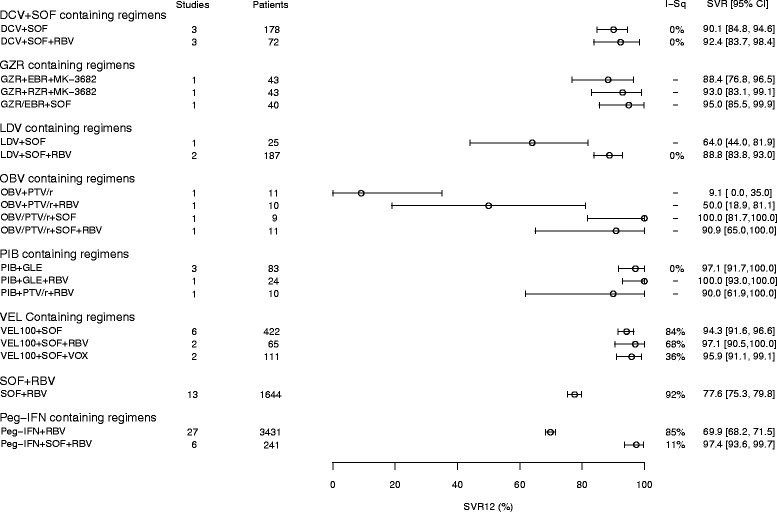
Of the all-oral regimens, the efficacy (SVR12 ≥ 90%) of sofosbuvir plus daclatasvir- and velpatasvir-based regimens in clinical trials supports and reinforces their recommendation by guidelines. Other promising regimens comprise grazoprevir + elbasvir + sofosbuvir, and ombitasvir + paritaprevir/ribavirin + sofosbuvir. Newer regimens incorporating pibrentasvir + glecaprevir or grazoprevir + ruzasvir + MK-3682 (uprifosbuvir), offer all-oral, ribavirin-free SVR12 rates consistently greater than 95%. Observational studies report slightly lower overall SVR rates but reflect corresponding clinical trial data in terms of treatments most likely to achieve good responses.
On the basis of SVR12, we established that for treating GT3 infections (i) regimens incorporating newer DAAs are more effective than those comprising older DAAs, and (ii) ribavirin may be of less benefit in newer DAA regimens than in older DAA regimens. The analysis provides evidence that DAA regimens can replace Peg-IFN-based regimens for GT3 infection.
丙型肝炎病毒(HCV)在全球存在六种不同的基因变异型(基因型1 - 6)。某些基因型在特定国家或地区比其他地区更为普遍,但在全球范围内,基因型3(GT3)是第二常见的。与基于聚乙二醇干扰素(Peg-IFN)的旧方案治疗相比,感染HCV GT1、2、4、5或6型的患者在接受基于直接抗病毒药物(DAA)的方案治疗后,通过持续病毒学应答(SVR)测量,恢复程度更高。然而,GT3被认为更难治疗,因为它是一种相对侵袭性较强的基因型,与更大的肝脏损伤和癌症风险相关;GT3感染患者的一些亚组对当前获批的DAA治疗反应较差。更新的DAA药物已经上市或正在研发中。
根据PRISMA指南,我们对通过PubMed、Medline In-Process和Embase检索确定的5年期间(2011年2月至2016年5月)相关临床试验或观察性(真实世界)研究出版物中的公共领域数据进行了系统综述(和描述性统计分析)。通过检索五个非索引文献来源进行补充,这些来源包括美国肝病研究学会(AASLD)、亚太肝病学会(APASL)、美国逆转录病毒和机会性感染会议(CROI)、欧洲肝脏研究学会(EASL)和世界卫生组织(WHO)的年度会议,检索时间限制为1年(2015年4月至2016年5月)。
在所有口服方案中,索磷布韦加达卡他韦和维帕他韦为基础的方案在临床试验中的疗效(SVR12≥90%)支持并强化了指南对它们的推荐。其他有前景的方案包括格卡瑞韦+艾尔巴韦+索磷布韦,以及奥比他韦+帕利普韦/利托那韦+索磷布韦。包含比格替尼+格莱普瑞韦或格卡瑞韦+鲁扎斯韦+MK-3682(uprifosbuvir)的更新方案提供了始终高于95%的全口服、无利巴韦林的SVR12率。观察性研究报告的总体SVR率略低,但在最有可能获得良好反应的治疗方面反映了相应的临床试验数据。
基于SVR12,我们确定对于治疗GT3感染,(i)包含更新DAA的方案比包含旧DAA的方案更有效,并且(ii)在更新的DAA方案中,利巴韦林可能比在旧的DAA方案中益处更少。该分析提供了证据表明DAA方案可以替代基于Peg-IFN的方案用于GT3感染。