Ratheesh Aparna, Jain Meenakashi, Gude Rajiv P
Advanced Centre for Treatment, Research & Education in Cancer (ACTREC), Tata Memorial Centre, Kharghar, Navi Mumbai, India-410210.
These authors contributed equally to this work.
World J Oncol. 2010 Oct;1(5):194-203. doi: 10.4021/wjon252e. Epub 2010 Nov 2.
Integrins are adhesion molecules known to regulate cellular processes like adhesion, migration and proliferation. At the same time role of integrin in progress of cancer metastasis is well established, increased integrin expression is reported to be linked to high metastasis potential of cells. Pentoxifylline a methyl xanthine derivative is a potent antimetastatic agent. Studies on the mechanism of inhibition of lung homing of B16F10 melanoma cells by PTX shows that it can inhibit cell- Extracellular Matrix adhesion, cell surface integrin expression as well as Protein kinase C activity. Previous study from our laboratory have shown PTX treatment can selectively inhibit the cell surface expression of α5 integrin in B16F10 cells without affecting its total cellular protein levels. Numerous studies have documented that differences in surface expression and distribution of integrins affects metastasis. The purpose of present study is to observe the effect of PTX on cellular distribution/ redistribution of integrins and to study the underlying molecular mechanism of PTX action.
Integrin internalization and transport was observed using immunofluorescence confocal microscopy. PKC activity was determined using MBP4-14 as a substrate. Immunoprecipitation and western blotting was used to show association between PKC and α5 integrin, cell adhesion assay was performed using fibronectin/fibrinogen as substrate.
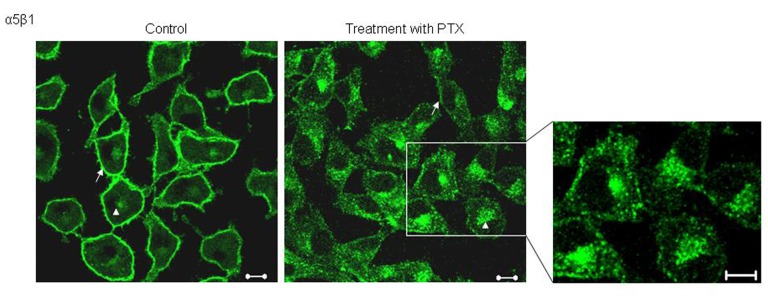
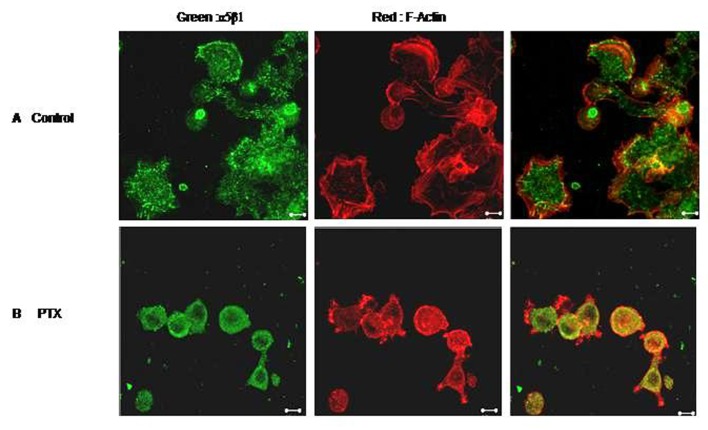
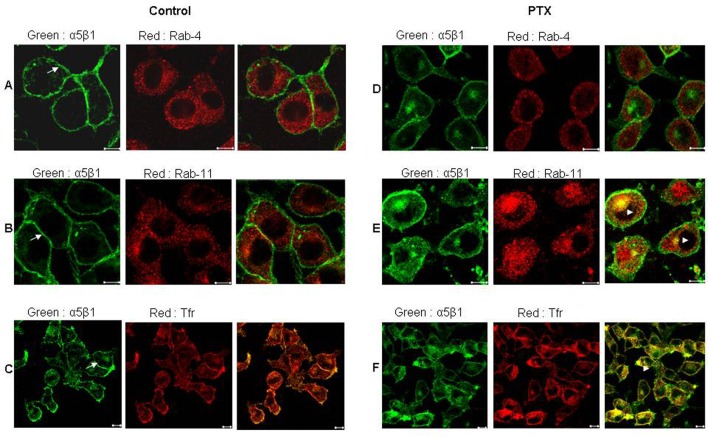
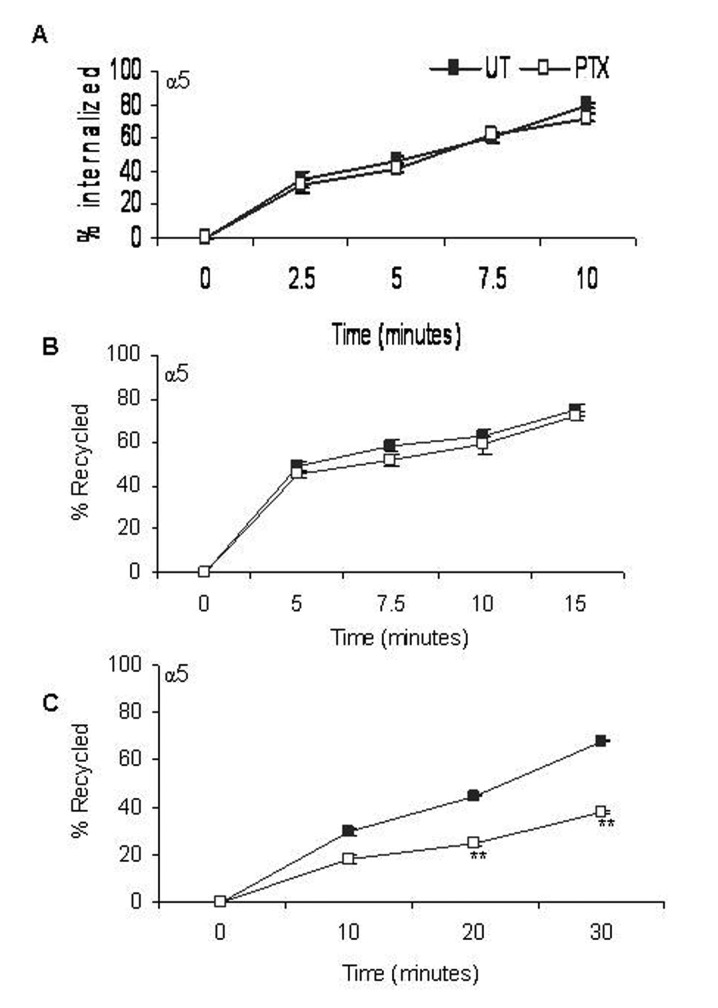
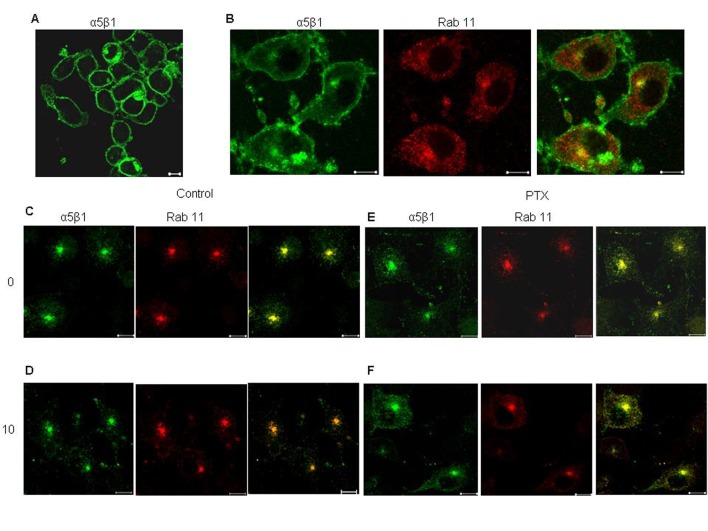
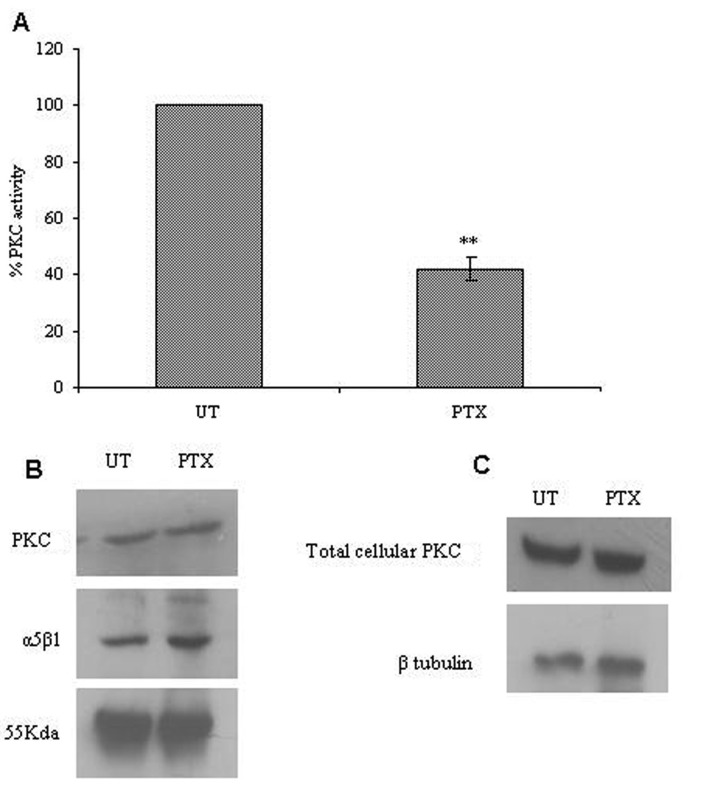
Immunofluorescence studies showed that PTX treatment caused a redistribution of α5 integrins from the plasma membrane to a perinuclear compartment where it colocalized with Transferrin receptor and Rab-11 GTPase. Rate of integrin internalization and recycling showed that PTX inhibited the recycling of α5 integrins from perinuclear recycling endosomes. PTX is reported to affect kinases; here we showed that PTX inhibited total PKC activity. Association between α5β1 integrin and PKC is studied using Immunoprecipitation which show that PTX affects α5β1 integrin associated PKC activity without affecting the levels of PKC. Studying the effect of delay in integrin recycling on cell functionality showed that it affects spreading of cells on fibronectin/fibrinogen.
Data in the present study shows that PTX interferes with PKC activity bringing about a change in integrin distribution, and there by affecting the functionality of the cell. And this may possibly serve as one of the mechanisms for antimetastatic action of PTX.
整合素是一类黏附分子,已知其可调节细胞黏附、迁移和增殖等过程。同时,整合素在癌症转移进程中的作用已得到充分证实,据报道整合素表达增加与细胞的高转移潜能相关。己酮可可碱是一种甲基黄嘌呤衍生物,是一种有效的抗转移剂。关于己酮可可碱抑制B16F10黑色素瘤细胞肺归巢机制的研究表明,它可以抑制细胞与细胞外基质的黏附、细胞表面整合素的表达以及蛋白激酶C的活性。我们实验室之前的研究表明,己酮可可碱处理可选择性抑制B16F10细胞中α5整合素的细胞表面表达,而不影响其细胞总蛋白水平。大量研究表明,整合素表面表达和分布上的差异会影响转移。本研究的目的是观察己酮可可碱对整合素细胞分布/重新分布的影响,并研究己酮可可碱作用的潜在分子机制。
使用免疫荧光共聚焦显微镜观察整合素的内化和转运。以MBP4-14为底物测定蛋白激酶C活性。采用免疫沉淀和蛋白质印迹法显示蛋白激酶C与α5整合素之间的关联,以纤连蛋白/纤维蛋白原为底物进行细胞黏附试验。
免疫荧光研究表明,己酮可可碱处理导致α5整合素从质膜重新分布到核周区室,在那里它与转铁蛋白受体和Rab-11 GTP酶共定位。整合素内化和再循环速率表明,己酮可可碱抑制α5整合素从核周再循环内体的再循环。据报道己酮可可碱会影响激酶;在这里我们表明己酮可可碱抑制总蛋白激酶C活性。使用免疫沉淀法研究α5β1整合素与蛋白激酶C之间的关联,结果表明己酮可可碱影响与α5β1整合素相关的蛋白激酶C活性,而不影响蛋白激酶C的水平。研究整合素再循环延迟对细胞功能的影响表明,它会影响细胞在纤连蛋白/纤维蛋白原上的铺展。
本研究数据表明,己酮可可碱干扰蛋白激酶C活性,导致整合素分布发生变化,从而影响细胞功能。这可能是己酮可可碱抗转移作用的机制之一。