Tazi El Mehdi, Essadi Ismail, M'rabti Hind, Errihani Hassan
Department of Medical Oncology, National Institute of Oncology, Rabat, Morocco.
World J Oncol. 2011 Feb;2(1):37-40. doi: 10.4021/wjon276e. Epub 2011 Feb 26.
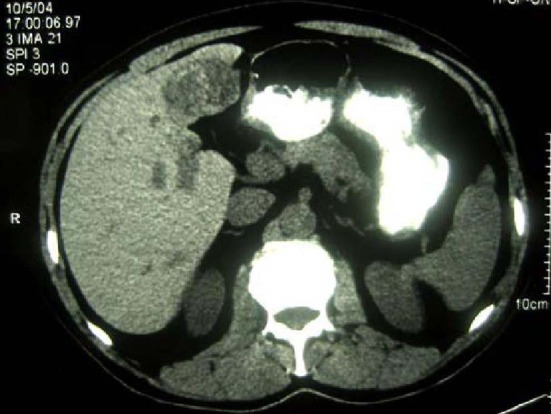
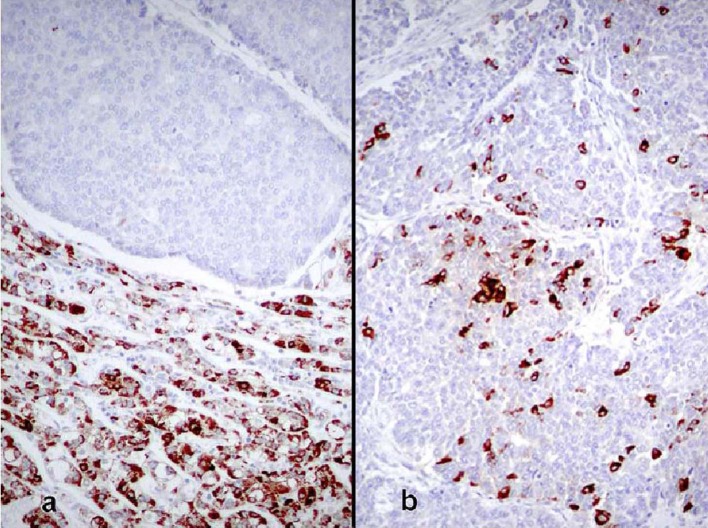
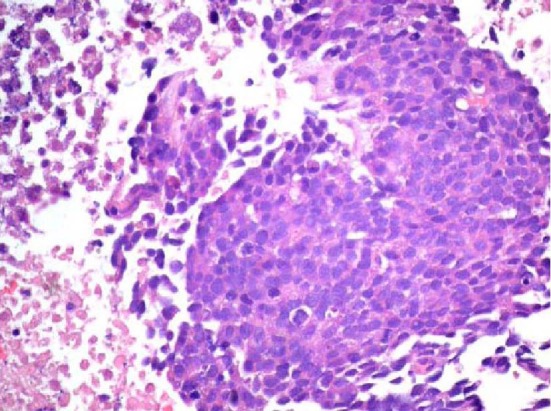
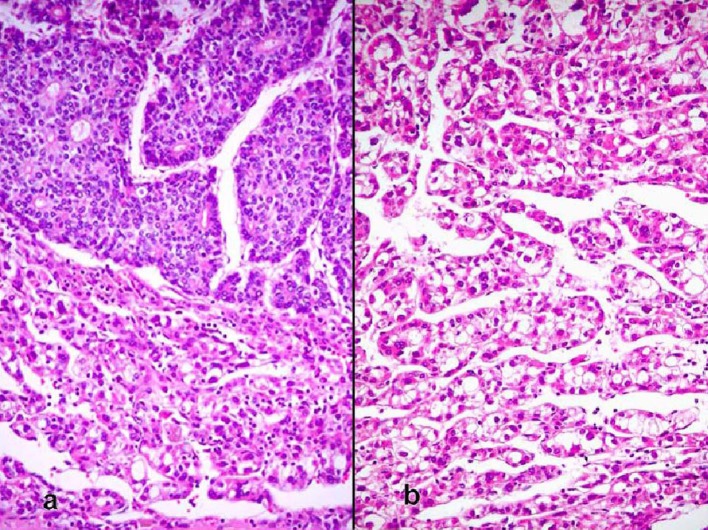
We describe a rare hepatic collision tumor composed of a hepatocellular carcinoma and a high-grade neuroendocrine carcinoma. The patient, a 68-year-old man, underwent a partial hepatectomy because of a 4.0 cm mass. The tumor had two distinctive patterns. The majority of the tumor was a high-grade neuroendocrine carcinoma with features of a small cell carcinoma that was positive for chromogranin, synaptophysin, and cytokeratin 19 and negative for hepatocellular antigen and alpha-fetoprotein (AFP). The second component was a moderately differentiated hepatocellular carcinoma that was positive for hepatocellular antigen and AFP and negative for neuroendocrine markers. The two tumors were separated by fibrous bands. In areas where they collided, there was no transition or intermingling of cells between the two components, thus, it is different from the combined type of tumors. After removal of the tumor, the patient underwent four courses of chemotherappy which included etoposide and cisplatin with a follow-up period of 28 months.
我们描述了一种罕见的肝脏碰撞瘤,它由肝细胞癌和高级别神经内分泌癌组成。该患者为一名68岁男性,因一个4.0厘米的肿块接受了部分肝切除术。肿瘤有两种不同的形态。肿瘤的大部分是高级别神经内分泌癌,具有小细胞癌的特征,嗜铬粒蛋白、突触素和细胞角蛋白19呈阳性,肝细胞抗原和甲胎蛋白(AFP)呈阴性。第二个成分是中度分化的肝细胞癌,肝细胞抗原和AFP呈阳性,神经内分泌标志物呈阴性。这两种肿瘤被纤维带分隔。在它们碰撞的区域,两种成分之间没有细胞过渡或混合,因此,它不同于肿瘤的联合类型。肿瘤切除后,患者接受了四个疗程的化疗,包括依托泊苷和顺铂,随访期为28个月。