Straube Ronny, Shah Meera, Flockerzi Dietrich, Wolf Dieter A
Max Planck Institute for Dynamics of Complex Technical Systems Magdeburg, Magdeburg, Germany.
Sanford Burnham Prebys Medical Discovery Institute, La Jolla, California, United States of America.
PLoS Comput Biol. 2017 Nov 17;13(11):e1005869. doi: 10.1371/journal.pcbi.1005869. eCollection 2017 Nov.
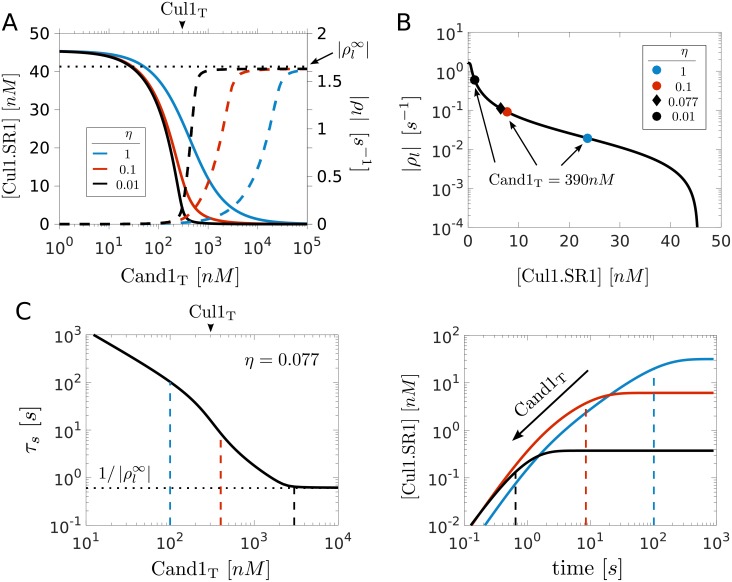
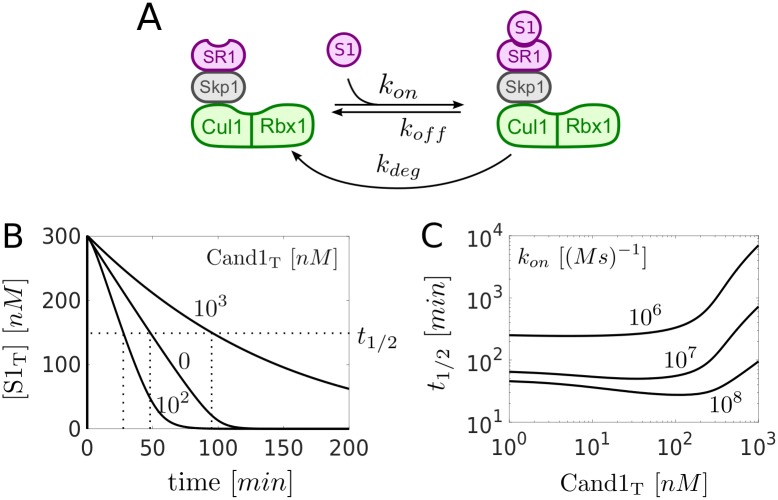
Cullin-RING ubiquitin ligases (CRLs) catalyze the ubiquitylation of substrates many of which are degraded by the 26S proteasome. Their modular architecture enables recognition of numerous substrates via exchangeable substrate receptors that competitively bind to a cullin scaffold with high affinity. Due to the plasticity of these interactions there is ongoing uncertainty how cells maintain a flexible CRL repertoire in view of changing substrate loads. Based on a series of in vivo and in vitro studies, different groups proposed that the exchange of substrate receptors is mediated by a protein exchange factor named Cand1. Here, we have performed mathematical modeling to provide a quantitative underpinning of this hypothesis. First we show that the exchange activity of Cand1 necessarily leads to a trade-off between high ligase activity and fast receptor exchange. Supported by measurements we argue that this trade-off yields an optimal Cand1 concentration in cells where the time scale for substrate degradation becomes minimal. In a second step we show through simulations that (i) substrates bias the CRL repertoire leading to preferential assembly of ligases for which substrates are available and (ii) differences in binding affinities or substrate receptor abundances create a temporal hierarchy for the degradation of substrates. Finally, we compare the Cand1-mediated exchange cycle with an alternative architecture lacking Cand1 which indicates superiority of a system with exchange factor if substrate receptors bind substrates and the cullin scaffold in a random order. Together, our results provide general constraints for the operating regimes of molecular exchange systems and suggest that Cand1 endows the CRL network with the properties of an "on demand" system allowing cells to dynamically adjust their CRL repertoire to fluctuating substrate abundances.
Cullin-RING泛素连接酶(CRLs)催化底物的泛素化,其中许多底物会被26S蛋白酶体降解。它们的模块化结构能够通过可交换的底物受体识别众多底物,这些受体以高亲和力竞争性地结合到cullin支架上。由于这些相互作用的可塑性,鉴于底物负载的变化,细胞如何维持灵活的CRL库仍存在不确定性。基于一系列体内和体外研究,不同的研究小组提出底物受体的交换是由一种名为Cand1的蛋白质交换因子介导的。在这里,我们进行了数学建模,为这一假设提供定量依据。首先,我们表明Cand1的交换活性必然导致高连接酶活性和快速受体交换之间的权衡。通过测量结果支持,我们认为这种权衡在底物降解时间尺度最小的细胞中产生了最佳的Cand1浓度。在第二步中,我们通过模拟表明:(i)底物使CRL库产生偏差,导致优先组装有可用底物的连接酶;(ii)结合亲和力或底物受体丰度的差异为底物降解创造了时间层次结构。最后,我们将Cand1介导的交换循环与缺乏Cand1的替代结构进行比较,结果表明,如果底物受体以随机顺序结合底物和cullin支架,具有交换因子的系统更具优势。总之,我们的结果为分子交换系统的运行机制提供了一般限制,并表明Cand1赋予CRL网络“按需”系统的特性,使细胞能够根据底物丰度的波动动态调整其CRL库。