Departamento de Matemática Aplicada, Facultad de Matemáticas, and Universidad Complútense de Madrid, Madrid, Spain.
Grupo Interdisciplinar de Sistemas Complejos (GISC), Universidad Complútense de Madrid, Madrid, Spain.
Sci Rep. 2017 Nov 17;7(1):15776. doi: 10.1038/s41598-017-15883-8.
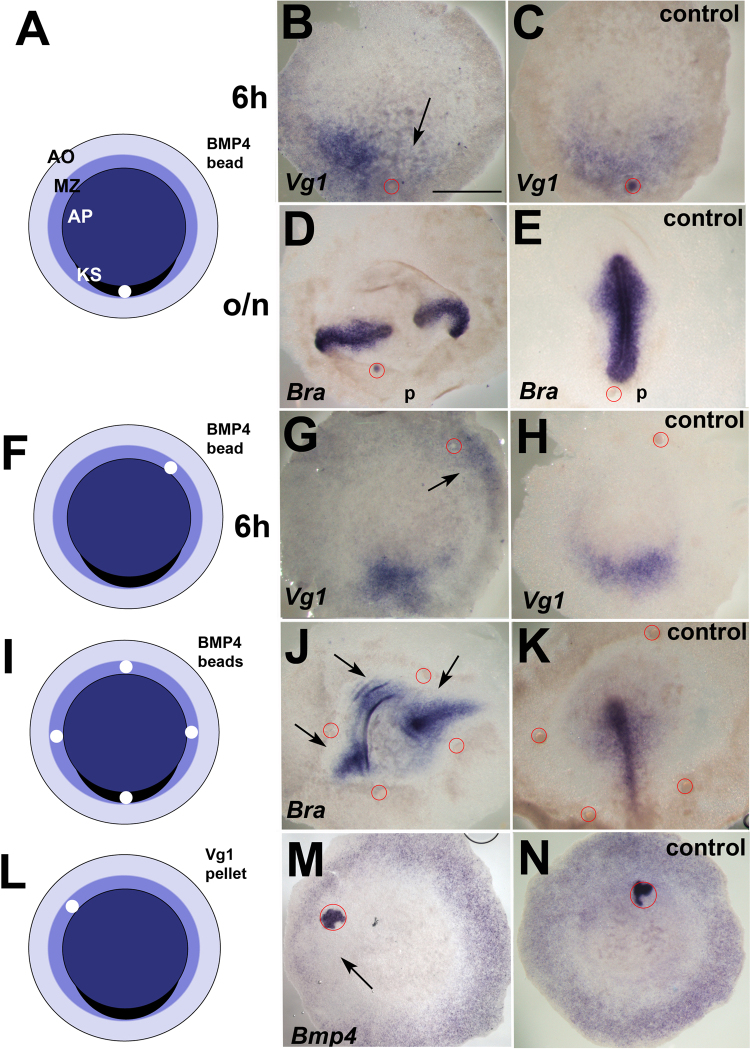
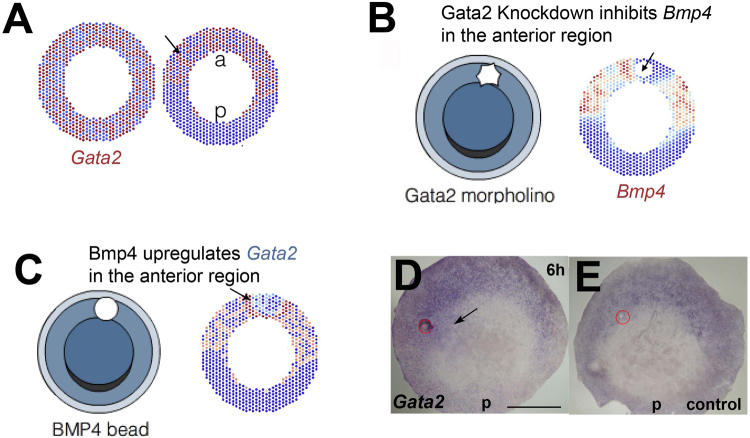
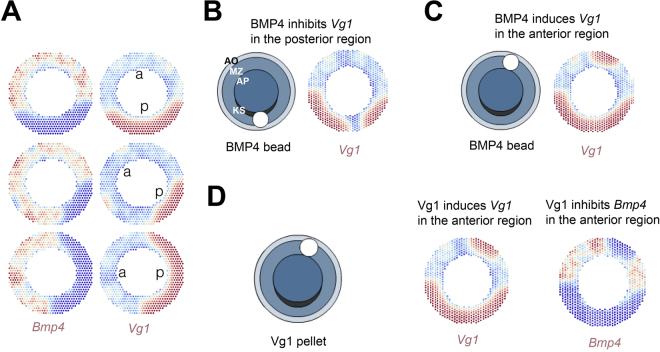
The first obvious sign of bilateral symmetry in mammalian and avian embryos is the appearance of the primitive streak in the future posterior region of a radially symmetric disc. The primitive streak marks the midline of the future embryo. The mechanisms responsible for positioning the primitive streak remain largely unknown. Here we combine experimental embryology and mathematical modelling to analyse the role of the TGFβ-related molecules BMP4 and Vg1/GDF1 in positioning the primitive streak. Bmp4 and Vg1 are first expressed throughout the embryo, and then become localised to the future anterior and posterior regions of the embryo, where they will, respectively, inhibit or induce formation of the primitive streak. We propose a model based on paracrine signalling to account for the separation of the two domains starting from a homogeneous array of cells, and thus for the topological transformation of a radially symmetric disc to a bilaterally symmetric embryo.
哺乳动物和禽类胚胎中双侧对称的第一个明显标志是原始条纹出现在径向对称盘的未来后区域。原始条纹标志着未来胚胎的中线。负责定位原始条纹的机制在很大程度上仍然未知。在这里,我们将实验胚胎学和数学建模结合起来,分析 TGFβ 相关分子 BMP4 和 Vg1/GDF1 在定位原始条纹中的作用。Bmp4 和 Vg1 最初在整个胚胎中表达,然后局部化到胚胎的未来前区和后区,在那里它们将分别抑制或诱导原始条纹的形成。我们提出了一个基于旁分泌信号的模型,以解释从均匀的细胞阵列开始的两个区域的分离,从而解释了从径向对称盘到双侧对称胚胎的拓扑转换。