
来自气体电子学会议射频参考单元的微波诊断结果。
Microwave Diagnostic Results from the Gaseous Electronics Conference RF Reference Cell.
作者信息
Overzet Lawrence J
机构信息
University of Texas at Dallas, P.O. Box 830688, EC33 Richardson, TX 75083-0688.
出版信息
J Res Natl Inst Stand Technol. 1995 Jul-Aug;100(4):401-414. doi: 10.6028/jres.100.030.
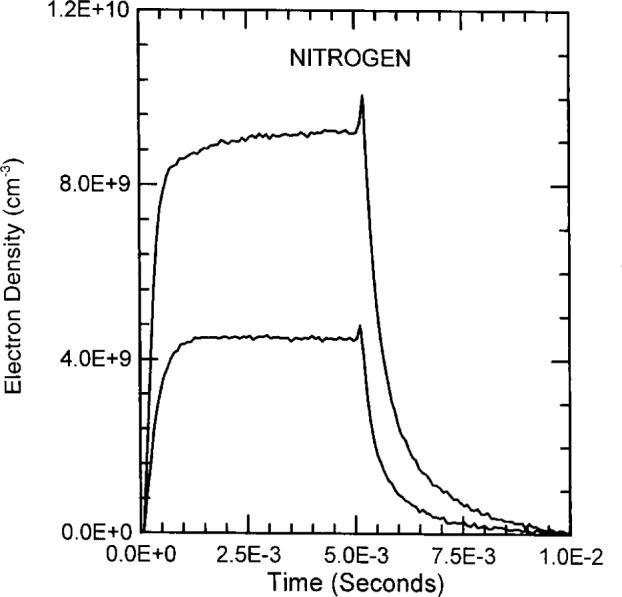
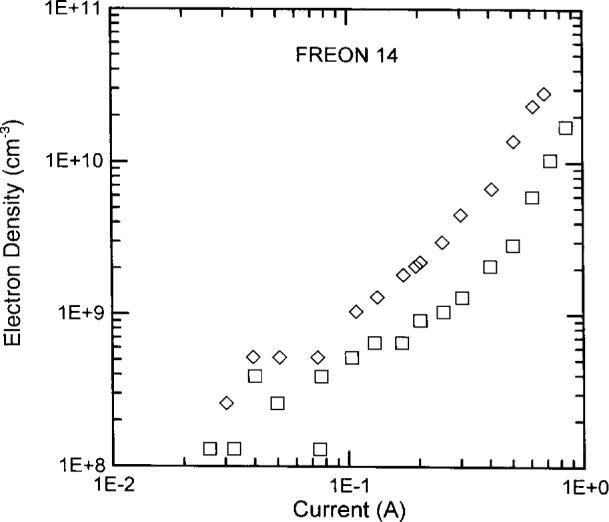
Electron density measurements with even the simplest microwave interferometry techniques can range over three to four orders of magnitude, can be responsive on time scales as fast as 50 ns, and are simple to obtain and interpret. Three groups have published electron density data taken in the Gaseous Electronics Conference (GEC) reference reactor using microwave interferometry. The agreement in the data from these groups at higher pressures is excellent especially when one considers that the GEC reactors involved have some key differences. These may have been the cause of some differences between the results obtained at low pressures, although, the manner in which the measurements were interpreted may also have contributed. The electron densities compare favorably in argon, helium, and nitrogen above 33.3 Pa (250 mTorr); but, the measurements tend to diverge some at 13.3 Pa (100 mTorr) and in 133 Pa helium above approximately 200 mA. It is speculated that the latter difference occurs as the discharges change from a bulk ionization or -mode to a secondary electron emission or -mode, and that this transition occurs at lower voltages and currents for reactors with aluminum electrodes than it does for those with stainless steel electrodes. In addition, time resolved electron densities are presented. There is agreement between time resolved measurements in the two reactors, in particular, the electron density in helium discharges is found to rise dramatically after the rf excitation is turned off while the electron densities in argon and nitrogen glows exhibit only slight increases.
即使使用最简单的微波干涉测量技术进行电子密度测量,其范围也可跨越三到四个数量级,响应时间尺度可达50纳秒之快,而且获取和解释都很简单。有三个研究小组发表了在气体电子学会议(GEC)参考反应堆中使用微波干涉测量法获取的电子密度数据。这些小组在较高压力下的数据一致性非常好,尤其是考虑到所涉及的GEC反应堆存在一些关键差异时。这些差异可能是低压下所得结果存在一些差异的原因,不过,测量结果的解释方式也可能有影响。在33.3帕(250毫托)以上的氩气、氦气和氮气中,电子密度的比较结果良好;但是,在13.3帕(100毫托)以及133帕的氦气中,当电流约高于200毫安时,测量结果往往会出现分歧。据推测,后一种差异的出现是由于放电从体电离或模式转变为二次电子发射或模式,并且对于带有铝电极的反应堆而言,这种转变发生时的电压和电流低于带有不锈钢电极的反应堆。此外,还给出了时间分辨电子密度。两个反应堆的时间分辨测量结果之间存在一致性,特别是发现氦气放电中的电子密度在射频激发关闭后会急剧上升,而氩气和氮气辉光中的电子密度仅略有增加。




 Zotero 插件