Theoretical Biology and Biophysics, Los Alamos National Laboratory, Los Alamos, NM 87545, USA.
Laboratório de Biomatemática, Faculdade de Medicina da Universidade de Lisboa, 1649-028 Lisboa, Portugal.
Viruses. 2017 Nov 18;9(11):350. doi: 10.3390/v9110350.
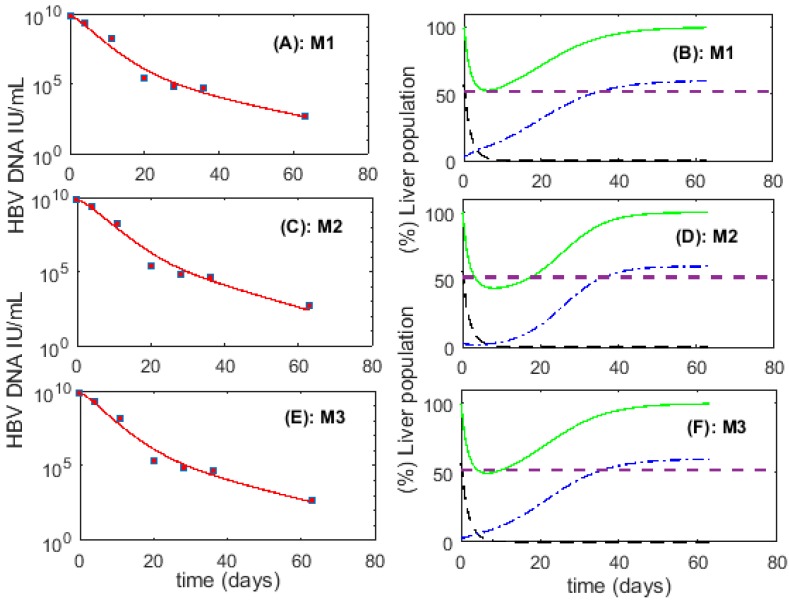
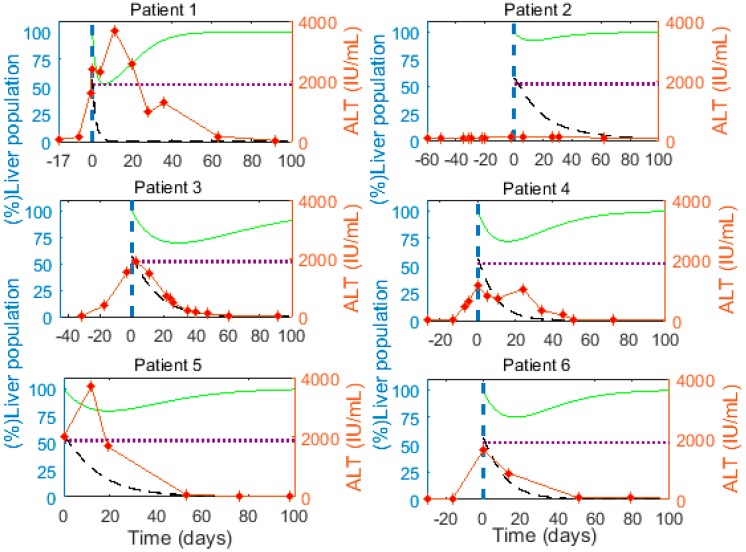
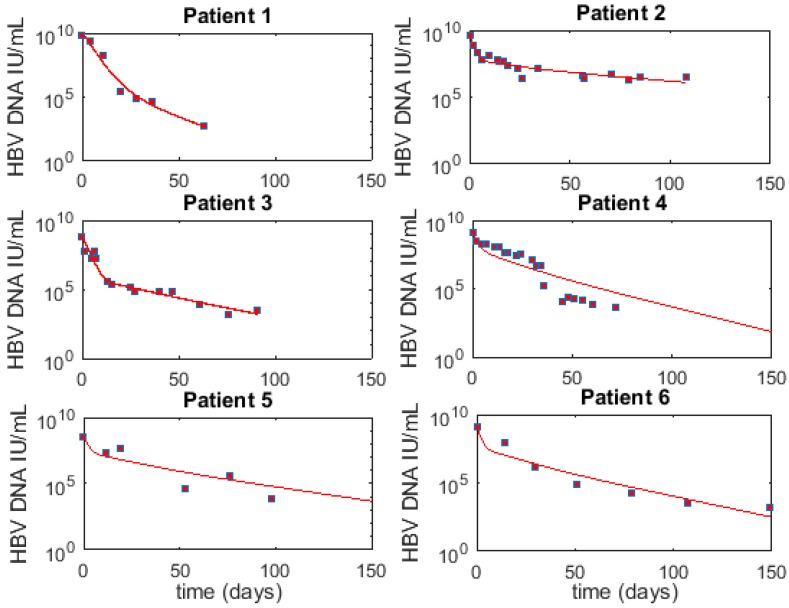
Around 90-95% of hepatitis B virus (HBV) infected adults do not progress to the chronic phase and, instead, recover naturally. The strengths of the cytolytic and non-cytolytic immune responses are key players that decide the fate of acute HBV infection. In addition, it has been hypothesized that proliferation of infected cells resulting in uninfected progeny and/or cytokine-mediated degradation of covalently closed circular DNA (cccDNA) leading to the cure of infected cells are two major mechanisms assisting the adaptive immune response in the clearance of acute HBV infection in humans. We employed fitting of mathematical models to human acute infection data together with physiological constraints to investigate the role of these hypothesized mechanisms in the clearance of infection. Results suggest that cellular proliferation of infected cells resulting in two uninfected cells is required to minimize the destruction of the liver during the clearance of acute HBV infection. In contrast, we find that a cytokine-mediated cure of infected cells alone is insufficient to clear acute HBV infection. In conclusion, our modeling indicates that HBV clearance without lethal loss of liver mass is associated with the production of two uninfected cells upon proliferation of an infected cell.
约 90-95%的乙型肝炎病毒 (HBV) 感染成年人不会进展为慢性期,而是自然恢复。细胞溶解和非细胞溶解免疫应答的强度是决定急性 HBV 感染命运的关键因素。此外,有人假设感染细胞的增殖导致未感染的后代和/或细胞因子介导的共价闭合环状 DNA (cccDNA) 降解导致感染细胞的治愈,是辅助适应性免疫反应清除人类急性 HBV 感染的两个主要机制。我们采用数学模型拟合人类急性感染数据,并结合生理约束条件,研究这些假设机制在清除感染中的作用。结果表明,感染细胞的细胞增殖导致两个未感染细胞是必要的,以最大限度地减少急性 HBV 感染清除过程中肝脏的破坏。相比之下,我们发现仅通过细胞因子介导的感染细胞治愈不足以清除急性 HBV 感染。总之,我们的模型表明,在不导致肝脏大量丧失的情况下清除 HBV 感染与感染细胞增殖时产生两个未感染细胞有关。