Lythgoe Katrina A, Lumley Sheila F, Pellis Lorenzo, McKeating Jane A, Matthews Philippa C
Big Data Institute, University of Oxford, Old Road Campus, Oxford OX3 7LF, UK.
Department of Zoology, University of Oxford, Medawar Building, South Parks Road, Oxford OX1 3SY, UK.
Virus Evol. 2020 Aug 25;7(1):veaa063. doi: 10.1093/ve/veaa063. eCollection 2021 Jan.
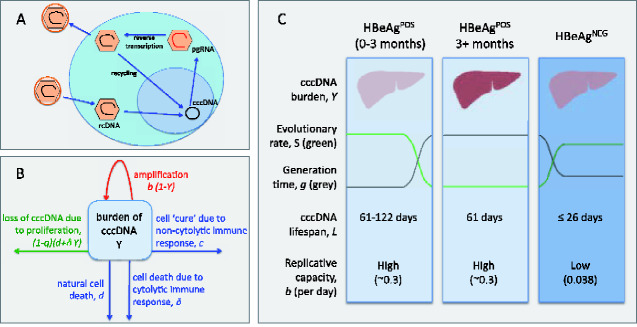
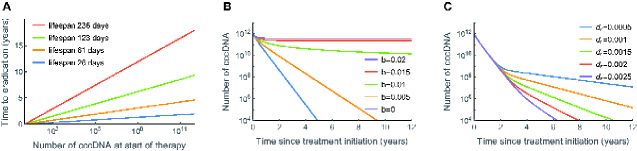
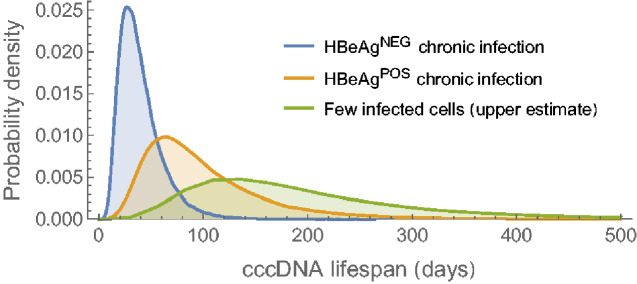
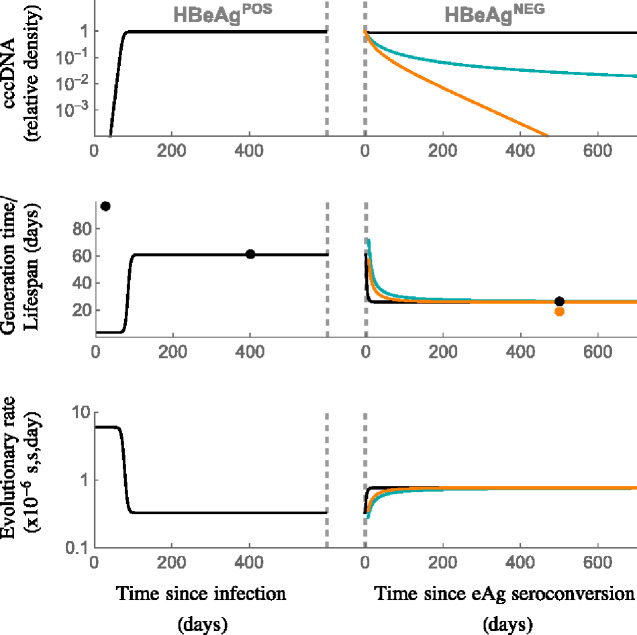
Hepatitis B virus (HBV) infection is a major global health problem with over 240 million infected individuals at risk of developing progressive liver disease and hepatocellular carcinoma. HBV is an enveloped DNA virus that establishes its genome as an episomal, covalently closed circular DNA (cccDNA) in the nucleus of infected hepatocytes. Currently, available standard-of-care treatments for chronic hepatitis B (CHB) include nucleos(t)ide analogues (NAs) that suppress HBV replication but do not target the cccDNA and hence rarely cure infection. There is considerable interest in determining the lifespan of cccDNA molecules to design and evaluate new curative treatments. We took a novel approach to this problem by developing a new mathematical framework to model changes in evolutionary rates during infection which, combined with previously determined within-host evolutionary rates of HBV, we used to determine the lifespan of cccDNA. We estimate that during HBe-antigen positive (HBeAg) infection the cccDNA lifespan is 61 (36-236) days, whereas during the HBeAg phase of infection it is only 26 (16-81) days. We found that cccDNA replicative capacity declined by an order of magnitude between HBeAg and HBeAg phases of infection. Our estimated lifespan of cccDNA is too short to explain the long durations of chronic infection observed in patients on NA treatment, suggesting that either a sub-population of long-lived hepatocytes harbouring cccDNA molecules persists during therapy, or that NA therapy does not suppress all viral replication. These results provide a greater understanding of the biology of the cccDNA reservoir and can aid the development of new curative therapeutic strategies for treating CHB.
乙型肝炎病毒(HBV)感染是一个重大的全球健康问题,超过2.4亿感染者有患进行性肝病和肝细胞癌的风险。HBV是一种包膜DNA病毒,其基因组以游离型共价闭合环状DNA(cccDNA)的形式存在于受感染肝细胞的细胞核中。目前,慢性乙型肝炎(CHB)的现有标准治疗方法包括核苷(酸)类似物(NAs),这些药物可抑制HBV复制,但不针对cccDNA,因此很少能治愈感染。确定cccDNA分子的寿命对于设计和评估新的治愈性治疗方法具有重要意义。我们采用了一种新方法来解决这个问题,即开发一个新的数学框架来模拟感染期间进化速率的变化,并结合先前确定的HBV宿主内进化速率,用于确定cccDNA的寿命。我们估计,在HBe抗原阳性(HBeAg)感染期间,cccDNA的寿命为61(36 - 236)天,而在感染的HBeAg阴性阶段,其寿命仅为26(16 - 81)天。我们发现,在感染的HBeAg阳性和阴性阶段之间,cccDNA的复制能力下降了一个数量级。我们估计的cccDNA寿命太短,无法解释接受NA治疗的患者中观察到的慢性感染的长时间持续,这表明要么在治疗期间存在携带cccDNA分子的长寿肝细胞亚群持续存在,要么NA治疗并未抑制所有病毒复制。这些结果有助于更深入地了解cccDNA库的生物学特性,并有助于开发治疗CHB的新的治愈性治疗策略。