Center for Medical Ethics and Health Policy, Baylor College of Medicine, Houston, TX, USA.
Department of Genetics, University of North Carolina, Chapel Hill, NC, USA.
Mol Psychiatry. 2018 Jan;23(1):15-23. doi: 10.1038/mp.2017.228. Epub 2017 Nov 21.
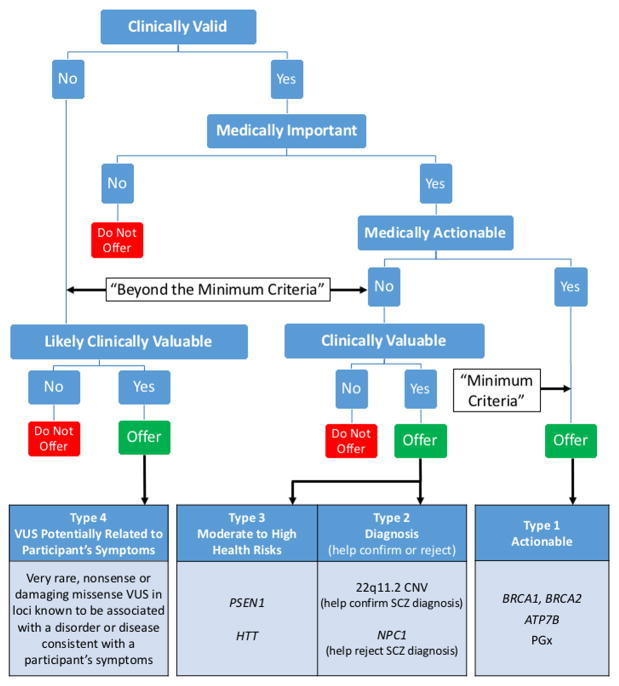
There is an emerging consensus that genomic researchers should, at a minimum, offer to return to individual participants clinically valid, medically important and medically actionable genomic findings (for example, pathogenic variants in BRCA1) identified in the course of research. However, this is not a common practice in psychiatric genetics research. Furthermore, psychiatry researchers often generate findings that do not meet all of these criteria, yet there may be ethically compelling arguments to offer selected results. Here, we review the return of results debate in genomics research and propose that, as for genomic studies of other medical conditions, psychiatric genomics researchers should offer findings that meet the minimum criteria stated above. Additionally, if resources allow, psychiatry researchers could consider offering to return pre-specified 'clinically valuable' findings even if not medically actionable-for instance, findings that help corroborate a psychiatric diagnosis, and findings that indicate important health risks. Similarly, we propose offering 'likely clinically valuable' findings, specifically, variants of uncertain significance potentially related to a participant's symptoms. The goal of this Perspective is to initiate a discussion that can help identify optimal ways of managing the return of results from psychiatric genomics research.
人们越来越达成共识,认为基因组研究人员至少应该向研究过程中发现的个体参与者提供具有临床有效性、医学重要性和可操作性的医学基因组发现(例如,BRCA1 中的致病性变体)。然而,这在精神遗传学研究中并不是常见的做法。此外,精神科研究人员经常产生不符合所有这些标准的发现,但可能有道德上令人信服的理由提供部分结果。在这里,我们回顾了基因组学研究中结果回报的争论,并提出,就像其他医学条件的基因组研究一样,精神遗传学研究人员应该提供符合上述最低标准的发现。此外,如果资源允许,精神科研究人员可以考虑提供预先指定的“具有临床价值”的发现,即使这些发现不具有可操作性,例如,有助于证实精神科诊断的发现,以及表明重要健康风险的发现。同样,我们建议提供“可能具有临床价值”的发现,特别是与参与者症状相关的意义不明的变体。本观点的目的是发起一场讨论,帮助确定管理精神遗传学研究结果回报的最佳方式。