Tomic Slavisa, Beko Marko, Dinis Rui, Gomes João Pedro
ISR/IST, LARSyS, Universidade de Lisboa, 1049-001 Lisbon, Portugal.
CICANT-CIC.DIGITAL, Universidade Lusófona de Humanidades e Tecnologias, Campo Grande 376, 1749-024 Lisboa, Portugal.
Sensors (Basel). 2017 Nov 21;17(11):2690. doi: 10.3390/s17112690.
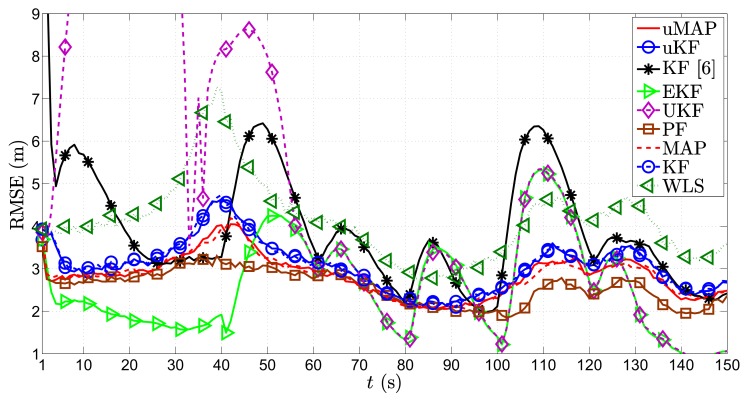
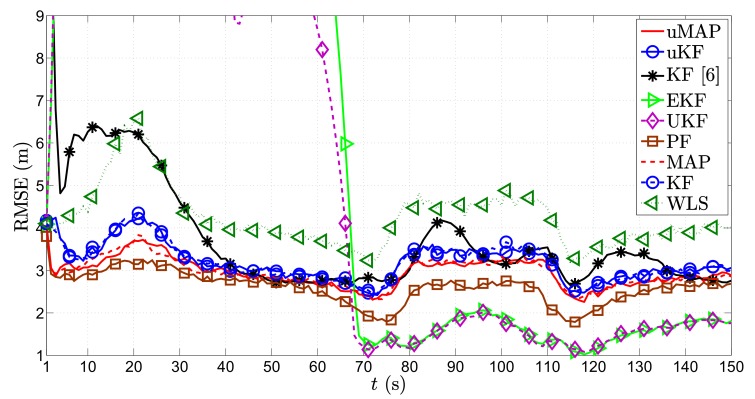
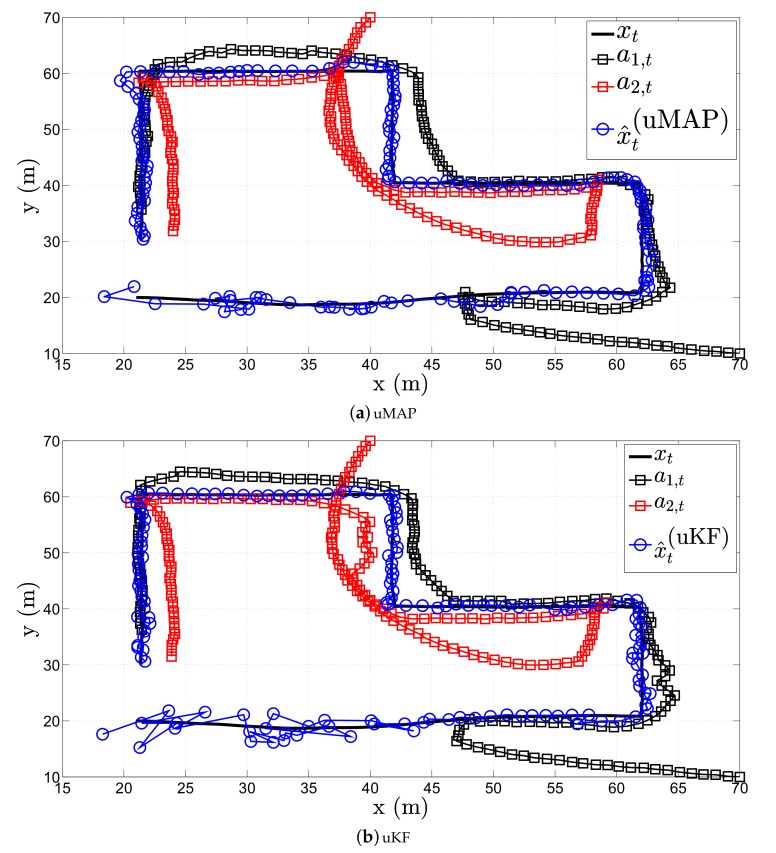
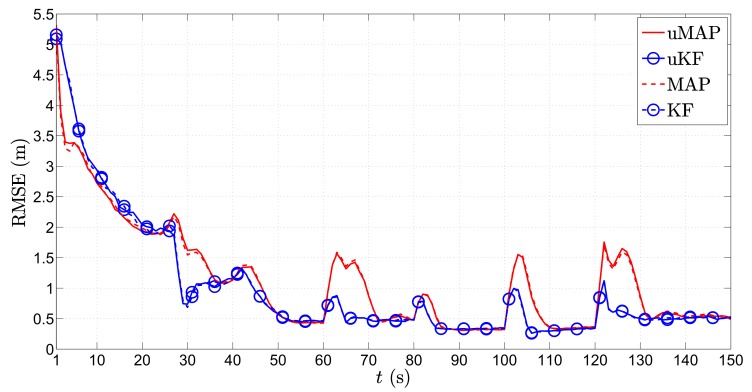
This work addresses the problem of tracking a signal-emitting mobile target in wireless sensor networks (WSNs) with navigated mobile sensors. The sensors are properly equipped to acquire received signal strength (RSS) and angle of arrival (AoA) measurements from the received signal, while the target transmit power is assumed not known. We start by showing how to linearize the highly non-linear measurement model. Then, by employing a Bayesian approach, we combine the linearized observation model with prior knowledge extracted from the state transition model. Based on the maximum a posteriori (MAP) principle and the Kalman filtering (KF) framework, we propose new MAP and KF algorithms, respectively. We also propose a simple and efficient mobile sensor navigation procedure, which allows us to further enhance the estimation accuracy of our algorithms with a reduced number of sensors. Model flaws, which result in imperfect knowledge about the path loss exponent (PLE) and the true mobile sensors' locations, are taken into consideration. We have carried out an extensive simulation study, and our results confirm the superiority of the proposed algorithms, as well as the effectiveness of the proposed navigation routine.
这项工作解决了在无线传感器网络(WSN)中使用导航移动传感器跟踪信号发射移动目标的问题。这些传感器经过适当配置,能够从接收到的信号中获取接收信号强度(RSS)和到达角(AoA)测量值,同时假设目标发射功率未知。我们首先展示如何将高度非线性的测量模型线性化。然后,通过采用贝叶斯方法,将线性化的观测模型与从状态转移模型中提取的先验知识相结合。基于最大后验概率(MAP)原理和卡尔曼滤波(KF)框架,我们分别提出了新的MAP和KF算法。我们还提出了一种简单高效的移动传感器导航程序,该程序使我们能够在减少传感器数量的情况下进一步提高算法的估计精度。考虑了模型缺陷,这些缺陷导致对路径损耗指数(PLE)和真实移动传感器位置的了解不完美。我们进行了广泛的仿真研究,结果证实了所提出算法的优越性以及所提出导航程序的有效性。