Lazar Damien J, Birkett Desmond H, Brams David M, Ford Heather A, Williamson Christina, Nepomnayshy Dmitry
Tufts University School of Medicine, Boston, Massachusetts.
Department of General Surgery.
JSLS. 2017 Oct-Dec;21(4). doi: 10.4293/JSLS.2017.00052.
There is a lack of consensus on the optimal repair technique and the definition of good outcomes in paraesophageal hernia (PEH) repair. We reviewed long-term patient-reported outcomes of open and laparoscopic PEH repair to assist with our future surgical consent process.
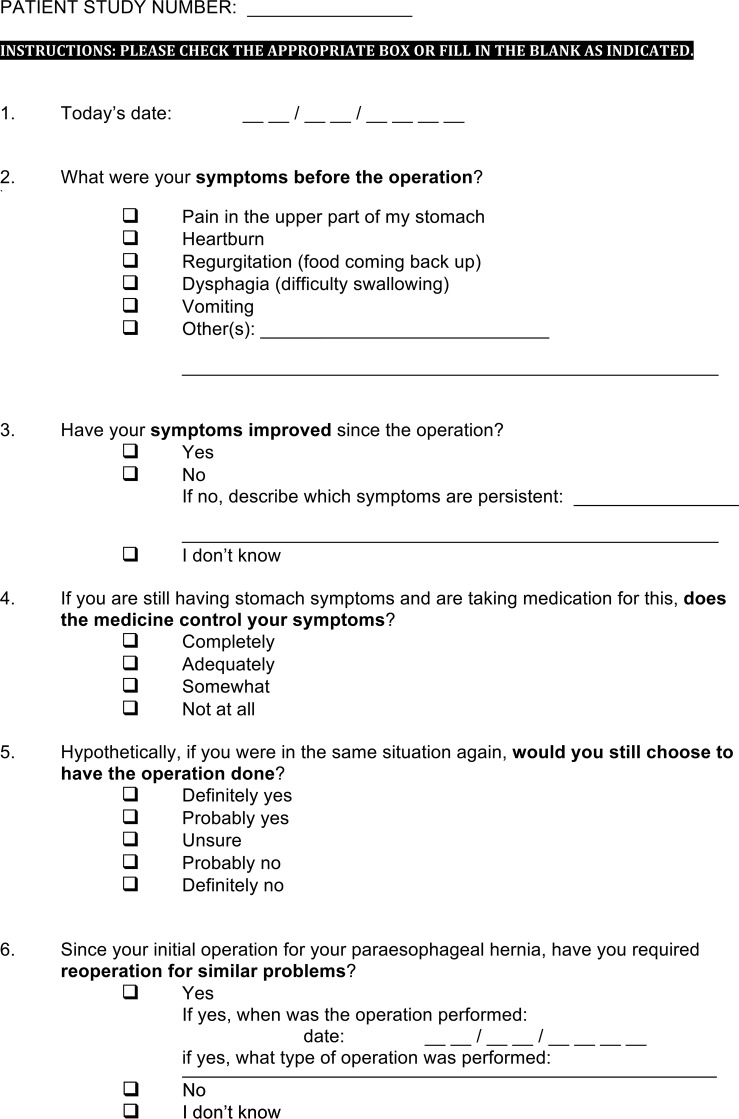
This was a retrospective case-control study including all patients with PEH repair performed from 2000 through 2012 at a single center without the use of mesh. We mailed questionnaires to patients to assess reoperation, symptom control, and satisfaction.
Chart review identified 217 patients who underwent PEH repair. Nineteen died during the follow-up period. Of the 106 returning the questionnaire, 87 underwent laparoscopic repair, and 19 had open repair, with follow-up of 6.6 (SD 3.9) years and 7.0 (SD 4.1) years, respectively. Reoperation rates were 9.9% and 5.3%, respectively ( = .720). Dysphagia, heartburn, and regurgitation improved in 95.4% of patients after laparoscopic repair and 89.5% after open repair ( = .318). Medication for symptom control was necessary in 54.0% of patients after laparoscopic repair and 26.3% after open repair ( = .029). In each group, 90% stated that they would still choose to have the operation ( = .713).
Long-term patient-specific outcomes showed comparable, encouraging results between open and laparoscopic repair of PEH without mesh reinforcement. However, half of those undergoing laparoscopic repair required the use of medication for symptom control. This study adds to the literature describing long-term patient-specific outcomes and can be useful when counseling patients about PEH repair.
对于食管旁疝(PEH)修复的最佳技术以及良好预后的定义,目前尚无共识。我们回顾了开放手术和腹腔镜手术修复PEH的长期患者报告结局,以辅助我们未来的手术知情同意过程。
这是一项回顾性病例对照研究,纳入了2000年至2012年在单一中心接受PEH修复且未使用补片的所有患者。我们向患者邮寄问卷,以评估再次手术情况、症状控制及满意度。
病历审查确定了217例接受PEH修复的患者。19例在随访期间死亡。在106例回复问卷的患者中,87例行腹腔镜修复,19例行开放修复,随访时间分别为6.6(标准差3.9)年和7.0(标准差4.1)年。再次手术率分别为9.9%和5.3%(P = 0.720)。腹腔镜修复后95.4%的患者吞咽困难、烧心和反流症状改善,开放修复后为89.5%(P = 0.318)。腹腔镜修复后54.0%的患者需要使用药物控制症状,开放修复后为26.3%(P = 0.029)。每组中,90%的患者表示仍会选择进行该手术(P = 0.713)。
长期的患者特异性结局显示,在不使用补片加强的情况下,开放手术和腹腔镜手术修复PEH的结果具有可比性且令人鼓舞。然而,接受腹腔镜修复的患者中有一半需要使用药物控制症状。本研究补充了描述长期患者特异性结局的文献,在为患者提供PEH修复咨询时可能会有所帮助。