Gan Yu, He Leye, Yao Kun, Tan Jing, Zeng Qing, Dai Yingbo, Liu Jianye, Tang Yuxin
Department of Urology, The Third Xiangya Hospital of Central South University, Changsha, Hunan 410013, P.R. China.
Oncol Lett. 2017 Dec;14(6):6463-6470. doi: 10.3892/ol.2017.7045. Epub 2017 Sep 25.
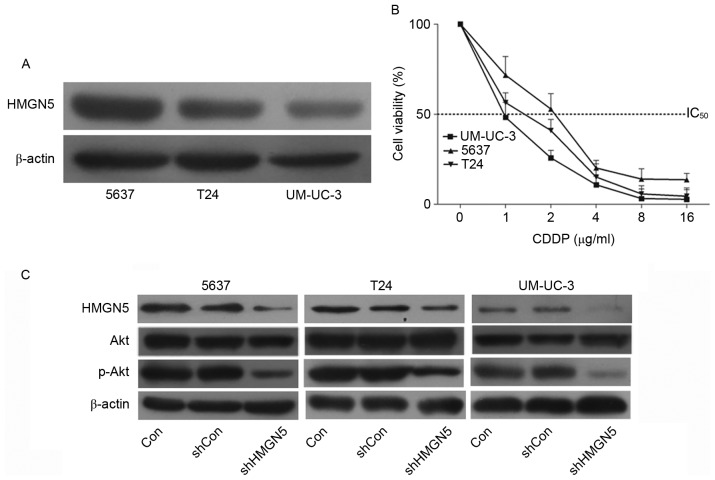
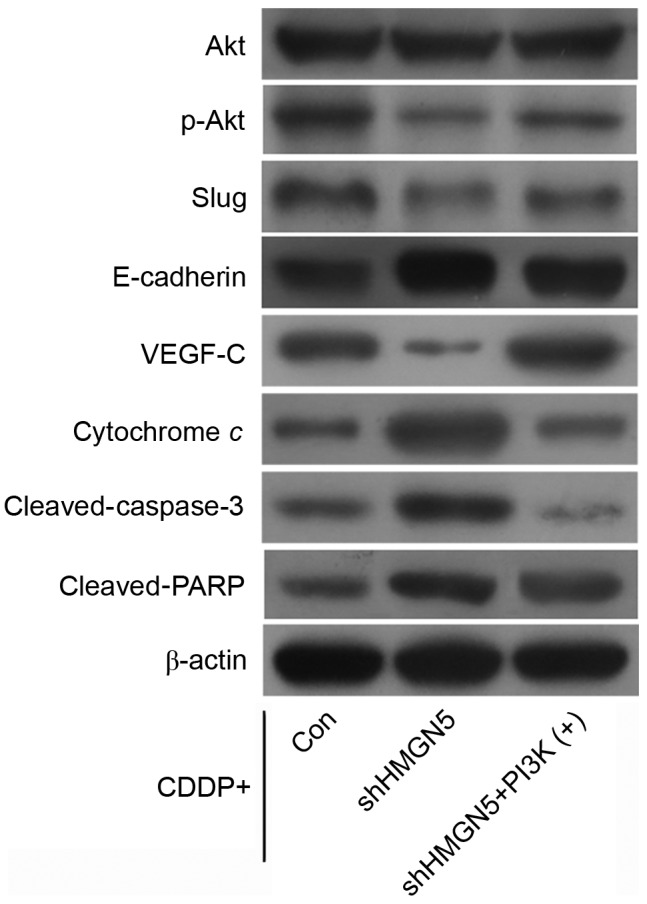
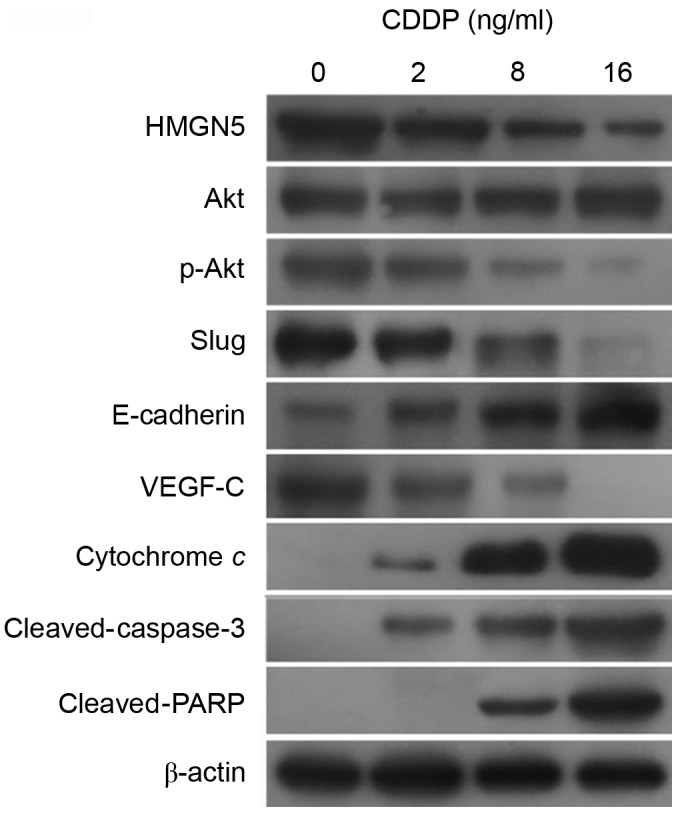
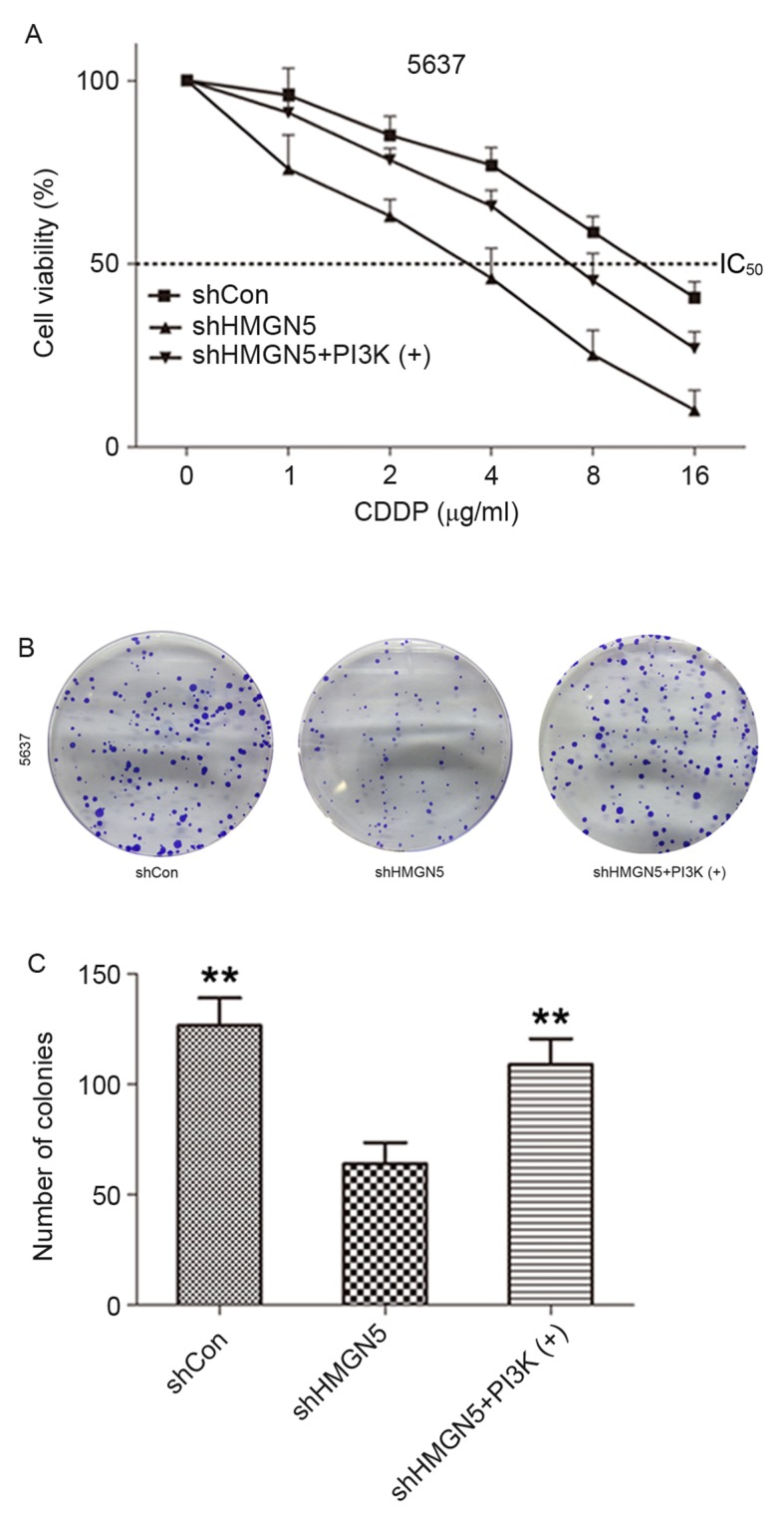
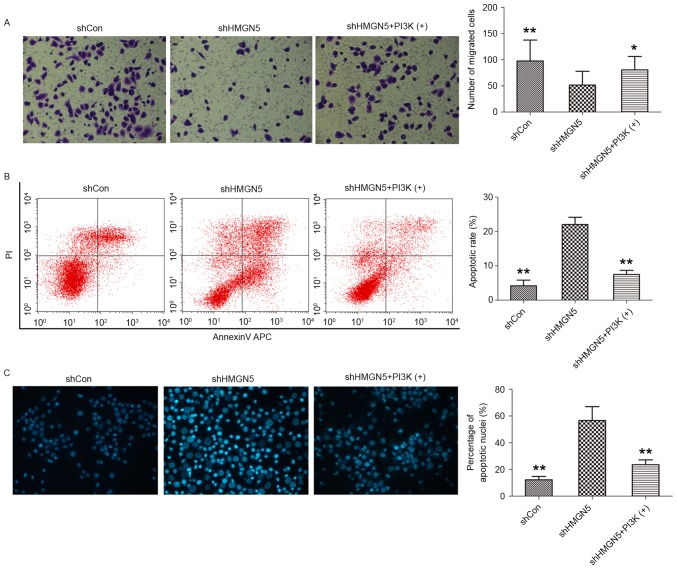
High-mobility group nucleosome-binding domain 5 (HMGN5) is the latest member of the HMGN family of proteins. Numerous studies have confirmed the carcinogenic role of HMGN5 in cancer, but its function in the regulation of chemosensitivity is largely unknown and controversial. A previous study by the authors of the present study demonstrated that HMGN5 contributes to the progression of urothelial bladder cancer (UBC) through regulating the expression of E-cadherin and vascular endothelial growth factor (VEGF)-C, which are associated with the sensitivity of tumor cells to cisplatin. Therefore, the present study aimed to elucidate the mechanisms underlying the regulation of HMGN5 and investigate the involvement of HMGN5 in cisplatin treatment. The results of the present study revealed that HMGN5 is able to positively regulate the expression of phosphorylated (p-)Akt in UBC cells. In addition, HMGN5 expression was negatively associated with the response of UBC cells to cisplatin. The findings indicated that HMGN5 may be a potential therapeutic target of cisplatin treatment, since cisplatin treatment reduced HMGN5 expression in a dose-dependent manner. It was also confirmed that the knockdown of HMGN5 decreased the viability, colony formation and invasion of 5637 cells but increased apoptosis under cisplatin treatment. The changes caused by HMGN5 knockdown in 5637 cells were able to be reversed by treatment with insulin-like growth factor-1 (IGF-1), which is a phosphoinositide 3-kinase (PI3K)/Akt signaling activator. Additionally, with the decreased expression of HMGN5, the expression of p-Akt, slug, E-cadherin and VEGF-C was subsequently inhibited. By contrast, the expression of cytochrome c, cleaved-caspase-3 and cleaved-poly ADP ribose polymerase was increased following HMGN5 knockdown. Consistently, these changes in protein expression were able to be reversed by IGF-1 treatment. In conclusion, findings from the experiments indicate that HMGN5 may a target of cisplatin treatment and that the inhibition of HMGN5 increases the chemosensitivity of UBC cells by inhibiting PI3K/Akt signaling.
高迁移率族核小体结合域5(HMGN5)是HMGN蛋白家族的最新成员。众多研究已证实HMGN5在癌症中的致癌作用,但其在化疗敏感性调节中的功能在很大程度上尚不清楚且存在争议。本研究的作者之前的一项研究表明,HMGN5通过调节E-钙黏蛋白和血管内皮生长因子(VEGF)-C的表达促进尿路上皮膀胱癌(UBC)进展,而这两种因子与肿瘤细胞对顺铂的敏感性相关。因此,本研究旨在阐明HMGN5调节的潜在机制,并研究HMGN5在顺铂治疗中的作用。本研究结果显示,HMGN5能够正向调节UBC细胞中磷酸化(p-)Akt的表达。此外,HMGN5表达与UBC细胞对顺铂的反应呈负相关。这些发现表明,HMGN5可能是顺铂治疗的潜在靶点,因为顺铂治疗以剂量依赖的方式降低HMGN5表达。还证实,敲低HMGN5可降低5637细胞的活力、集落形成和侵袭能力,但在顺铂治疗下增加细胞凋亡。5637细胞中由HMGN5敲低引起的变化能够被胰岛素样生长因子-1(IGF-1)处理逆转,IGF-1是一种磷酸肌醇3-激酶(PI3K)/Akt信号激活剂。此外,随着HMGN5表达降低,p-Akt、蛞蝓蛋白、E-钙黏蛋白和VEGF-C的表达随后受到抑制。相反,敲低HMGN5后细胞色素c、裂解的半胱天冬酶-3和裂解的聚ADP核糖聚合酶的表达增加。一致地,这些蛋白质表达的变化能够被IGF-1处理逆转。总之,实验结果表明HMGN5可能是顺铂治疗的靶点,并且抑制HMGN5通过抑制PI3K/Akt信号增加UBC细胞的化疗敏感性。