Department of Gastrointestinal Cancer Biology, Tianjin Medical University Cancer Institute & Hospital, National Clinical Research Center for Cancer; Key Laboratory of Cancer Prevention and Therapy, Tianjin; Tianjin's Clinical Research Center for Cancer, Tianjin 300060, China.
Department of Gastrointestinal Surgery, Tianjin Medical University Cancer Institute & Hospital, National Clinical Research Center for Cancer; Key Laboratory of Cancer Prevention and Therapy, Tianjin; Tianjin's Clinical Research Center for Cancer, Tianjin 300060, China.
Cancer Med. 2018 Nov;7(11):5577-5588. doi: 10.1002/cam4.1770. Epub 2018 Sep 17.
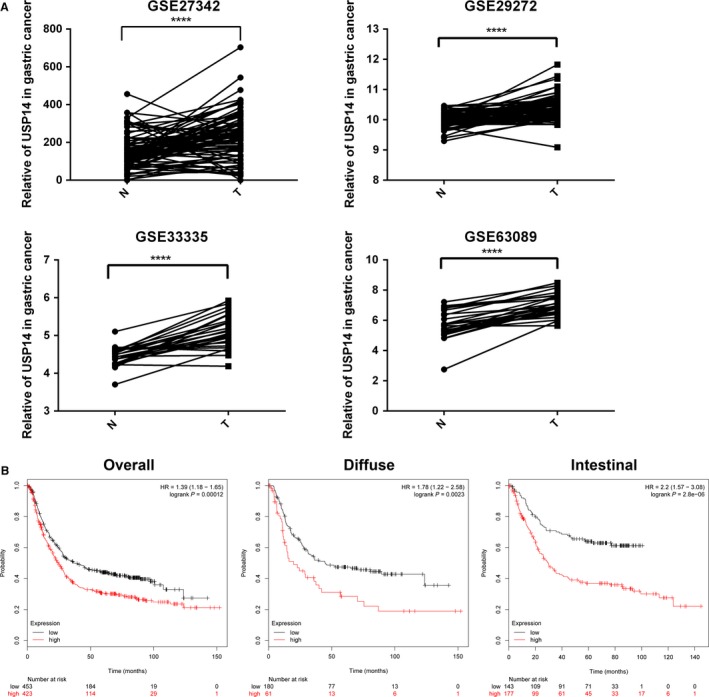
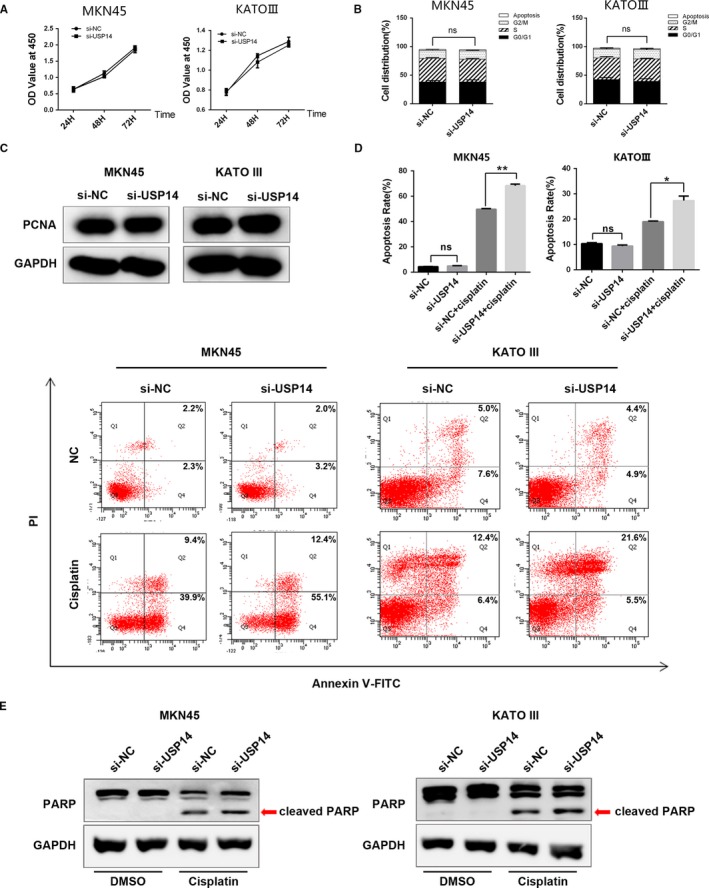
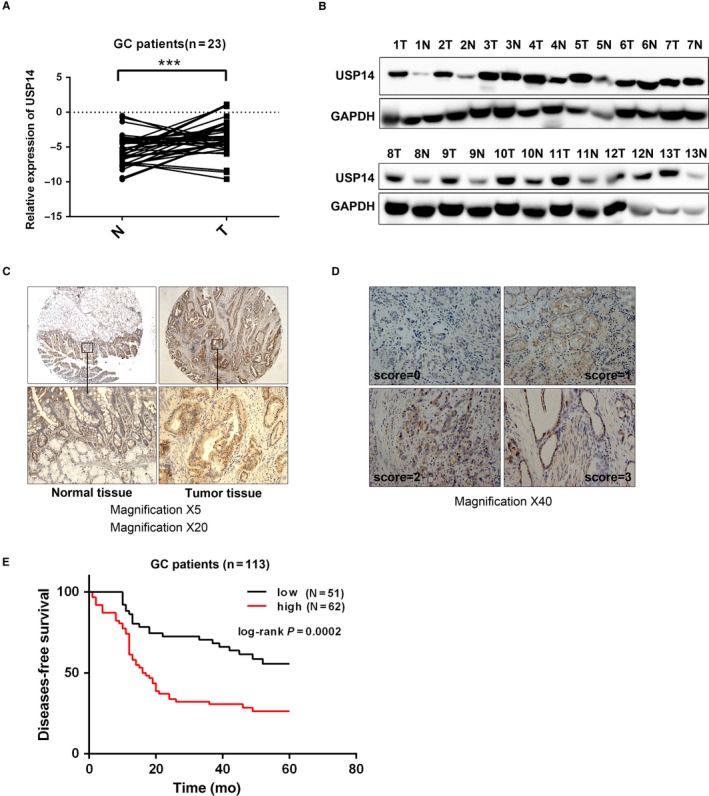
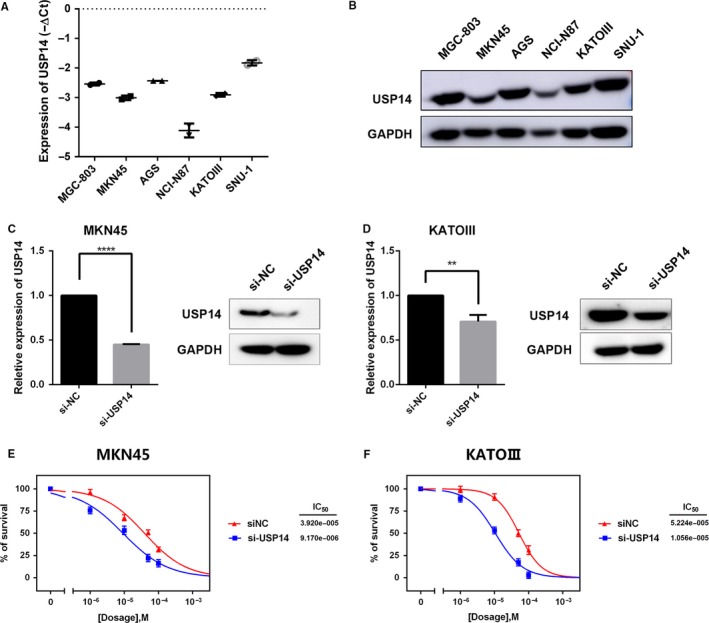
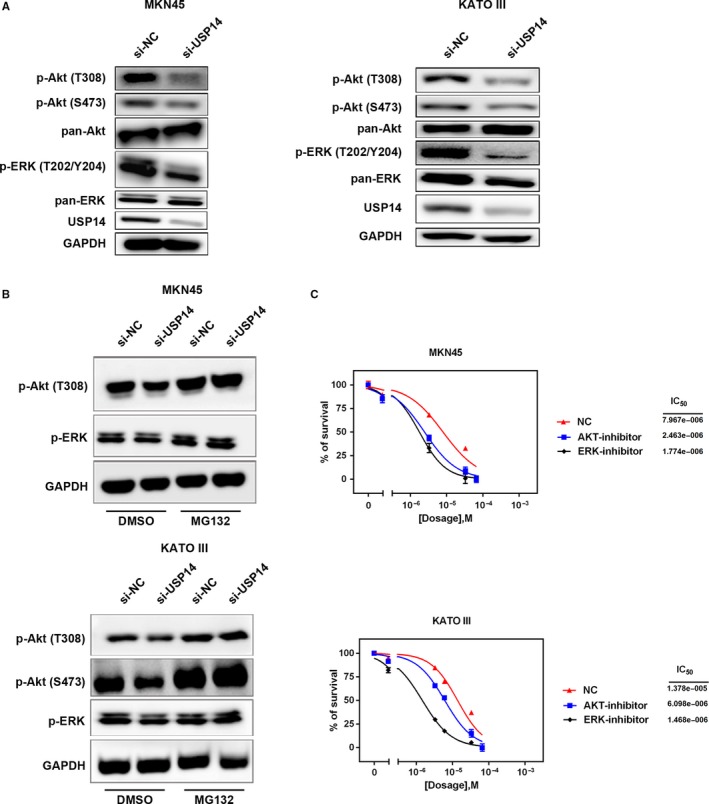
Gastric cancer (GC) ranks the third leading cause of global cancer mortality. Despite recent progress in surgery combined with chemotherapy, the outcomes of GC patients have barely improved. Therefore, better understanding of the molecular mechanisms involved in chemoresistance of GC may help develop novel strategies to treat this deadly disease. Previous evidence has shown aberrant expressions of USP14 in multiple malignancies, suggesting an important role of USP14 in tumorigenesis. However, its role in modulating chemoresistance in GC still remains elusive. In this study, we observed that USP14 levels were significantly increased in GC tissues compared to the paired normal tissues. Multivariate analysis demonstrated that USP14 level was an independent prognostic factor for DFS in GC patients. Silencing of USP14 promoted proteasomal degradation of p-ERK (T202/Y204) and p-Akt (T308/S473), thus inactivating Akt and ERK signaling pathways. Interestingly, silencing of USP14 alone was not sufficient to cause overt effects on cell growth, proliferation, and apoptosis, while resulting in significant apoptosis in the presence of cisplatin in GC cells. Thus, knockdown of USP14 sensitized GC cells to cisplatin by triggering cisplatin-induced apoptosis via impeding Akt and ERK signaling pathways. These results revealed a novel role of USP14 in modulating chemosensitivity of GC cells, suggesting USP14 may serve as not only a prognostic marker, but also a potential therapeutic target for GC patients.
胃癌(GC)是全球癌症死亡的第三大主要原因。尽管手术联合化疗最近取得了进展,但 GC 患者的预后几乎没有改善。因此,更好地了解 GC 化疗耐药性相关的分子机制可能有助于开发治疗这种致命疾病的新策略。先前的证据表明,USP14 在多种恶性肿瘤中表达异常,表明 USP14 在肿瘤发生中起重要作用。然而,其在调节 GC 化疗耐药性中的作用仍不清楚。在这项研究中,我们观察到 GC 组织中 USP14 水平明显高于配对的正常组织。多变量分析表明,USP14 水平是 GC 患者DFS 的独立预后因素。USP14 的沉默促进了 p-ERK(T202/Y204)和 p-Akt(T308/S473)的蛋白酶体降解,从而使 Akt 和 ERK 信号通路失活。有趣的是,单独沉默 USP14 不足以对细胞生长、增殖和凋亡产生明显影响,但在 GC 细胞中加入顺铂后,会导致明显的凋亡。因此,沉默 USP14 通过阻断 Akt 和 ERK 信号通路,触发顺铂诱导的凋亡,使 GC 细胞对顺铂敏感。这些结果揭示了 USP14 在调节 GC 细胞化疗敏感性中的新作用,表明 USP14 不仅可以作为预后标志物,还可以作为 GC 患者的潜在治疗靶点。