Int J Mol Sci. 2017 Nov 22;18(11):2498. doi: 10.3390/ijms18112498.
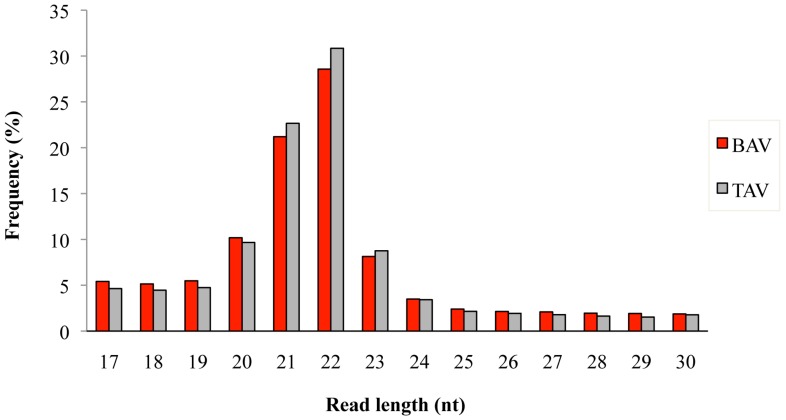
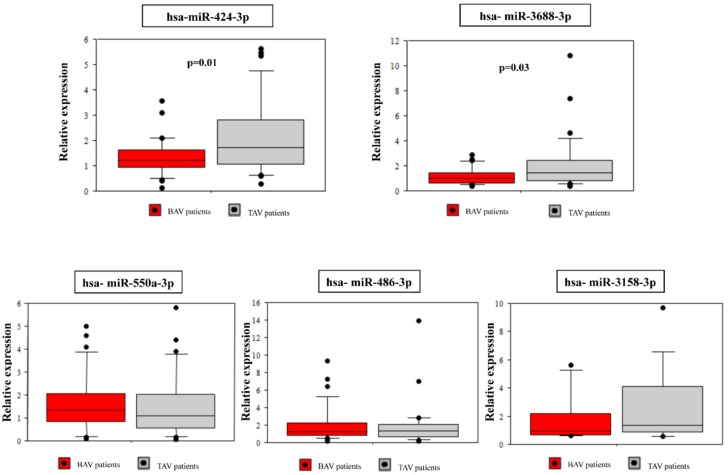
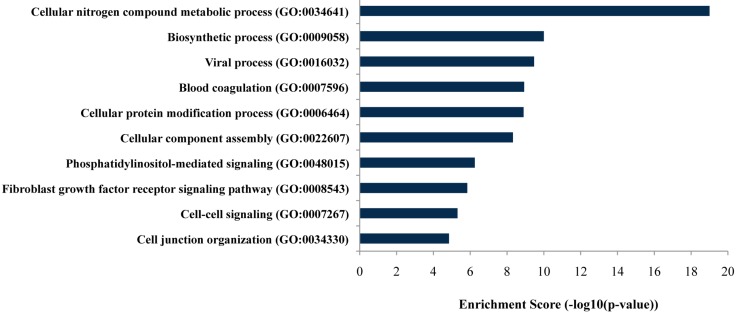
The molecular mechanisms underlying thoracic aortic aneurysm (TAA) in patients with bicuspid aortic valve (BAV) are incompletely characterized. MicroRNAs (miRNAs) may play a major role in the different pathogenesis of aortopathy. We sought to employ next-generation sequencing to analyze the entire miRNome in TAA tissue from patients with BAV and tricuspid aortic valve (TAV). In the discovery stage, small RNA sequencing was performed using the Illumina MiSeq platform in 13 TAA tissue samples (seven patients with BAV and six with TAV). Gene ontology (GO) and KEGG pathway analysis were used to identify key pathways and biological functions. Validation analysis was performed by qRT-PCR in an independent cohort of 30 patients with BAV (26 males; 59.5 ± 12 years) and 30 patients with TAV (16 males; 68.5 ± 9.5 years). Bioinformatic analysis identified a total of 489 known mature miRNAs and five novel miRNAs. Compared to TAV samples, 12 known miRNAs were found to be differentially expressed in BAV, including two up-regulated and 10 down-regulated (FDR-adjusted -value ≤ 0.05 and fold change ≥ 1.5). GO and KEGG pathway enrichment analysis (FDR-adjusted -value < 0.05) identified different target genes and pathways linked to BAV and aneurysm formation, including Hippo signaling pathway, ErbB signaling, TGF-beta signaling and focal adhesion. Validation analysis of selected miRNAs confirmed the significant down-regulation of miR-424-3p ( = 0.01) and miR-3688-3p ( = 0.03) in BAV patients as compared to TAV patients. Our study provided the first in-depth screening of the whole miRNome in TAA specimens and identified specific dysregulated miRNAs in BAV patients.
在二叶式主动脉瓣(BAV)患者的胸主动脉瘤(TAA)的分子机制尚未完全阐明。微小 RNA(miRNA)可能在不同的主动脉病变发病机制中起主要作用。我们试图采用下一代测序技术分析 BAV 和三尖瓣主动脉瓣(TAV)患者 TAA 组织中的整个 miRNA 组。在发现阶段,使用 Illumina MiSeq 平台对 13 个 TAA 组织样本(7 例 BAV 和 6 例 TAV)进行了小 RNA 测序。GO 和 KEGG 通路分析用于鉴定关键通路和生物学功能。在一个独立的 BAV 患者队列(26 名男性;59.5 ± 12 岁)和 30 名 TAV 患者(16 名男性;68.5 ± 9.5 岁)中,通过 qRT-PCR 进行了验证分析。生物信息学分析共鉴定出 489 个已知成熟 miRNA 和 5 个新 miRNA。与 TAV 样本相比,在 BAV 中发现了 12 个差异表达的已知 miRNA,包括 2 个上调和 10 个下调(FDR 调整值≤0.05 和倍数变化≥1.5)。GO 和 KEGG 通路富集分析(FDR 调整值<0.05)鉴定出与 BAV 和动脉瘤形成相关的不同靶基因和通路,包括 Hippo 信号通路、ErbB 信号通路、TGF-β信号通路和焦点黏附。对选定 miRNA 的验证分析证实,与 TAV 患者相比,BAV 患者的 miR-424-3p(=0.01)和 miR-3688-3p(=0.03)明显下调。本研究首次对 TAA 标本中的整个 miRNA 组进行了深入筛选,并鉴定出 BAV 患者中特定的失调 miRNA。