Department of Dermatology and Allergy Center, Odense Research Center for Anaphylaxis (ORCA), Odense University Hospital, Kløvervænget 15, entrance 142, 5000, Odense, Denmark.
Department of Emergency Medicine, Odense University Hospital, Odense, Denmark.
Scand J Trauma Resusc Emerg Med. 2017 Nov 22;25(1):111. doi: 10.1186/s13049-017-0402-0.
Current data on anaphylaxis is based on retrospective and register based studies. The objective of this study was to describe the epidemiology of anaphylaxis in a 1 year prospective study at the emergency care setting, Odense University Hospital, Denmark (2013-2014).
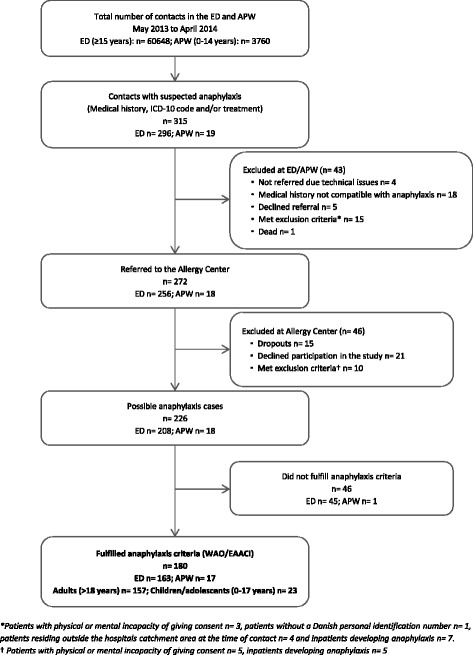
Prospective study at the emergency care setting, Odense University Hospital, Denmark (2013-2014). To identify anaphylaxis cases, records from all patients with clinical suspicion on anaphylaxis or a related diagnosis according to the International Classification of Diseases 10 and from patients treated at the emergency care setting or at prehospital level with adrenaline, antihistamines or glucocorticoids were reviewed daily. The identified cases were referred to the Allergy Center, where a standardized interview regarding the anaphylactic reaction was conducted. International guidelines were applied for the assessment of anaphylaxis and its pharmacological treatment. Severity of the anaphylactic reaction was evaluated according to Sampson's severity score.
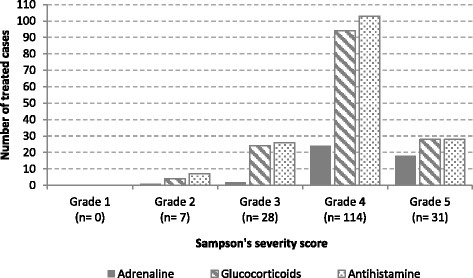
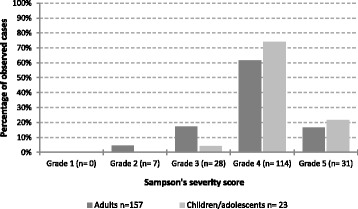
We identified 180 anaphylactic patients. Anaphylaxis represented 0.3%-0.4% of all contacts in the emergency care setting with an incidence rate of 26.8 cases per 100,000 person years (95% CI: 14.3-45.8) in children and 40.4 cases per 100,000 person years (95% CI: 32.8-49.3) in adults. Moderate to severe anaphylaxis was registered in 96% of the cases. Skin (96%) and respiratory (79%) symptoms were the most frequent registered, but 7% of cases in adults occurred without skin manifestations. The most common elicitor in children was food (61%), while drugs (48%) and venom (24%) were the main suspected elicitors in adults. Adrenaline was administered in 25% of the cases and it was significantly less administered than glucocorticoids (83%) and antihistamines (91%). The mortality rate during our study period was 0.3 cases per 100,000 person years.
This is one of the first prospective studies on the epidemiology of anaphylaxis in children and adults, where the patients are identified not only based on diagnosis codes but also on history, symptoms and treatment and thereafter classified according to international diagnosis criteria for anaphylaxis. A limitation of this study is that only patients who gave consent to participate in the study were included. Furthermore, patients may have attended other hospitals during the study period. Therefore, the estimates are minimum figures.
The prospective study design with a broad search profile yield a higher incidence than previously reported. Adrenaline was administered in a low proportion of the patients with moderate to severe anaphylaxis. Standardized diagnosis criteria among physicians treating anaphylaxis are needed.
目前的过敏反应数据基于回顾性研究和登记研究。本研究的目的是在丹麦欧登塞大学医院的急诊环境中进行为期 1 年的前瞻性研究,描述过敏反应的流行病学情况(2013-2014 年)。
在丹麦欧登塞大学医院的急诊环境中进行前瞻性研究(2013-2014 年)。为了识别过敏反应病例,我们每天审查所有疑似过敏反应或根据国际疾病分类第 10 版有相关诊断的患者的记录,以及在急诊环境中或在院前水平接受肾上腺素、抗组胺药或糖皮质激素治疗的患者的记录。识别出的病例将被转介到过敏中心,在那里对过敏反应进行标准化访谈。应用国际指南评估过敏反应及其药物治疗。根据 Sampson 严重程度评分评估过敏反应的严重程度。
我们确定了 180 例过敏反应患者。过敏反应占急诊就诊人数的 0.3%-0.4%,儿童发病率为 26.8 例/10 万人年(95%CI:14.3-45.8),成人发病率为 40.4 例/10 万人年(95%CI:32.8-49.3)。96%的病例记录为中重度过敏反应。皮肤(96%)和呼吸(79%)症状是最常见的症状,但 7%的成年病例无皮肤表现。儿童最常见的致敏原是食物(61%),而药物(48%)和毒液(24%)是成年患者的主要可疑致敏原。在我们的研究期间,肾上腺素的使用率为 25%,明显低于糖皮质激素(83%)和抗组胺药(91%)。在研究期间,死亡率为 0.3 例/10 万人年。
这是儿童和成人过敏反应流行病学的首批前瞻性研究之一,患者不仅基于诊断代码进行识别,还基于病史、症状和治疗,然后根据过敏反应的国际诊断标准进行分类。本研究的一个局限性是,只有同意参加研究的患者才被纳入。此外,患者在研究期间可能在其他医院就诊。因此,这些估计数是最低数字。
采用广泛搜索特征的前瞻性研究设计,发病率高于以往报道。在中重度过敏反应患者中,肾上腺素的使用率较低。治疗过敏反应的医生需要使用标准化的诊断标准。