Department of Microbiology, National Institute for Research in Tribal Health, Jabalpur, India.
Department of Community Medicine, National Institute for Research in Tribal Health, Jabalpur, India.
Indian J Med Res. 2017 Jul;146(1):97-104. doi: 10.4103/ijmr.IJMR_1029_16.
BACKGROUND & OBJECTIVES: Prevalence of pulmonary tuberculosis (PTB) is known to be high in the indigenous tribal community Saharia in Madhya Pradesh, India. The risk factors for PTB are not well known among them. This study was done to determine various risk factors associated with PTB in the indigenous community Saharia.
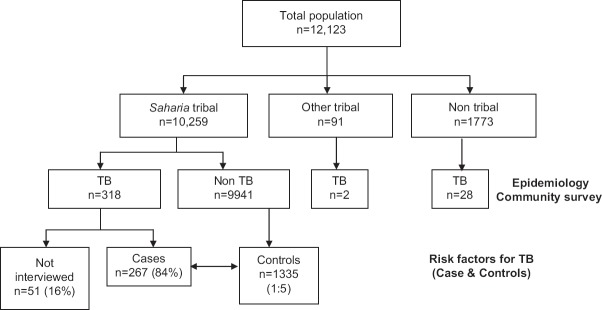
A prevalence survey was conducted among Saharias of Gwalior district of Madhya Pradesh. The population surveyed was 12,123 which was the source of cases and controls for the present study. All the bacillary-positive cases and controls in the ratio of 1:5 were included in the survey. Data were collected by the trained health workers from the patients and controls using a semi-structured pre-coded and pre-tested questionnaire which included data on risk factors including demographic factors, host-related factors and household factors. The individuals were also screened for diabetes mellitus and HIV.
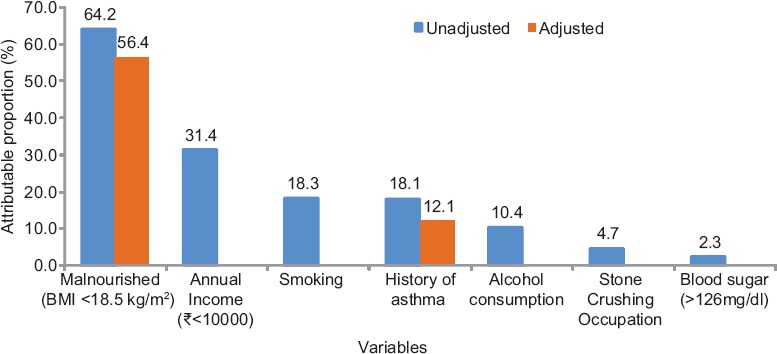
Malnutrition and history of asthma were associated with an increased risk of PTB. More than 56 per cent cases were attributed to malnutrition and 12 per cent attributed to asthma. Low family income, alcohol consumption and smoking were the other contributors. The risk was higher in males as compared to females.
INTERPRETATION & CONCLUSIONS: The study emphasized that the main contributors were social factors. Nutrition supplementation, especially in tuberculosis (TB) patients and integrated approach to improve their living conditions are needed to control TB in this community.
印度中央邦的萨哈里亚土著部落的肺结核(PTB)患病率很高,但人们对其相关的风险因素知之甚少。本研究旨在确定与萨哈里亚土著社区中肺结核相关的各种风险因素。
在中央邦瓜廖尔区的萨哈里亚人中进行了一项患病率调查。调查的人群为 12123 人,是本研究病例和对照的来源。将所有菌阳性病例和对照按 1:5 的比例纳入调查。受过培训的卫生工作者从患者和对照中收集数据,使用半结构化的预编码和预测试问卷,其中包括与风险因素相关的数据,包括人口统计学因素、宿主相关因素和家庭因素。还对个体进行了糖尿病和艾滋病毒筛查。
营养不良和哮喘史与肺结核发病风险增加有关。超过 56%的病例归因于营养不良,12%归因于哮喘。家庭收入低、饮酒和吸烟也是其他因素。与女性相比,男性的风险更高。
研究强调,主要的贡献因素是社会因素。需要营养补充,特别是在结核病(TB)患者中,并采取综合方法来改善他们的生活条件,以控制该社区的结核病。