Zhou Ning, Lee Jia-Jye, Stoll Shaunrick, Ma Ben, Costa Kevin D, Qiu Hongyu
Division of Cardiology, Department of Internal Medicine, Tongji Hospital, Tongji Medical College, Huazhong University of Science and Technology, Wuhan, China.
Division of Physiology, Department of Basic Sciences, School of Medicine, Loma Linda University, Loma Linda, California, USA.
Cell Physiol Biochem. 2017;44(2):701-715. doi: 10.1159/000485284. Epub 2017 Nov 23.
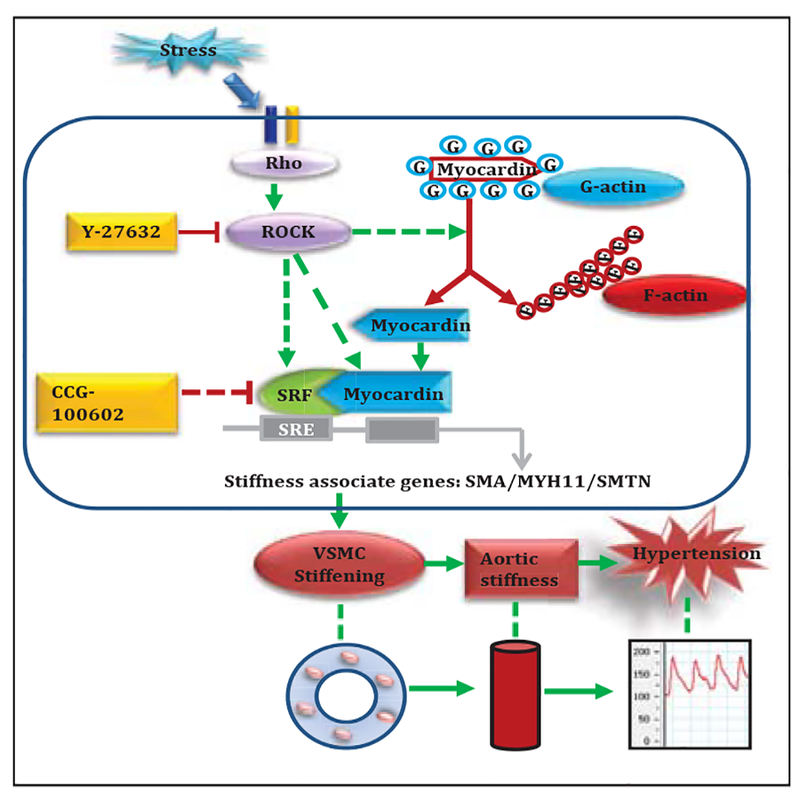
BACKGROUND/AIMS: Our previous studies demonstrated that intrinsic aortic smooth muscle cell (VSMC) stiffening plays a pivotal role in aortic stiffening in aging and hypertension. However, the underlying molecular mechanisms remain largely unknown. We here hypothesized that Rho kinase (ROCK) acts as a novel mediator that regulates intrinsic VSMC mechanical properties through the serum response factor (SRF) /myocardin pathway and consequently regulates aortic stiffness and blood pressure in hypertension.
Four-month old male spontaneously hypertensive rats (SHR) and Wistar-Kyoto (WKY) rats were studied. Aortic stiffness was measured by echography. Intrinsic mechanical properties of VSMCs were measured by atomic force microscopy (AFM) in vitro.
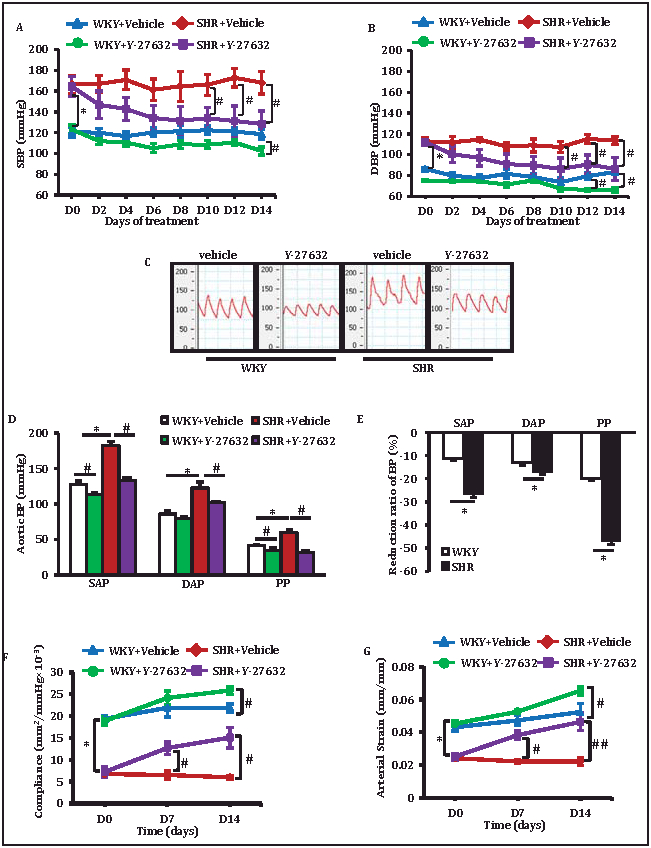
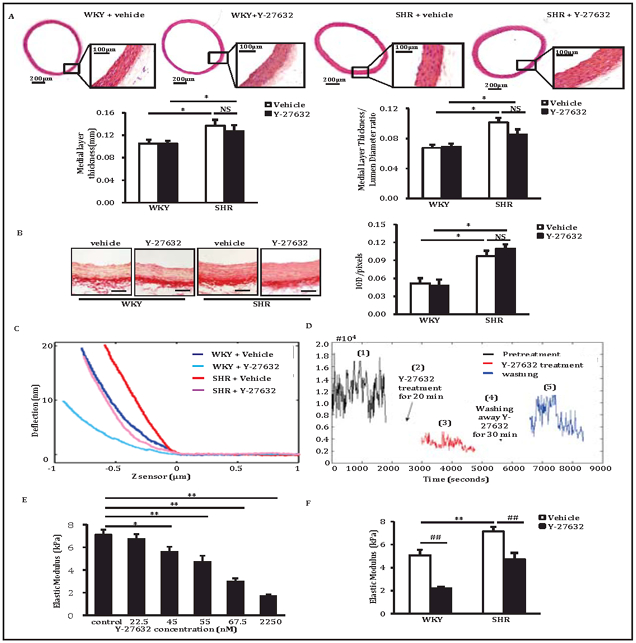
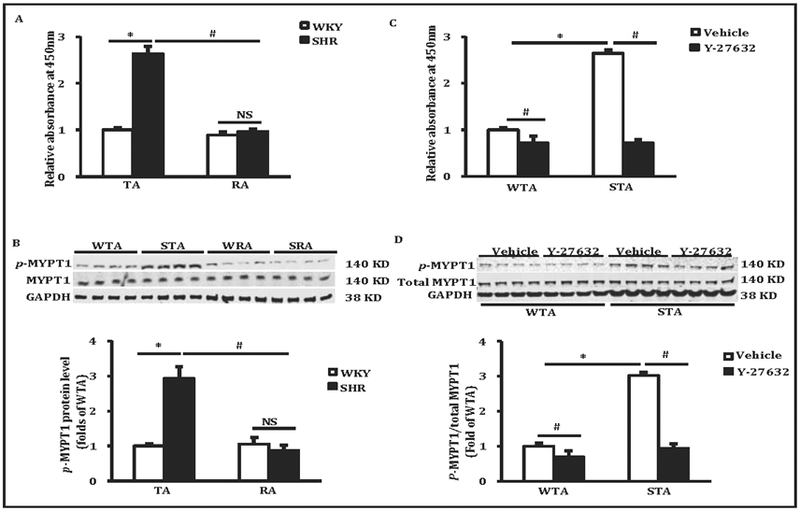
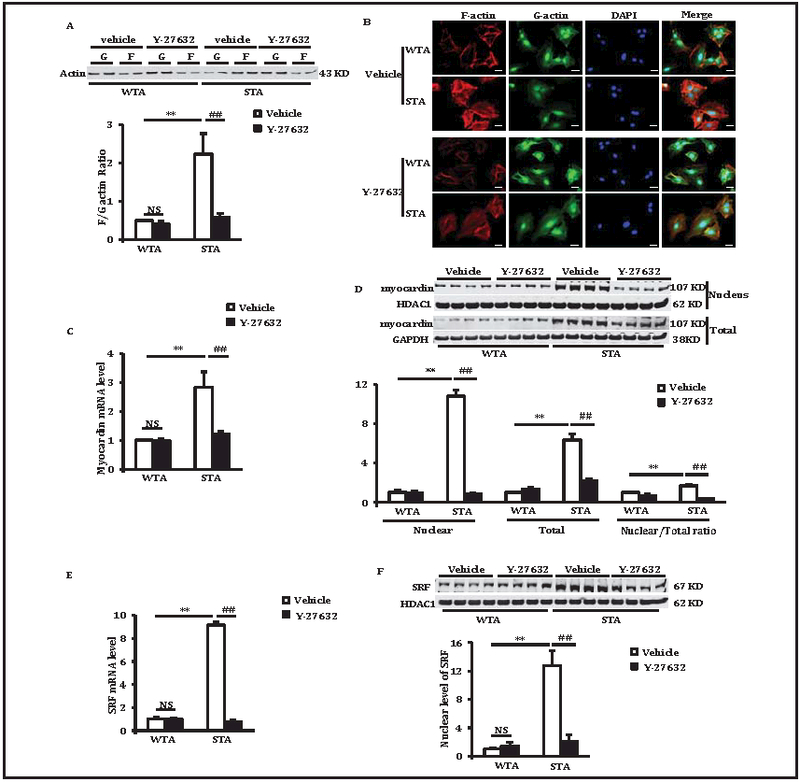
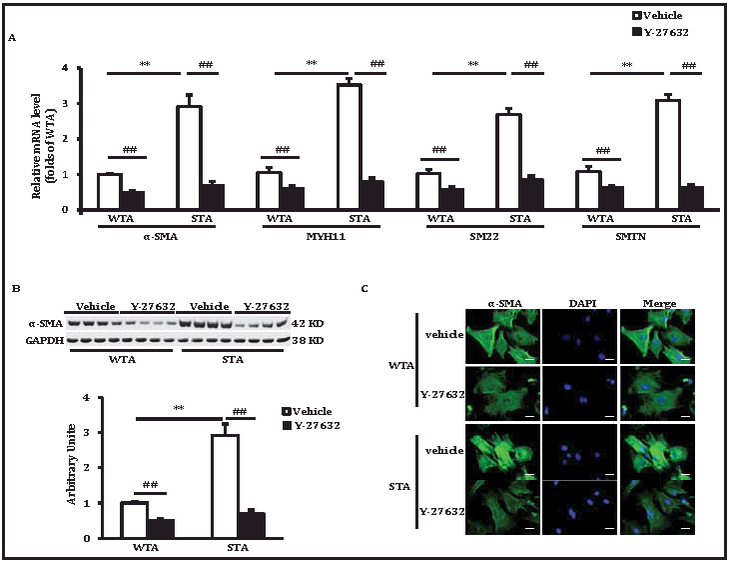
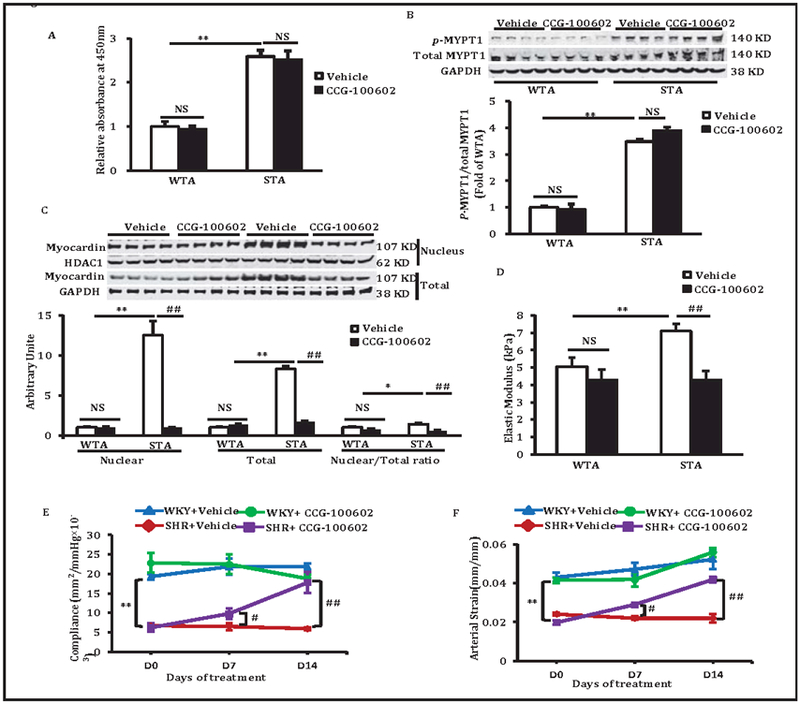
Compared to WKY rats, SHR showed a significant increase in aortic stiffness and blood pressure, which is accompanied by a remarkable cell stiffening and ROCK activation in thoracic aortic (TA) VSMCs. Theses alterations in SHR were abolished by Y-27632, a specific inhibitor of ROCK. Additionally, boosted filamentous/globular actin ratio was detected in TA VSMCs from SHR versus WKY rats, resulting in an up-regulation of SRF and myocardin expression and its downstream stiffness-associated genes including α-smooth muscle actin, SM22, smoothelin and myosin heavy chain 11. Reciprocally, these alterations in SHR TA VSMCs were also suppressed by Y-27632. Furthermore, a specific inhibitor of SRF/myocardin, CCG-100602, showed a similar effect to Y-27632 in SHR in both TA VSMCs stiffness in vitro and aorta wall stiffness in vivo.
ROCK is a novel mediator modulating aortic VSMC stiffness through SRF/myocardin signaling which offers a therapeutic target to reduce aortic stiffening in hypertension.
背景/目的:我们之前的研究表明,主动脉平滑肌细胞(VSMC)内在僵硬度在衰老和高血压导致的主动脉僵硬度增加中起关键作用。然而,其潜在的分子机制仍不清楚。我们在此假设,Rho激酶(ROCK)作为一种新的介质,通过血清反应因子(SRF)/心肌钙蛋白途径调节VSMC的内在机械性能,从而调节高血压时的主动脉僵硬度和血压。
对4月龄雄性自发性高血压大鼠(SHR)和Wistar-Kyoto(WKY)大鼠进行研究。通过超声心动图测量主动脉僵硬度。体外采用原子力显微镜(AFM)测量VSMC的内在机械性能。
与WKY大鼠相比,SHR的主动脉僵硬度和血压显著升高,同时胸主动脉(TA)VSMC出现明显的细胞僵硬度增加和ROCK激活。ROCK特异性抑制剂Y-27632消除了SHR中的这些改变。此外,与WKY大鼠相比,SHR的TA VSMC中丝状/球状肌动蛋白比例升高,导致SRF和心肌钙蛋白表达及其下游与僵硬度相关的基因上调,包括α-平滑肌肌动蛋白、SM22、平滑肌蛋白和肌球蛋白重链11。相反,Y-27632也抑制了SHR的TA VSMC中的这些改变。此外,SRF/心肌钙蛋白的特异性抑制剂CCG-100602在体外对SHR的TA VSMC僵硬度和体内主动脉壁僵硬度方面显示出与Y-27632相似的效果。
ROCK是一种通过SRF/心肌钙蛋白信号调节主动脉VSMC僵硬度的新介质,为降低高血压时的主动脉僵硬度提供了一个治疗靶点。